
How much of your free will is actually yours, and how much is just peer pressure wearing a blazer and calling itself "consensus"?
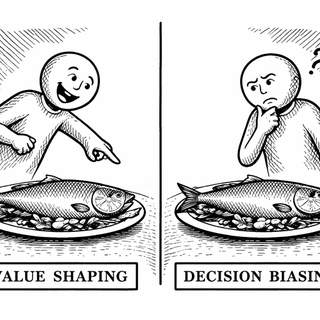
That question is lurking inside a new paper on social learning. In a 2025 PNAS study, researchers modeled two ways people learn from other people when the world feels uncertain: one strategy treats popular choices like extra reward points, while the other copies behavior more cautiously and keeps the real score based on personal experience [1]. One is "everyone's ordering the fish, I too am suddenly a fish person." The other is "fine, I'll try the fish, but I still reserve the right to hate it."
The paper compares two social-learning algorithms with names that sound like rejected fintech startups: value shaping and decision biasing.
Value shaping, or VS, means other people's choices actually change how valuable an option feels to you. If enough people pick Option A, your brain starts treating that popularity itself like a reward signal. In plain English, the crowd is not just influencing what you do - it is editing your taste.
Decision biasing, or DB, is more skeptical. You may follow the crowd behaviorally when you are unsure, but you do not rewrite your internal value system just because the group got excited. You still update based on what happens when you try the thing yourself. It is the difference between "I copied everybody else" and "I became everybody else."
Fast in calm weather, clumsy in a storm
The researchers dropped simulated agents into uncertain environments where the better option could flip halfway through. In stable conditions, value shaping looked great. It pushed groups to converge quickly, which is efficient when the world stays put [1]. If the best restaurant in town is still the best restaurant in town, a little social copying saves everyone a lot of disappointing pasta.
But when conditions changed, value shaping had a bad habit of sticking with yesterday's winner. The group kept loving the now-worse option because popularity had seeped into the valuation process itself. Decision biasing was slower to settle, but better at pivoting when reality changed [1]. VS is the coworker who builds a clean workflow fast, then refuses to update the spreadsheet after the apocalypse. DB is less elegant, but at least it notices the building is on fire.
That tradeoff fits a bigger picture in recent research. A 2021 review in Trends in Cognitive Sciences argued that social learning is hard to model because social worlds are messy and interdependent [2]. A 2024 review in Perspectives on Psychological Science made the same basic point: whether groups get wise or weird depends on the learning rules inside individual minds, not some mystical power of "the crowd" [3].
Why mixed groups beat copy-paste humans
The sneaky interesting part of the PNAS paper is that it does not end with "one strategy wins." It finds that both strategies can coexist, and that mixed groups may outperform groups made of only one type [1].
That is a reminder in an era built out of feeds and recommender systems. Pure efficiency is great until the environment changes. Pure flexibility is great until nobody can agree on lunch. The best-performing collective may be the one with some fast convergers and some reality-checkers.
Other recent work points the same way. In a 2025 Nature Communications study, people in a virtual group foraging task adjusted both individual and social learning depending on how well they were doing, and they paid selective attention to successful others rather than copying blindly [4]. Another 2024 PNAS paper found that people can use social information flexibly even when other people do not share exactly the same rewards or preferences [5]. So the broader story is not "humans are sheep." It is more annoying and more impressive: humans are conditional sheep.
Why this matters outside the simulation sandbox
This paper is theoretical, so nobody should run off yelling that democracy, stock markets, and AI assistants have all been solved. They have not.
Still, the implications are real. If you are designing social platforms, communication systems, collaborative AI tools, or group decision processes inside organizations, this study offers a warning: systems that reward popularity too directly may become efficient at the wrong moment. They can lock into consensus when flexibility matters most. Systems that preserve some independence may be better built for a world that changes its mind mid-sentence.
So apparently the crowd can make you smarter, dumber, faster, slower, wiser, and weirder - all depending on the rule by which social information gets into your head. Which is very on-brand for brains. Give a human nervous system one elegant dilemma, and it responds like a committee trapped in an escape room.
References
- Suganuma H, Katahira K, Ohtsuki H, Kameda T. How social learning enhances-or undermines-efficiency and flexibility in collective decision-making under uncertainty. Proceedings of the National Academy of Sciences of the United States of America. 2025;122(48):e2516827122. DOI: https://doi.org/10.1073/pnas.2516827122. PMCID: https://pmc.ncbi.nlm.nih.gov/articles/PMC12685029/
- FeldmanHall O, Nassar MR. The computational challenge of social learning. Trends in Cognitive Sciences. 2021;25(12):1045-1057. DOI: https://doi.org/10.1016/j.tics.2021.09.002. PMCID: https://pmc.ncbi.nlm.nih.gov/articles/PMC8585698/
- Tump AN, Deffner D, Pleskac TJ, Romanczuk P, Kurvers RHJM. A Cognitive Computational Approach to Social and Collective Decision-Making. Perspectives on Psychological Science. 2024;19(2):538-551. DOI: https://doi.org/10.1177/17456916231186964. PMCID: https://pmc.ncbi.nlm.nih.gov/articles/PMC10913326/
- Wu CM, Deffner D, Kahl B, Meder B, Ho MK, Kurvers RHJM. Adaptive mechanisms of social and asocial learning in immersive collective foraging. Nature Communications. 2025;16(1):3539. DOI: https://doi.org/10.1038/s41467-025-58365-6. PMCID: https://pmc.ncbi.nlm.nih.gov/articles/PMC12032219/
- Witt A, Toyokawa W, Lala KN, Gaissmaier W, Wu CM. Humans flexibly integrate social information despite interindividual differences in reward. Proceedings of the National Academy of Sciences of the United States of America. 2024;121(39):e2404928121. DOI: https://doi.org/10.1073/pnas.2404928121. PMCID: https://pmc.ncbi.nlm.nih.gov/articles/PMC11441569/
Disclaimer: The image accompanying this article is for illustrative purposes only and does not depict actual experimental results, data, or biological mechanisms.