
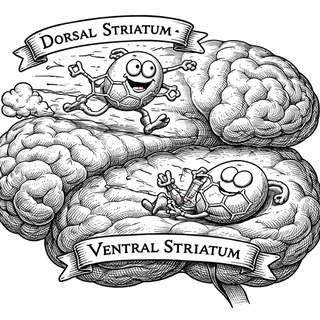
"Dorsal striatum, you need to relax," said one dopamine molecule, sprinting into the scene like it had three deadlines and no lunch break.
"Relax?" said the ventral striatum. "Look at you. You vanish in 0.2 seconds and call it a personality."
That, more or less, is the plot of a new eLife paper on dopamine in the striatum - a brain region involved in movement, motivation, habit, and reward learning. The study asks a deceptively simple question: when dopamine shows up in different parts of the striatum, why does it behave so differently? The answer appears to be less "the neurons are dramatic artists" and more "the cleanup crew is wildly overcommitted in one neighborhood."
The Brain's Weird Timing Problem
Dopamine gets talked about like it's one thing. It is not one thing. It changes meaning depending on where it lands, how fast it arrives, and how quickly someone sweeps it off the floor. In the striatum, scientists often talk about fast "phasic" signals and slower "tonic" background levels. Nice tidy categories. Maybe too tidy, because the brain rarely respects our PowerPoint habits.
In this paper, Ejdrup and colleagues built a large 3D computational model of extracellular dopamine in two striatal zones: dorsal striatum (DS) and ventral striatum (VS) (Ejdrup et al., 2025). Their model predicts that dopamine in DS is fast and fleeting, with little or no stable basal level. In VS, dopamine hangs around longer and can build into something more like tonic background. Same chemical, very different local vibe.
The big twist is what causes that difference. Not bigger release events. Not some dramatic change in firing style. The model points instead to the dopamine transporter, or DAT - the molecular vacuum cleaner that clears dopamine away. In DS, DAT activity is strong enough to stop dopamine from pooling into a shared background bath. In VS, weaker uptake lets dopamine linger.
It's Not Just Release - It's Cleanup
That matters because dopamine theories often obsess over release. Bursts are flashy. But this study says signal cleanup may matter just as much as signal launch.
The authors also modeled receptor behavior. D1 receptors tracked dopamine changes with a delay of only milliseconds. D2 receptors were slower and more cumulative, integrating dopamine over seconds rather than reacting sharply to every brief dip or pause (Ejdrup et al., 2025). In plain English: one receptor is refreshing the group chat constantly, the other is checking it later and getting the gist.
That helps explain how the same transmitter can support both rapid signaling and slower motivational states. It also fits with a broader trend in dopamine research: people are moving away from the cartoon version where dopamine does exactly one job in exactly one timescale. Recent work shows striatal dopamine helps integrate cost, benefit, and motivation, not just reward prediction in the narrow textbook sense (Eshel et al., 2024), PMCID: PMC10922131.
Why You Should Care, Even If You Are Not a Mouse
This starts to matter for Parkinson's disease, addiction, compulsive behavior, and other disorders where dopamine signaling goes sideways. If one striatal subregion naturally supports quick, local dopamine spikes while another supports slower, more sustained tone, then "fix dopamine" is not a single engineering problem. It is more like trying to repair a city's plumbing when one district needs fire hoses and another needs drip irrigation.
That perspective lines up with recent reviews arguing that local striatal circuitry and dopamine clearance shape behavior-specific signals (Holly et al., 2024), PMCID: PMC11066854. It also fits the view that dopamine's functions stretch across multiple timescales and cell types, with real consequences for how Parkinson's symptoms emerge and why replacement therapies can help some things more than others (Seiler et al., 2024).
There is even newer evidence that classic dopamine stories may need updating. A 2024 Nature Communications study reported learning-related dopamine patterns in dorsal striatum that do not sit neatly inside standard reinforcement-learning formulations (Mohebi et al., 2024). Meanwhile, expert coverage in The Transmitter highlighted how newly characterized striatal circuits may influence movement by modulating dopamine release in ways the old "go/no-go" model did not really budget for (The Transmitter, January 24, 2025).
The Catch, Because There Is Always a Catch
This is still a model. A sophisticated one, grounded in experimental data, but a model nonetheless. Models are like very disciplined thought experiments. Powerful, yes. Also perfectly capable of being humbled by future experiments.
Still, this paper does something useful. It gives the field a testable framework for why dorsal and ventral striatum handle dopamine differently, and it shifts attention toward uptake dynamics and receptor timing instead of obsessing over release alone. That is the kind of reframing that can quietly change a field - not with fireworks, but with better questions.
References
- Ejdrup A, Dreyer JK, Lycas MD, Jørgensen SH, Robbins TW, Dalley JW, Herborg F, Gether U. Computational modelling identifies key determinants of subregion-specific dopamine dynamics in the striatum. eLife. 2025. DOI: https://doi.org/10.7554/eLife.105214
- Eshel N, Touponse GC, Wang AR, Osterman AK, Shank A, Groome AM, Taniguchi L, Cardozo Pinto DF, Tucciarone J, Bentzley BS, Malenka RC. Striatal dopamine integrates cost, benefit, and motivation. Neuron. 2024;112(3):500-514.e5. DOI: https://doi.org/10.1016/j.neuron.2023.10.038. PMCID: https://pmc.ncbi.nlm.nih.gov/articles/PMC10922131/
- Holly EN, Galanaugh J, Fuccillo MV. Local regulation of striatal dopamine: A diversity of circuit mechanisms for a diversity of behavioral functions? Current Opinion in Neurobiology. 2024;85:102839. DOI: https://doi.org/10.1016/j.conb.2024.102839. PMCID: https://pmc.ncbi.nlm.nih.gov/articles/PMC11066854/
- Seiler JL, Zhuang X, Nelson AB, Lerner TN. Dopamine across timescales and cell types: Relevance for phenotypes in Parkinson's disease progression. Experimental Neurology. 2024;374:114693. DOI: https://doi.org/10.1016/j.expneurol.2024.114693
- Mohebi A, et al. Dopamine release plateau and outcome signals in dorsal striatum contrast with classic reinforcement learning formulations. Nature Communications. 2024. https://www.nature.com/articles/s41467-024-53176-7
- López Lloreda C. Newly characterized striatal circuits add twist to 'go/no-go' model of movement control. The Transmitter. January 24, 2025. https://www.thetransmitter.org/basal-ganglia/newly-characterized-striatal-circuits-add-twist-to-go-no-go-model-of-movement-control/
Disclaimer: The image accompanying this article is for illustrative purposes only and does not depict actual experimental results, data, or biological mechanisms.