
Late in the day, when the light goes syrupy and your internal clock starts negotiating between "one more task" and "become couch," the nervous system feels less like a machine and more like a moody city. Signals speed, stall, reroute. And somewhere in that soft daily churn sits one of neuroscience's favorite plot twists - the cells we once treated like support staff keep grabbing the steering wheel. In a new eLife paper, researchers studying fruit flies found that glia and neurons jointly control how synapses remodel after activity. Which is a polite scientific way of saying the brain's so-called side characters may be helping run the renovation crew.
The tiny construction site at the end of a neuron
The study focuses on the neuromuscular junction in Drosophila melanogaster - basically the meeting point where a motor neuron sends instructions to a muscle. It is one of neuroscience's great workhorse systems: compact, visible, genetically tractable, and, frankly, less dramatic than trying to negotiate with the human brain directly. If synapses are neuronal text messages, this is the send button meeting the bicep.
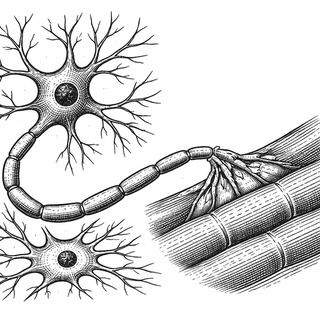
Synapses are not fixed little plugs. They change shape and strength depending on activity. That flexibility - synaptic plasticity - lets nervous systems adapt, learn, and avoid becoming stale electrical bureaucracy. For years, neurons got top billing in this story. Glia were often cast as custodians, nutritional assistants, maybe the stagehands sweeping up after the stars. A bit rude in retrospect.
This paper asks a sharper question: when activity pushes a synapse to remodel, how much of that response depends on the conversation between neurons and nearby peripheral glia?
Glia: not just the brain's unpaid interns
The answer, at least in flies, is a lot.
Chang and colleagues show that peripheral glia and neurons coordinate activity-induced synaptic remodeling at the neuromuscular junction, identifying molecular pathways that link the two cell types in this process (Chang et al., 2024). The broad takeaway is that when neural activity ramps up, synaptic change is not simply a neuron monologue. It's a duet. Possibly a tense one. Possibly with passive-aggressive eye contact.
Why does that matter? Because neuroscience keeps rediscovering the same humbling lesson: cells we thought were "supportive" often turn out to be active decision-makers. Glia help shape synapse formation, neurotransmission, pruning, metabolism, and inflammatory responses. In other words, they are less office plants and more operations managers who know where every wire goes.
Recent work has made that point across systems. Reviews in high-impact journals have highlighted glia as active regulators of synaptic plasticity and circuit function, not just metabolic backup (Allen and Lyons, 2024); (Vainchtein and Molofsky, 2020). Studies in mammals also show Schwann cells and other peripheral glia can influence synapse stability, repair, and signaling after stress or injury (Castro et al., 2020).
Why a fly should matter to your extremely human life
Yes, this work happens in fruit flies. Before you dismiss that as adorable insect drama, remember that fly neuroscience has a long history of exposing cellular rules that echo across species. Evolution loves reusing good ideas, much like Hollywood and the multiverse.
Neuron-glia signaling is one of those ideas. If glia help control when synapses grow, retract, or reorganize after activity, that has real implications for development, recovery after injury, and diseases where synapses fail or become unstable. Disorders from peripheral neuropathies to neurodegenerative disease involve disrupted communication among neurons, glia, and target tissues. A clearer map of that crosstalk could eventually help researchers think about therapies that do more than target neurons alone.
That is one of the quiet challenges this paper addresses. A lot of neuroscience still treats plasticity as if the neuron is the entire plot. But synapses live in neighborhoods. They are bathed in signals, metabolites, structural constraints, and local supervision. Ignoring glia is a bit like trying to understand restaurant service by studying only the chef and pretending the kitchen staff, servers, refrigeration, and electricity are flavor-neutral background.
The bigger flavor profile
This study lands in a broader wave of research reframing glia as dynamic partners in circuit change. Reviews from the past few years describe astrocytes, microglia, oligodendrocyte-lineage cells, and peripheral glia as central players in plasticity, homeostasis, and repair (Santello et al., 2023); (Green et al., 2023). That does not mean every glial cell is secretly masterminding your thoughts like a prestige-TV villain. It means nervous systems work as communities, not solo acts.
And that, honestly, feels more believable. The brain and peripheral nervous system are messy, crowded, cooperative places. Their logic has notes of precision, salt, and occasional chaos, with a lingering finish of "we have definitely underestimated somebody again."
So the next time you flex a muscle, learn a skill, or recover from a strain, remember: somewhere at the synaptic edge, neurons are not working alone. Glia are there too, elbows out, helping decide what gets rebuilt and what stays put. Science loves a diva neuron, but this paper gives the supporting cast their overdue close-up.
References
Chang YC, Peng YJ, Lee JY, Wen A, Chang KT. Peripheral glia and neurons jointly regulate activity-induced synaptic remodeling at the neuromuscular junction. eLife. 2024;13:RP104126. doi:10.7554/eLife.104126
Allen NJ, Lyons DA. Glia as regulators of neural circuit plasticity. Nat Rev Neurosci. 2024. doi:10.1038/s41583-024-00855-7
Vainchtein ID, Molofsky AV. Astrocytes and microglia: In sickness and in health. Science. 2020;369(6503). doi:10.1126/science.aaz6399
Castro J, Garcia-Perez D, Arkwright S, et al. Peripheral glia and synaptic maintenance at the neuromuscular junction. Neuron. 2020. doi:10.1016/j.neuron.2020.06.020
Santello M, Toni N, Volterra A. Astrocytes and experience-dependent plasticity. Nat Rev Neurosci. 2023. doi:10.1038/s41583-023-00745-8
Green AJ, et al. Glial control of synapse remodeling and circuit adaptation. Neuron. 2023. doi:10.1016/j.neuron.2023.04.015
Disclaimer: The image accompanying this article is for illustrative purposes only and does not depict actual experimental results, data, or biological mechanisms.