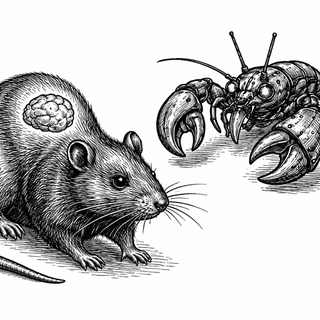
A rat's medial prefrontal cortex is tiny, but in this study it had to manage a job list that would make a family group chat burst into flames: find sugar, track distance, avoid a robot predator, and decide when to retreat.
That patch, called the mPFC, sits near the front-middle of the brain. In humans, nearby prefrontal regions help with planning, flexible decisions, emotion regulation, and the executive control you need when the grocery store is out of coffee. In rats, the mPFC has long been linked to goal-directed behavior, threat responses, and foraging decisions.
The Lobsterbot Enters the Chat
Ji Hoon Jeong and June-Seek Choi recorded single neurons from rats while the animals moved freely between a safe nest, a foraging zone, and a reward area containing sucrose. Lovely, right? Except the researchers also added an unpredictable robotic predator called Lobsterbot, because apparently even rats deserve a Tuesday with plot development.
The researchers asked whether the same mPFC population could encode different information depending on what the rat was doing. They trained an artificial neural network on the recorded activity and asked it to estimate the rat's distance from Lobsterbot. The decoder worked best in the middle foraging zone, where the rats were actively navigating. In plain English: when the animal was in travel mode, the neural crowd carried useful spatial information.
Same Neurons, Different Errands
Then things changed near the reward and robot encounter zone. As the rat approached the sucrose and possible attack, the same population became less useful for estimating distance and more tied to decision events, especially whether the rat would withdraw its head before trouble arrived.
This makes the mPFC look less like a filing cabinet and more like a frazzled aunt at Thanksgiving. One minute she knows where the spoons are. The next minute she is managing Uncle Bob, the smoke alarm, and three people asking about gluten-free rolls. Same person, different mode.
The team used a naive Bayesian classifier to predict avoidance success or failure from mPFC activity. It could predict the outcome up to about 6 seconds before the rat withdrew its head. Six seconds is a small eternity in rat decision time. That is more like the neural household whispering, "Honey, maybe back away from the robot."
They also found two neuron subpopulations with different timing patterns. Some responded briefly around head entry, while others showed sustained activity. The authors argue that overlapping mPFC neurons may switch between encoding location during goal-directed navigation and encoding an imminent challenge during threat-reward conflict.
Why This Is More Than Rat Drama
For years, neuroscience often studied decision-making with simplified tasks: press this, choose that, wait for a tone, collect a reward. Those tasks are useful, but they can make the brain look tidier than it is. Natural behavior is cluttered. Animals sniff, pause, groom, hesitate, and occasionally behave like they have remembered an urgent appointment elsewhere. That clutter is not a nuisance. It is the point.
Recent work has pushed neuroscience toward richer behavior, helped by neural recording, machine learning, and movement tracking. Reviews of rodent mPFC circuits emphasize that this region helps adapt behavior when conditions change, especially when rewards and aversive signals compete. Other work on navigation argues that prefrontal regions help when routes are flexible and goals shift.
This paper fits that larger picture. It suggests that the mPFC does not just hold one neat code for "space" or "fear" or "choice." It may reweight what matters as the situation changes. In the foraging zone, distance is useful. At the risky sucrose site, the urgent question becomes: grab the treat or get out?
The Human-ish Angle, With Caution
No, this does not mean your prefrontal cortex contains a tiny Lobsterbot department. Please do not request that scan from your doctor.
But the basic problem is familiar. Anxiety, PTSD, addiction, compulsive behavior, and frontal lobe injury all involve trouble balancing reward, threat, and action. A 2021 review of prefrontal-amygdala threat processing notes that avoidance and active coping remain major targets for understanding fear-related disorders. If future work can show how prefrontal cell groups help switch between navigating, evaluating risk, and acting, researchers may get better maps of what goes wrong when threat signals boss the whole family around.
The caveats matter. This was a rat study, in males, using recordings that show correlations rather than direct proof that the neurons caused the behavior. Translation to humans will require care, patience, and probably fewer robotic crustaceans.
Still, the result reminds us that the brain is not a set of labeled drawers. It is more like a neighborhood committee in a power outage: everyone has a usual job, but suddenly the snack table and emergency plan become the same meeting.
References
- Jeong JH, Choi JS. Population analyses reveal heterogenous encoding in the medial prefrontal cortex during naturalistic foraging. eLife. DOI: 10.7554/eLife.93994
- Howland JG, Ito R, Lapish CC, Villaruel FR. The rodent medial prefrontal cortex and associated circuits in orchestrating adaptive behavior under variable demands. Neuroscience & Biobehavioral Reviews. 2022;135:104569. DOI: 10.1016/j.neubiorev.2022.104569, PMCID: PMC9248379
- Patai EZ, Spiers HJ. The Versatile Wayfinder: Prefrontal Contributions to Spatial Navigation. Trends in Cognitive Sciences. 2021;25(6):520-533. DOI: 10.1016/j.tics.2021.02.010
- Herzallah MM, Amir A, Pare D. Influence of Rat Central Thalamic Neurons on Foraging Behavior in a Hazardous Environment. Journal of Neuroscience. 2022;42(31):6053-6068. DOI: 10.1523/JNEUROSCI.0461-22.2022, PMCID: PMC9351640
- Saleem AB, Busse L. Interactions between rodent visual and spatial systems during navigation. Nature Reviews Neuroscience. 2023;24:487-501. DOI: 10.1038/s41583-023-00716-7
- Giustino TF, Maren S. Prefrontal cortex, amygdala, and threat processing: implications for PTSD. Neuropsychopharmacology. 2021;46:247-259. DOI: 10.1038/s41386-021-01155-7
Disclaimer: The image accompanying this article is for illustrative purposes only and does not depict actual experimental results, data, or biological mechanisms.