
The apprentice brain-builder stared at the soft gray balloon on the workbench and whispered, "Okay, grow fast, but do not make it weird." The balloon immediately made it weird. One side puffed, the surface buckled, and suddenly the whole thing looked less like a command center and more like a raisin with ambition.
That is the puzzle behind brain folding. The cortex expands, bends, buckles, and settles into ridges called gyri and grooves called sulci. In humans, those folds help pack a large cortical sheet into a skull that, thankfully, does not need to be the size of a beach ball.
A new eLife study by Gary Choi and colleagues asks a mechanical question: can normal and abnormal folding patterns be explained by a few physical rules, not a bespoke instruction manual for every wrinkle? Is the brain doing soft-matter physics while biology runs around with a clipboard?
The Cortex Is a Pushy Carpet
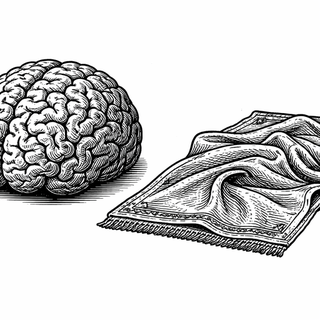
The simple version: the cortex grows faster than the tissue underneath it. When a surface sheet expands while attached to a slower-growing core, it can either politely stop growing, which biology rarely chooses, or it can buckle. If you have ever shoved a rug across the floor and watched it wrinkle, congratulations, you have performed a low-budget cortical folding demo. Please do not bill NIH.
Choi and colleagues used ferrets because their brains fold after birth, unlike human fetal brains, where the interesting parts happen behind a strict "no visitors" policy. Ferrets are gyrencephalic, meaning their brains have folds, unlike mouse brains, which are smoother and less helpful for this mystery.
The team combined MRI scans of developing ferret brains, physical gel models that wrinkle as their outer layer swells, and computer simulations that let researchers adjust the physics. The key variables were cortical thickness and cortical expansion rate. Those two knobs, the authors argue, can reproduce many normal folding and misfolding patterns.
Two Knobs, Many Wrinkles
This is where the brain starts acting like a very expensive simulation engine. Make the cortex thinner, and the model tends to produce more numerous, smaller folds, resembling polymicrogyria. Turn down overall growth, and it can look more like microcephaly. Reduce growth while increasing cortical thickness, and folding becomes weaker and broader, echoing lissencephaly-like patterns where the brain surface is unusually smooth or broadly folded.
The claim is not that genes are irrelevant. Quite the opposite. Genes still shape cell proliferation, migration, and tissue organization. But this paper suggests that very different genetic disruptions may converge on the same physical outcome: change the thickness of the cortical sheet, change how fast it expands, and the geometry follows. Biology writes the messy script; mechanics handles some stage directions.
That matters because malformations of cortical development are not just quirky MRI findings. They can be associated with epilepsy, developmental delay, intellectual disability, and other serious neurological problems. A fold in the wrong place can change how the brain wires itself.
Why Ferrets Got the Assignment
Recent reviews make the ferret case strong. Ferrets have a folded cortex, progenitor-rich growth zones, and tools that let scientists manipulate genes during development. One review notes that ferret cortical folding starts around postnatal day 4 and finishes around postnatal day 30, a rare gift-wrapped window for researchers who enjoy sleep less than they claim.
Other work points out that realistic simulations need tissue properties, geometry, skull and fluid constraints, regional differences, and fiber tracts. Translation: the brain is not a balloon, a rug, or a Jell-O mold, though it keeps rudely borrowing features from all three.
The eLife study links scales that usually live in separate academic neighborhoods. Genetic variants affect cells. Cells affect tissue growth. Tissue growth affects shape. Shape affects wiring and function. The paper does not solve the whole chain, but it gives researchers a sturdier bridge than "well, development is complicated."
The Real-World Payoff, If This Holds Up
If these results reproduce and expand, they could help clinicians interpret fetal or neonatal brain scans with better intuition. Instead of only saying, "this folding pattern is abnormal," future models might ask, "what kind of growth problem produced this?" That could sharpen genetic diagnosis, guide organoid experiments, and improve risk prediction.
The caveat, because science is legally required to bring snacks and caveats: these are models. The human comparisons are indirect, and real developing brains include blood vessels, cell-type diversity, molecular signals, activity, tissue stiffness changes, and many other biological drama queens. Still, the big idea is powerful. Brain folds may look wildly ornate, but some of their logic may come from a short list of physical rules.
The cortex, it seems, is not merely built. It is negotiated - between genes, growth, geometry, and soft tissue that buckles when pushed. Honestly, relatable.
References
- Choi GPT, Liu C, Yin S, Séjourné G, Smith RS, Walsh CA, Mahadevan L. Biophysical basis for brain folding and misfolding patterns in ferrets and humans. eLife. 2025;14:RP107141. doi:10.7554/eLife.107141. PMCID: PMC12747519
- Akula SK, Exposito-Alonso D, Walsh CA. Shaping the brain: The emergence of cortical structure and folding. Developmental Cell. 2023;58(24):2836-2849. doi:10.1016/j.devcel.2023.11.004. PMCID: PMC10793202
- Darayi M, Hoffman ME, Sayut J, Wang S, Demirci N, Consolini J, Holland MA. Computational models of cortical folding: A review of common approaches. Journal of Biomechanics. 2022;139:110851. doi:10.1016/j.jbiomech.2021.110851
- Shinmyo Y, Hamabe-Horiike T, Saito K, Kawasaki H. Investigation of the mechanisms underlying the development and evolution of the cerebral cortex using gyrencephalic ferrets. Frontiers in Cell and Developmental Biology. 2022;10:847159. doi:10.3389/fcell.2022.847159. PMCID: PMC8977464
- Brock S, Cools F, Jansen AC. Neuropathology of genetically defined malformations of cortical development: A systematic literature review. Neuropathology and Applied Neurobiology. 2021;47(5):585-602. doi:10.1111/nan.12696. PMCID: PMC8359484
Disclaimer: The image accompanying this article is for illustrative purposes only and does not depict actual experimental results, data, or biological mechanisms.