
Stripes.
Not the kind on your favorite shirt, and definitely not the kind on the one you keep meaning to return. We're talking about the stripes hiding in the back of your skull, in a little cauliflower-shaped region called the cerebellum. And it turns out that when your brain gets older and starts losing cells, it doesn't lose them at random. It loses them in a pattern. Like aging is less of a slow fade and more of a tailored suit.
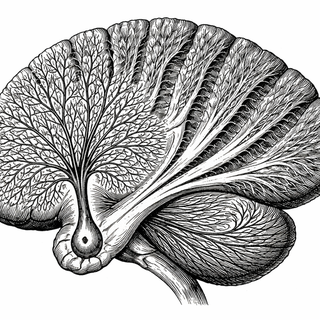
A team led by Sarah Donofrio and Roy Sillitoe just published this in eLife, and honestly the finding is the neuroscience equivalent of discovering your messy roommate was secretly alphabetizing the trash.
Meet the Purkinje cell, the high-maintenance ex of neurons
Your cerebellum runs on Purkinje cells, and these things are divas. They're huge, they're elaborate, they fan out like coral, and they're the only cells allowed to send messages out of the cerebellar cortex. Everything funnels through them. If your movements are smooth - catching a glass, walking without looking drunk, signing your name - you have Purkinje cells to thank.
The problem with being the star of the show is that you're also the one everyone notices when you don't show up. Purkinje cells are famously fragile. They bail in disease, they bail after injury, and as this study confirms, they quietly start ghosting you as you age, no diagnosis required.
The plot twist: the cells leave in formation
Here's where it gets weird in a good way. The researchers looked at aged mouse cerebellums and found the dying Purkinje cells weren't scattered like confetti. They vanished in neat parasagittal stripes - long bands running front to back across the cerebellum. Some stripes got hollowed out while the stripes right next door stayed packed and healthy. Differential vulnerability, side by side, like one apartment flooding while the unit next door stays bone dry.
This isn't totally out of nowhere. The cerebellum has long been known to come pre-organized into stripes, mapped out by a marker with the very metal name zebrin II (a protein, aldolase C, that paints some Purkinje cells and skips others). These zebrin stripes are basically your cerebellum's seating chart, and each band wires up to its own specific circuitry (Apps & Hawkes, 2009). So the brain already had the lines drawn. Aging just decided which seats to empty.
But - and the study is refreshingly honest about this - the aging pattern only partly matches the classic zebrin map. It rhymes; it doesn't copy. So whatever decides which stripes are doomed, it's not simply "zebrin said so." The relationship is a situationship, not a marriage.
So does losing the stripes wreck your moves?
You'd assume fewer Purkinje cells means worse coordination, full stop. The aged mice did struggle more - shakier on the rotarod (a tiny rodent treadmill of doom) and rocking noticeably stronger tremors than the young ones. Case closed, right?
Not quite. The link between which stripes disappeared and how badly the mice moved turned out to be messier than expected. The brain, ever the over-functioner, seems to have ways of limping along even after losing cells in specific zones. Which is either deeply reassuring or mildly insulting, depending on how much you wanted your symptoms to make tidy sense.
Why you should care, even if you're not a mouse
Here's the part that pulls it out of the petri dish: the team checked postmortem cerebellums from older humans who had no neurological disease - just normal, ordinary aging - and saw the same selective Purkinje cell loss. Not everyone, not everywhere, but a real signal that human brains may pinstripe their aging too.
That matters because we usually treat "normal aging" and "disease" as different countries. This work suggests they might share a passport. If healthy aging already nibbles away at the cerebellum in patterns, then the runaway loss seen in conditions like ataxia or other degenerative disorders might be the same process with the volume cranked up. Figure out why one stripe is bulletproof while its neighbor crumbles, and you've got a genuine lead on protecting vulnerable cells before things go sideways.
It also helps explain something almost everyone over a certain age quietly notices: handwriting gets a little shakier, balance gets a little dodgier, the coffee cup needs two hands now. That's not you being dramatic. That may be your cerebellum thinning out a few of its pinstripes.
The takeaway
Aging in the brain isn't a uniform dimming of the lights. At least in the cerebellum, it's selective, structured, and weirdly organized - vulnerability and resistance living one stripe apart (Donofrio et al., 2026). The next job is cracking the code of that pattern, because the stripe that stays might be the one that teaches us how to save the stripe that goes.
Your brain, it seems, has a dress code even on the way down.
Disclaimer: The image accompanying this article is for illustrative purposes only and does not depict actual experimental results, data, or biological mechanisms.
References
-
Donofrio SG, Brandenburg C, Brown AM, Lin T, Lu HC, Sillitoe RV. (2026). Cerebellar Purkinje cell stripe patterns reveal a differential vulnerability and resistance to cell loss during normal aging in mice. eLife, 14:e106273. DOI: 10.7554/eLife.106273 | PMID: 41324576
-
Apps R, Hawkes R. (2009). Cerebellar cortical organization: a one-map hypothesis. Nature Reviews Neuroscience, 10(9):670-681. DOI: 10.1038/nrn2698
-
Cooper CP, Cheng L, Bhatti J, Melendez ER, Huell D, Banuelos C, Perez E, Long JM, Rapp PR. (2024). Cerebellum Purkinje cell vulnerability in aged rats with memory impairment. Journal of Comparative Neurology, 532(4):e25610. DOI: 10.1002/cne.25610 | PMCID: PMC11027960