
Scientists love naming things, and this one's called gyrification. Say it out loud. It sounds like a malfunctioning blender, or maybe a yoga pose you'd pull a muscle attempting. What it actually means is the process by which your brain gets all those wrinkles - the ridges (gyri) and grooves (sulci) that make a brain look like a walnut having a bad day. For something so fundamental to being smart, it has a name that sounds like a sneeze.
Let me show you something, because the explanation for how those wrinkles happen turns out to be a lot dumber and a lot more beautiful than you'd expect.
Two Layers, One Growing Faster Than the Other
Here's the setup. Take a flat sheet. Glue it on top of a softer, thicker base. Now make the top sheet grow - just the top one - while the bottom mostly sits there. The top layer runs out of room. It can't expand sideways without crashing into itself, so it does the only thing it can: it buckles. It folds up into ridges and valleys.
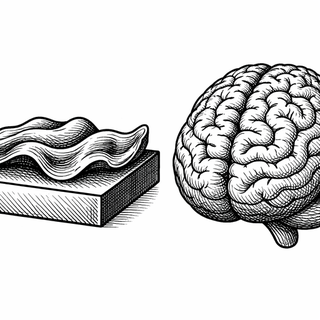
That's it. That's a brain.
The outer cortex (the gray matter, the part doing the thinking) grows faster than the white matter underneath it. Same as gluing veneer onto a workbench and watching the veneer warp when it swells. The wood doesn't move. The veneer has nowhere to go but up. Measure twice, cut once - except the brain doesn't measure at all, it just runs the growth and lets physics handle the layout.
A team led by L. Mahadevan at Harvard, working with collaborators across France and beyond, just published a study in eLife that pushes this idea across multiple species, and they did it three different ways to make sure they weren't fooling themselves.
They Built Brains Out of Gel
This is the part I love. The researchers took MRI scans of three real brains - a newborn ferret, a fetal macaque, and a fetal human - and built physical models out of soft gel. Two layers of gel, just like the brain: an outer layer rigged to swell when you drop it in solvent, sitting on a base that doesn't.
Then they dunked them.
The outer layer soaked up solvent, swelled, ran out of room, and folded - and the folds came out looking like real brain folds. No biology required. No genes telling each wrinkle where to go. Just a sheet that grew too big for its backing, doing what any over-stuffed material does. They poked around in jars of gel (as one does on a Tuesday) and watched brains wrinkle themselves into existence.
To check the gel wasn't a fluke, they ran the same thing as a 3D computer simulation - a "differential growth" model, which is a fancy way of saying "let the top grow faster and see what the math does." The simulated brains folded too. Then they used geometric morphometrics, which is the measuring-tape stage of the operation, to compare the real brains, the gel brains, and the computer brains side by side.
All three agreed. The wrinkles matched.
Why the Ferret and the Human Look Different
Here's the satisfying kicker. If folding is just one simple mechanical process, why does a ferret brain look so different from a human brain? Why isn't every brain wrinkled the same way?
Two knobs. That's the answer. Tweak how much the outer layer grows, and tweak the starting shape of the brain, and you get all the variety across species. Same trick, different settings. A human cortex grows a lot relative to its base, so it folds into that dense, crowded, deeply grooved walnut. A ferret's grows less, so it stays smoother. You don't need a different rulebook for every animal. You need one rule and a couple of dials.
Why Bother Wrinkling at All
Practical reason: folding lets you cram a huge sheet of thinking-tissue into a skull that has to fit through a birth canal. A flattened-out human cortex is roughly the size of a large dinner napkin. Try fitting a napkin in your skull without folding it. You can't. So the brain folds, same as you fold a map to get it back in the glovebox.
The bigger payoff is medical. When folding goes wrong - too smooth (lissencephaly) or too many small folds (polymicrogyria) - it shows up alongside serious neurological problems. If the wrinkles come from a mechanical process with just a couple of controlling factors, then understanding those factors gives doctors a real handle on what went sideways during development, and when. You can't fix a warped panel until you know which way the grain was pulling.
The wild part isn't that the brain is complicated. It's that something this complicated-looking runs on a rule simple enough to reproduce in a jar of gel. The brain's most distinctive feature is, at heart, a wet towel that grew too big for the rack.
Disclaimer: The image accompanying this article is for illustrative purposes only and does not depict actual experimental results, data, or biological mechanisms.
References
-
Yin S, Liu C, Choi GPT, Jung Y, Heuer K, Toro R, Mahadevan L. Morphogenesis and morphometry of brain folding patterns across species. eLife. 2026. DOI: 10.7554/eLife.107138. PMID: 41459643.
-
Companion study. Biophysical basis for brain folding and misfolding patterns in ferrets and humans. eLife. DOI: 10.7554/eLife.107141.
-
Tallinen T, Chung JY, Rousseau F, Girard N, Lefèvre J, Mahadevan L. On the growth and form of cortical convolutions. Nature Physics. 2016;12:588-593. DOI: 10.1038/nphys3632.
-
Tallinen T, Chung JY, Biggins JS, Mahadevan L. Gyrification from constrained cortical expansion. PNAS. 2014;111(35):12667-12672. DOI: 10.1073/pnas.1406015111.
-
Kroenke CD, Bayly PV. Mechanics of cortical folding: stress, growth and stability. Philosophical Transactions of the Royal Society B. 2018;373(1759):20170321. PMCID: PMC6158197.