
The year is 2025. A computational neuroscientist in Marseille just noticed something strange: we can build breathtakingly detailed virtual copies of an entire human brain, simulate them on a laptop, watch them flicker and oscillate like the real thing - and yet, when asked the simplest question, which knob did we turn to make it do that?, we had no honest answer. We could build the puppet. We just couldn't see the strings.
This is the paradox that "Virtual Brain Inference," or VBI, sets out to dissolve. And it is a very French sort of problem: a thing of immense beauty that nobody could quite explain.
The Brain as a Theater of Tipping Points
Let's start with the puppet. A whole-brain model - "virtual brain modeling," if you want the formal name - works like this: you take a person's brain scan, carve it into a few hundred regions, drop a little equation of neural activity onto each region, and then wire them together using that individual's actual neural highways. The result is a simulated brain that hums along, generating its own activity, its own rhythms, its own quiet electrical weather.
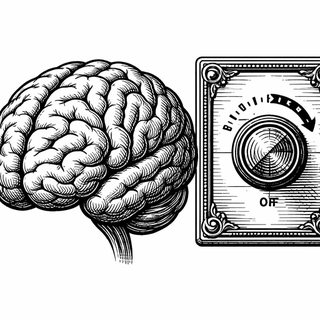
Here is where it gets interesting. Each of those little regional equations has a control parameter, sometimes called a bifurcation parameter, and it behaves exactly like the dimmer switch in a theater. Turn it one way and a brain region sits in the dark, silent and resting. Turn it past a certain threshold and the lights crash on - the region starts oscillating, firing, performing. The drama of the brain, it turns out, lives almost entirely at these tipping points.
The trouble is that nobody hands you the dimmer settings. You see the play; you never see the lighting booth.
Running the Movie Backwards
What scientists actually want is the reverse operation. Not "give me a setting and I'll predict the brain," but "give me a real brain recording and tell me what settings produced it." This is called inversion, and it is roughly as easy as un-baking a cake to recover the recipe.
Worse, the honest scientific answer is rarely a single number. It's a probability - a cloud of plausible settings, some more likely than others. That cloud has a name (the posterior distribution) and a long history of giving researchers migraines, because computing it for a model with hundreds of interacting regions used to be punishingly slow.
VBI's move is elegant. Instead of grinding through the math billions of times for every new patient, it simulates the virtual brain across thousands of parameter settings once, then trains a machine-learning network to recognize the relationship between "brain activity that looks like this" and "the dial was probably set there." Show the trained network a fresh recording and it answers almost instantly - and, crucially, it answers with honesty, returning not a smug single guess but the full cloud of uncertainty. The approach builds directly on earlier simulation-based inference work on virtual brain models of neurological disorders (Hashemi et al., 2024).
The toolkit bundles the unglamorous-but-essential plumbing too: fast simulations, a tidy taxonomy of features to extract from messy recordings, efficient data storage, and the probabilistic algorithms that do the heavy lifting. It speaks fluently to the major neuroimaging modalities, each with its own maddening trade-off between spatial and temporal resolution - the eternal compromise of brain science, where you can know where or know when, but rarely both at once.
Why a Cloud Beats a Number
You might ask why anyone should celebrate a method that refuses to give a straight answer. Because in medicine, a confident wrong number is the most dangerous thing in the room.
If a clinician one day uses a virtual brain to predict how a patient's seizures might spread, or how a region might respond to stimulation, the width of that uncertainty cloud is the clinical information. A narrow cloud says "we're sure." A wide one says "proceed carefully." Tellingly, these recovered bifurcation parameters aren't just bookkeeping - they shift measurably between resting and task states, behaving like genuine biomarkers of what the brain is actually doing (Lavanga et al., 2025). Quantifying that doubt, rather than papering over it, is what nudges virtual brains from elegant simulations toward instruments of precision medicine - the long-promised bridge from physics to bedside (Jirsa et al., 2022).
The Quiet Revolution
There is something almost theatrical about the whole enterprise: an entire human brain, rebuilt in silico, interrogated not for what it does but for the hidden settings that make it do anything at all. For years we admired the performance and ignored the lighting booth. VBI, open-source and validated on the standard family of whole-brain models, finally hands us the keys to that booth.
The brain keeps most of its secrets in the gap between activity and cause. This is a tool built precisely to live in that gap - and, for once, to send back word of what it finds.
Disclaimer: The image accompanying this article is for illustrative purposes only and does not depict actual experimental results, data, or biological mechanisms.
References
-
Ziaeemehr, A., Woodman, M., Domide, L., Petkoski, S., Jirsa, V., & Hashemi, M. (2025). Virtual Brain Inference (VBI), a flexible and integrative toolkit for efficient probabilistic inference on whole-brain models. eLife. DOI: 10.7554/eLife.106194 | PMCID: PMC12700528
-
Hashemi, M., et al. (2024). Simulation-based inference on virtual brain models of disorders. Machine Learning: Science and Technology. DOI: 10.1088/2632-2153/ad6230
-
Lavanga, M., et al. (2025). Deep learning and whole-brain networks for biomarker discovery: modeling the dynamics of brain fluctuations in resting-state and cognitive tasks. Scientific Reports. DOI: 10.1038/s41598-025-24702-4 | PMCID: PMC12635380
-
Jirsa, V., et al. (2022). Whole-Brain Network Models: From Physics to Bedside. Frontiers in Computational Neuroscience. DOI: 10.3389/fncom.2022.866517