Step off a curb at the wrong moment and a two-ton problem arrives faster than your apology. The only thing standing between you and the grille of a delivery van is a prediction your brain made about where that van would be a quarter-second from now. Get the math wrong and you become a statistic. So it matters, a lot, that the visual system is tuned to the actual physics of stuff moving through the world. A new study in eLife went digging into what that physics actually looks like, and the answer is messier than anyone wanted.
The world does not move politely
Here is the comforting version, the one in the textbooks. Things move smoothly. A car rolls along, a bird glides, a ball arcs. Velocity is predictable, correlations last a few hundred milliseconds, and your brain rides that predictability like a banister down the stairs. The researchers tracked thousands of individual points across movies of real natural scenes, and yes, the banister is real. Motion is persistent. Once a point is moving, it keeps moving the same way for a satisfyingly long stretch of time.
That is the part that holds up. Now the leak.
Heavy tails, or why the surprises are extra surprising
When the team plotted how fast those points actually moved, the distribution was not the tidy bell curve everyone draws. It was heavy-tailed. Most of the time velocities sit in a calm middle range, and then, far more often than a normal bell curve would ever allow, something rips across the frame at a speed that should basically never happen. Picture a plumbing system that runs at gentle pressure for hours and then, with no warning, slams you with a burst that blows the gasket. The average looks fine. The averages are lying to you.
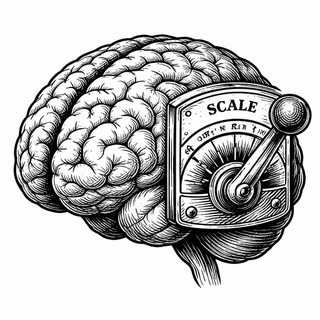
This is not a quirk of one weird video. Heavy tails show up everywhere in natural scene statistics, and vision scientists have been chewing on them for decades. Back in 1999, Wainwright and Simoncelli showed that the statistics of natural images are beautifully captured by something called a Gaussian scale-mixture, which is a fancy way of saying: take a normal bell curve, then randomly crank its width up and down (Wainwright and Simoncelli, 1999). Most of the time the curve is narrow and life is calm. Occasionally the dial spins wide and you get a monster.
The dial has its own life
The real contribution of this paper is taking that idea and letting it move through time. They call it a dynamic scale-mixture model. The recipe is two ingredients: a smooth, predictable motion signal, multiplied by a separate "scale" knob that drifts around on its own schedule. The motion part is the banister. The scale knob is the gremlin in the basement turning the water pressure up and down while you shower.
And the genuinely clever bit is where that knob comes from. It is not mystical. It is mostly distance. An object far away crawls across your retina; the same object up close screams across it. Same motion in the world, wildly different speed in your eye, just because it got closer. So the "scale" your brain has to track is, to a first approximation, how near the thing is, plus whatever else is jerking the scene around. Your visual system is not just guessing where things go. It is also constantly re-guessing how fast the whole scene is currently allowed to move.
Why this is the brain's actual job
Here is the part that should keep a neuroscientist up at night. The study found that those heavy tails barely change your prediction of where something goes next. What they wreck is your confidence. When the scale knob could secretly be turned way up, your brain has to widen its uncertainty, hedge its bets, and stay ready for the van that comes out of nowhere. A system tuned only to the polite average would be calm, efficient, and occasionally dead.
This connects to a bigger idea that has been building for years: brains seem built to predict the near future from natural input, not just to record the present (Palmer et al., 2015). A retina that wasted its limited bandwidth on smooth, boring motion and got blindsided by the tails would lose every race that mattered. So the efficient move is to budget for chaos. Neurons that adapt their gain to the current scale of motion are not being twitchy. They are doing exactly the renovation the building needs.
None of this makes crossing the street safe. But it does mean the machine doing the crossing was built by a world that throws the occasional van, and it kept the receipts.
Disclaimer: The image accompanying this article is for illustrative purposes only and does not depict actual experimental results, data, or biological mechanisms.
References
Salisbury, J. M., and Palmer, S. E. (2025). A dynamic scale-mixture model of motion in natural scenes. eLife. DOI: 10.7554/eLife.104054 | PMC12807455
Wainwright, M. J., and Simoncelli, E. P. (1999). Scale Mixtures of Gaussians and the Statistics of Natural Images. Advances in Neural Information Processing Systems (NeurIPS). Proceedings link
Palmer, S. E., Marre, O., Berry, M. J., and Bialek, W. (2015). Predictive information in a sensory population. Proceedings of the National Academy of Sciences, 112(22), 6908-6913. DOI: 10.1073/pnas.1506855112
Bányai, M., et al. (2021). Neuronal variability reflects probabilistic inference tuned to natural image statistics. Nature Communications, 12, 3635. DOI: 10.1038/s41467-021-23838-x