
About 25 milliseconds. That is how far in advance a little knot of cells deep in your head calls which way you are about to face, firing off the new direction before your neck has even finished the turn. Twenty-five thousandths of a second of pure prediction, running silently every time you swivel to see who just walked in. Your inner compass is not waiting to find out where you are pointed. It already decided.
Scientists call these head direction cells, and they are exactly what they sound like: neurons that perk up only when your head faces one particular way. Like that one relative who will only sit in her chair at the dinner table and nowhere else, each cell has its preferred direction and sulks the rest of the time. String enough of them together and you get a working compass, the kind that lets you find the bathroom in a dark hotel hallway without thinking about it.
The compass has a known weakness
Here is the catch every compass shares: it drifts. A magnetic compass needs north. Your brain's version needs landmarks, the visual cues that say "ah, the couch is over there, so I must be facing the kitchen." Without that occasional reality check, the internal needle slowly wanders off, the way your sense of direction falls apart the moment you leave a windowless mall parking garage.
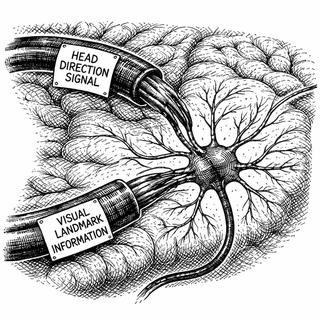
So the brain has to do something genuinely tricky. It has to take the raw "which way is my head pointed" signal and quietly cross-check it against "what am I actually looking at," then nudge the compass back in line. The question that has nagged researchers for years is the boringly mechanical one: where, physically, do those two streams of information shake hands?
A tiny relay station does the matchmaking
A new study in eLife went looking for that handshake in a sliver of mouse brain called the presubiculum, and found it happening at the level of single cells. The team traced two incoming cables. One carries the head direction signal from the anterior thalamus, the brain's main compass hub. The other carries visual landmark information by way of the retrosplenial cortex, which is basically the department that keeps track of where things are in the room.
Both cables, it turns out, plug into the very same individual neurons in layer 3 of the presubiculum. And these cells are pickier than you might expect. Using light to switch each input on independently (the modern lab equivalent of testing two doorbells), the researchers found that the neuron only really fires when both signals arrive at nearly the same moment. Compass says "north," eyes say "north," the cell agrees and passes the now visually-confirmed message along to the entorhinal cortex, your brain's mapping division. It is coincidence-detection, the same logic your grandmother used when she would only believe a piece of gossip if she heard it from two different neighbors.
A second floor, with a twist
There is a downstairs to this building too. Layer 4 cells, which send their messages back toward the lateral mammillary nucleus (another compass waystation), barely touch those two main cables directly. Instead they get poked one step removed, and when they fire they do not just blip politely. They burst, rattling off a quick volley of spikes. Even better, a splash of acetylcholine, the brain's "pay attention now" chemical, cranks their excitability up. So when you are alert and actively scanning a new place, the system is chemically primed to update your compass faster. Convenient, given that is precisely when you need it.
Why bother caring about a mouse's sense of direction
Losing your bearings is one of the earliest and most frightening signs of Alzheimer's disease, and these same brain regions are among the first to falter. Knowing the exact wiring, that landmarks and direction get welded together cell by cell in projection-specific layers, gives researchers a real circuit to point at when something goes wrong. It also hands robotics and navigation engineers a tidy blueprint, because a machine that fuses "where am I pointed" with "what do I see" the way these neurons do would get lost a lot less often than the ones we have now.
Not bad for a clump of cells smaller than a grain of rice, quietly running the most reliable compass you own and politely double-checking it against the furniture.
Disclaimer: The image accompanying this article is for illustrative purposes only and does not depict actual experimental results, data, or biological mechanisms.
References
-
Richevaux L, Lim D, Nassar M, Dias Rodrigues L, Mauthe C, Cohen I, Sol-Foulon N, Fricker D. Projection-specific integration of convergent thalamic and retrosplenial signals in the presubicular head direction cortex. eLife. 2025. DOI: 10.7554/eLife.92443 | PMID: 41439747
-
Ajabi Z, et al. A neural compass for real-world navigation. Nature Reviews Neuroscience. 2025. DOI: 10.1038/s41583-025-00994-3
-
Ajabi Z, Keinath AT, Wei XX, Brandon MP. Population dynamics of head-direction neurons during drift and reorientation. Nature. 2023;615:892-899. DOI: 10.1038/s41586-023-05813-2
-
Jankowski MM, O'Mara SM. Nucleus reuniens of the thalamus contains head direction cells. eLife. 2014;3:e03075. DOI: 10.7554/eLife.03075 | PMCID: PMC4115655
-
Jacob PY, et al. Retrosplenial and postsubicular head direction cells compared during visual landmark discrimination. Brain and Neuroscience Advances. 2017. PMCID: PMC6124005