Long before brains were writing emails, losing keys, or pretending to understand Kullback-Leibler divergence at parties, they had one job: keep the organism alive long enough to learn what mattered. A rustle in the grass might be lunch, death, or just wind being dramatic. So evolution built brains that guess what comes next, then update fast. A new eLife study suggests that one visible piece of this updating machinery sits in the middle of your eye: the pupil.
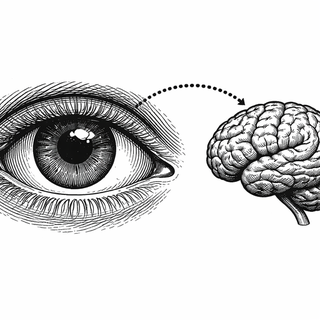
The paper asks a deceptively simple question: when your pupil changes size after feedback, is it just reacting to surprise, or is it tracking something deeper - the brain updating its internal model of reality? In other words, when the world corrects you, does your eye briefly become a scoreboard for "oops, recalculating"? (Colizoli et al., 2026)
The Brain Runs on Educated Guesswork
Prediction error is the gap between what the brain expected and what actually happened. You expected coffee, got orange juice, and somewhere in your nervous system a tiny committee flips a table. But not all surprises teach you equally. If a coin lands tails after you expected heads, fine. If your dog starts speaking fluent Italian, that is a different meeting.
The authors focused on associative learning, learning that certain things go together. Think: this symbol predicts that outcome, this restaurant predicts regret. Participants made perceptual decisions while researchers recorded pupil size. After feedback appeared, the team asked whether the pupil response lined up with prediction error and "information gain."
Information gain asks: how much did this evidence change the learner's beliefs? The study measured it using Kullback-Leibler divergence, which sounds like a law firm but is really a way to compare prior and updated belief. In plain English: how much did the new evidence make the old model wobble?
The Pupil Is Not Just a Mood Ring
Pupillometry measures pupil size and reactivity. Clinicians have long checked pupils during neurological exams, and researchers use eye tracking to study attention, arousal, memory, decision-making, and learning. The pupil reacts to light, of course, but it also moves with mental effort and arousal, like a small weather vane for internal brain states.
That does not mean "big pupil equals big thought." Biology rarely hands us a bumper sticker. Prior work has linked pupil dilation to uncertainty, surprise, conditioning, exploration, and the locus coeruleus-norepinephrine system, a brainstem arousal network with the vibe of an emergency group chat. A 2021 review supports pupil dilation as a Pavlovian conditioning marker (Finke et al., 2021), while a 2022 study linked it to exploratory choices (Kozunova et al., 2022).
Colizoli and colleagues add a sharper point: after feedback, pupil changes explained a meaningful slice of variability in information gain. The pupil was not merely waving a flag that said "unexpected!" It seemed to offer a brief time-window into model updating, when the brain edits its assumptions like a frantic Wikipedia moderator.
Plot Twist: Bigger Is Not Always More
One of the neatest findings keeps this from becoming too tidy. The direction of the pupil response depended on context. Sometimes information gain aligned with dilation. Sometimes it aligned with constriction. Annoying? Yes. Useful? Also yes, like a smoke alarm that tells you the toaster is not the whole story.
The result argues against treating pupil size as a universal surprise thermometer. Instead, the pupil may reflect how task structure, uncertainty, feedback, and learning demands interact. That fits with work showing that the locus coeruleus can broadcast prediction-error-like signals across cortex in mice (Jordan & Keller, 2023), and that different patterns of locus coeruleus stimulation shift brain networks differently (Grimm et al., 2024).
So the humble pupil is not a direct livestream from one brain region. It is more like seeing steam above a city and inferring that kitchens, factories, and one overambitious espresso machine are all involved.
Why This Could Matter Outside the Lab
If these findings hold up and expand, pupillometry could become a useful, noninvasive way to study feedback learning. Eye tracking is cheaper and easier than brain imaging, and it works while people perform real tasks instead of lying in a scanner trying not to think about how itchy their nose is.
The real-world possibilities are broad but early: adaptive learning tools, clinical research on arousal or learning differences, and better experiments on belief updating under uncertainty. The challenge is that pupils are busy little overachievers. Light, fatigue, emotion, drugs, eye movements, task difficulty, and individual biology can all affect them. A pupil signal is not a confession. It is a clue.
Still, this study gives researchers a sharper clue. When the world proves us wrong, the brain recalculates. And briefly, the eye may quietly show the math.
References
Colizoli O, van Leeuwen TM, Rutar D, Bekkering H. Pupil dilation offers a time-window on prediction error. eLife. 2026;14:e105287. DOI: 10.7554/eLife.105287
Finke JB, Roesmann K, Stalder T, Klucken T. Pupil dilation as an index of Pavlovian conditioning. A systematic review and meta-analysis. Neuroscience & Biobehavioral Reviews. 2021;130:351-368. DOI: 10.1016/j.neubiorev.2021.09.005
Kozunova GL, Sayfulina KE, Prokofyev AO, Medvedev VA, Rytikova AM, Stroganova TA, Chernyshev BV. Pupil dilation and response slowing distinguish deliberate explorative choices in the probabilistic learning task. Cognitive, Affective, & Behavioral Neuroscience. 2022;22:1108-1129. DOI: 10.3758/s13415-022-00996-z. PMCID: PMC9458574
Jordan R, Keller GB. The locus coeruleus broadcasts prediction errors across the cortex to promote sensorimotor plasticity. eLife. 2023;12:RP85111. DOI: 10.7554/eLife.85111. PMCID: PMC10328511
Grimm C, Duss SN, Privitera M, et al. Tonic and burst-like locus coeruleus stimulation distinctly shift network activity across the cortical hierarchy. Nature Neuroscience. 2024;27:2167-2177. DOI: 10.1038/s41593-024-01755-8
Disclaimer: The image accompanying this article is for illustrative purposes only and does not depict actual experimental results, data, or biological mechanisms.