
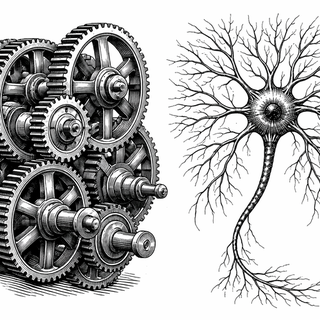
How many moving parts can your brain juggle before the whole contraption starts flinging screws across the workshop? Quite a lot, apparently, but not as many as some earlier analyses suggested. A new 2025 PNAS paper on mouse visual cortex argues that when neurons respond to images, the population code is not an endless cathedral of hidden dimensions. It is more like a finely machined gear train: still intricate, still mildly rude to anyone hoping for simplicity, but more compact and organized than it first looked (Pospisil and Pillow, 2025).
The Old Story Had a Very Large Closet
Back in 2019, a Nature paper reported that visual cortex responses seemed to follow a power law spectrum across principal components - in plain English, useful signal kept dribbling into many dimensions instead of neatly packing itself into a few (Stringer et al., 2019).
The new paper revisits that claim with a less trusting attitude toward noisy data. Neuroscience, like antique clock repair, gets weird when you pretend dust is part of the mechanism.
Pospisil and Pillow built new statistical tools to estimate signal geometry when datasets have more neurons than trials, which is exactly the sort of setup where noise can swagger in wearing a fake mustache. Using mouse primary visual cortex, or V1, they found the eigenspectrum fits a broken power law better than one clean slope. Early modes fall off one way, later modes crash much faster (Pospisil and Pillow, 2025).
That matters because it changes the picture from "visual cortex is using an enormous number of equally important hidden axes" to "the important action is concentrated in earlier modes, and the tail is thinner than we thought." Same machine, fewer cogs.
Why a Population Beats a Soloist
This is the fun part. The paper does not just say the representation is lower-dimensional than expected. It also shows those dominant population modes encode visual features more faithfully than single neurons do, and they are easier to model with both classical and deep-network approaches (Pospisil and Pillow, 2025).
A single neuron is a bit like one band member insisting you can understand the whole symphony by listening only to the triangle. Respectfully: no. Population coding asks what the ensemble is doing together, and PCA is one way to find the main shared directions of variation in that giant response cloud.
So instead of obsessing over one neuron's tuning curve like it is the chosen one in a very niche fantasy franchise, this paper says the cleaner object of study may be the leading population modes. Those modes behave more predictably, carry more stimulus information, and look less like each neuron is running its own tiny improv set.
The Field Has Been Tightening the Gears
This paper lands in a moment when systems neuroscience is getting more serious about manifolds, latent structure, and circuit-level organization. Recent reviews argue that population activity often makes more sense in a reduced state space, where dynamics and computation can be studied without drowning in single-cell chaos (Duncker and Sahani, 2021), (Langdon et al., 2023), (Gallego, 2025).
Recent experiments in mouse visual cortex also point the same way. Horrocks and colleagues showed that behavioral state changes how population trajectories move through neural space, affecting how quickly and stably visual information is encoded (Horrocks et al., 2024). Bolaños and colleagues linked the geometry of population responses to perception of natural image textures, showing that representational distances in mouse visual cortex track what animals can actually discriminate (Bolaños et al., 2024).
In April 2025, NIH highlighted MICrONS work combining activity measurements and connectomics in mouse visual cortex, pushing the field toward linking response patterns to real wiring diagrams instead of educated shrugging (NIH, April 29, 2025).
Why You Should Care, Even If You Are Not a Mouse
If these results keep holding up, they make visual cortex seem more tractable. That means better models, better decoding, and fewer years spent staring at spreadsheets like they personally betrayed you. A lower-dimensional, population-based description could make it easier to compare brains with AI systems, interpret large recording datasets, and design experiments that target the most informative modes instead of poking randomly at the neural orchestra pit.
It also sharpens a deeper point: the brain may hide complexity behind coordinated group behavior rather than inside exquisitely legible single cells. Very on-brand for biology.
The challenge now is generalization. Does this broken-power-law structure show up across other visual areas, stimuli, behaviors, and species? Does it survive different recording methods? Those are the main plot.
For now, this paper does something rare and valuable. It takes a fashionable big idea, opens the casing, checks the tolerances, and finds that the machine is still remarkable - just less infinite, more engineered.
References
Pospisil DA, Pillow JW. Revisiting the high-dimensional geometry of population responses in the visual cortex. Proc Natl Acad Sci U S A. 2025;122(45):e2506535122. DOI: https://doi.org/10.1073/pnas.2506535122. PubMed: https://pubmed.ncbi.nlm.nih.gov/41191501/ . PMCID: https://pmc.ncbi.nlm.nih.gov/articles/PMC12625980/
Stringer C, Pachitariu M, Steinmetz N, et al. High-dimensional geometry of population responses in visual cortex. Nature. 2019;571:361-365. DOI: https://doi.org/10.1038/s41586-019-1346-5
Duncker L, Sahani M. Dynamics on the manifold: Identifying computational dynamical activity from neural population recordings. Curr Opin Neurobiol. 2021;70:163-170. DOI: https://doi.org/10.1016/j.conb.2021.10.014
Langdon C, Genkin M, Engel TA. A unifying perspective on neural manifolds and circuits for cognition. Nat Rev Neurosci. 2023;24(6):363-377. DOI: https://doi.org/10.1038/s41583-023-00693-x
Gallego JA. Neural manifolds: more than the sum of their neurons. Nat Rev Neurosci. 2025;26(6):312. DOI: https://doi.org/10.1038/s41583-025-00919-0
Horrocks EAB, Rodrigues FR, Saleem AB. Flexible neural population dynamics govern the speed and stability of sensory encoding in mouse visual cortex. Nat Commun. 2024;15(1):6415. DOI: https://doi.org/10.1038/s41467-024-50563-y. PubMed: https://pubmed.ncbi.nlm.nih.gov/39080254/ . PMCID: https://pmc.ncbi.nlm.nih.gov/articles/PMC11289260/
Bolaños F, Orlandi JG, Aoki R, et al. Efficient coding of natural images in the mouse visual cortex. Nat Commun. 2024;15(1):2466. DOI: https://doi.org/10.1038/s41467-024-45919-3. PubMed: https://pubmed.ncbi.nlm.nih.gov/38503746/ . PMCID: https://pmc.ncbi.nlm.nih.gov/articles/PMC10951403/
National Institutes of Health. Understanding how visual information is processed in the brain. April 29, 2025. https://www.nih.gov/news-events/nih-research-matters/understanding-how-visual-information-processed-brain
Disclaimer: The image accompanying this article is for illustrative purposes only and does not depict actual experimental results, data, or biological mechanisms.