
Start in the brain’s ventricles, those fluid-filled rooms tucked deep inside the central nervous system, then follow the clear cerebrospinal fluid as it loops around the brain and spinal cord like a quiet hallway with excellent acoustics. That hallway is where this study went eavesdropping. Not on neurons firing their tiny jazz solos, but on stray scraps of tumor DNA floating in the cerebrospinal fluid, or CSF. It is less glamorous than a brain scan, sure, but sometimes the whisper in the plumbing tells you what the mansion is hiding.
The Brain Has a Moat, Which Is Rude but Useful
Liquid biopsy usually means looking for tumor DNA in blood. That works nicely for some cancers because tumor fragments shed into the bloodstream like confetti after a very bad parade. Brain tumors are trickier. The blood-brain barrier acts like a velvet rope at an exclusive club, keeping many molecules in or out with the stern energy of a bouncer who has seen everything.
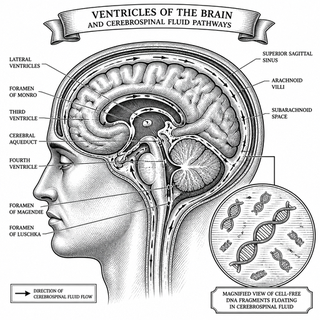
So instead of asking blood to carry the news, researchers are increasingly turning to CSF, the clear fluid that cushions the brain and spinal cord. CSF is close to the action. If a brain or spinal tumor sheds bits of DNA, those fragments may show up there before they ever make it into blood. In other words, CSF is not just brain bathwater. It is more like the backstage audio feed.
What This Study Did
Nobre and colleagues tested whether CSF liquid biopsy could work in real clinical life, not just in the polished showroom version of science where every sample behaves and nobody spills anything. They analyzed 148 CSF samples from 120 pediatric patients with central nervous system tumors. The team used droplet digital PCR and next-generation sequencing to look for mutations, gene fusions, copy number changes, and mismatch-repair deficient signatures, which they call “MMRDness” because apparently science still lets people name things before coffee.
The headline: tumor-derived cell-free DNA showed up in 54% of samples overall. Detection was higher when CSF came from ventricular sources, such as during surgery or through shunts, than from lumbar puncture: 65% versus 45%. That makes intuitive sense. If the tumor is the band, ventricular CSF may be closer to the stage, while lumbar CSF is hearing the show from the parking lot.
The signal also depended on tumor type and spread. In high-grade gliomas at diagnosis, ctDNA detection reached 100%, with one sample considered equivocal. In low-grade gliomas, detection was 50%, and it was stronger when disease had disseminated: 80% versus 43% in non-disseminated cases. So this is not a magic truth serum. It is a sensitive microphone whose performance depends on where you place it, how loud the tumor is, and whether the tumor is shedding enough DNA to hum along.
Why This Matters at the Bedside
Pediatric brain tumors can be hard to biopsy. Some sit in deep or delicate regions where “just take a sample” has the same energy as “just remove the olive from the martini while riding a roller coaster.” Surgery can be necessary, but repeat sampling is not exactly a casual Tuesday activity.
A CSF liquid biopsy could help answer questions clinicians already wrestle with. What kind of tumor is this? Is it coming back? Is this a relapse, or a second cancer caused by prior therapy? Is treatment quieting the disease, or is the tumor changing keys mid-song?
In this study, serial CSF samples suggested that ctDNA levels could track treatment response and progression. The test also helped distinguish relapse from second malignancy, a problem with real consequences because those scenarios can call for different treatment decisions. In mismatch-repair deficient tumors, a high MMRDness score in ctDNA supported active disease. That is the sort of molecular clue that can keep doctors from flying by MRI alone, which is helpful because MRI sometimes looks at scar tissue, swelling, treatment effect, and tumor and says, with suspicious confidence, “good luck.”
The Bigger Chorus
This paper lands in a growing rhythm of CSF liquid biopsy research. A 2023 Neuro-Oncology study used patient-specific mutations and droplet digital PCR to monitor pediatric brain cancers, showing that ctDNA patterns often tracked clinical course and treatment response [2]. Another 2023 Neuro-Oncology paper showed that CSF methylation patterns could classify malignant brain tumors, opening the door to identifying tumors by their epigenetic “accent” rather than only by single mutations [3].
The field is also moving fast. In 2026, St. Jude researchers reported M-PACT, an AI method trained to classify pediatric brain tumors from CSF cell-free DNA methylation patterns, with strong performance in benchmarking and validation cohorts [4]. That does not make today’s neurosurgeons obsolete, despite what the robots may be putting in their vision boards. It means the diagnostic orchestra is getting more instruments.
The Catch, Because Biology Always Has One
CSF liquid biopsy still has limits. A negative result does not prove a tumor is absent. Some tumors shed little DNA. Some samples come from too far downstream. Some assays look for known changes, which helps when the target is obvious and hurts when the tumor is improvising in a weird key.
The strength of the Nobre study is that it tested combined methods in a real-world pediatric cohort. That messy realism matters. Children with brain tumors do not arrive as textbook diagrams. They arrive with different diagnoses, prior treatments, shunts, surgeries, relapse questions, tiny sample volumes, and families who need answers that are accurate enough to shape care.
The future version of this work is not “one spinal tap replaces everything.” More likely, CSF liquid biopsy becomes a sharp companion to MRI, pathology, surgery, and clinical judgment. A quieter test. A repeatable test. A way to hear the tumor’s molecular riff without always having to cut into the amplifier.
If these results hold up in larger studies, pediatric neuro-oncology could get something it badly needs: a better way to monitor disease over time, choose targeted therapies, and spot molecular changes before the tumor makes a louder entrance. In cancer care, earlier information is not just data. It is time. And time, when a child has a brain tumor, is the only instrument nobody wants to waste.
References
- Nobre L, Nakano Y, Burns I, et al. Tumor-derived cell-free DNA detected in cerebrospinal fluid enables minimally invasive profiling of pediatric brain tumors. Journal of Clinical Investigation. 2026;136(12):e197391. https://doi.org/10.1172/JCI197391
- Kojic M, Maybury MK, Waddell N, et al. Efficient detection and monitoring of pediatric brain malignancies with liquid biopsy based on patient-specific somatic mutation screening. Neuro-Oncology. 2023;25(8):1507-1517. https://doi.org/10.1093/neuonc/noad032
- Zuccato JA, Patil V, Mansouri S, et al. Cerebrospinal fluid methylome-based liquid biopsies for accurate malignant brain neoplasm classification. Neuro-Oncology. 2023;25(8):1452-1460. https://doi.org/10.1093/neuonc/noac264
- Han K, Smith KS, Northcott PA, et al. M-PACT leverages cell-free DNA methylomes to achieve robust classification of pediatric brain tumors. Nature Cancer. 2026. https://doi.org/10.1038/s43018-026-01115-4
Disclaimer: The image accompanying this article is for illustrative purposes only and does not depict actual experimental results, data, or biological mechanisms.