
How fast can one tiny cell pass a note? Very fast. In your ear and eye, some cells do not get to loaf around and send occasional postcards - they have to keep a steady stream of information moving with near-watchmaker timing, millisecond by millisecond, or the whole signal turns to mush.
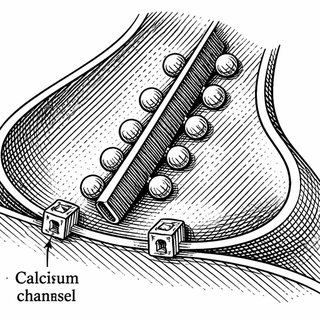
That is where ribbon synapses come in. These are specialized contact points used by sensory cells, especially in hearing and vision, to keep neurotransmitter release rapid, precise, and sustained. Think of a standard synapse as a decent espresso machine. A ribbon synapse is the industrial cafe setup that somehow keeps serving during the morning rush without catching fire. In a paper published in eLife on January 13, 2026, Rohan Kapoor and colleagues tried something audacious: instead of only studying ribbon synapses where nature built them, they assembled a simplified, synthetic version inside HEK293 cells, a lab-grown human cell line that normally has no business pretending to be part of your inner ear (Kapoor et al., 2026).
The Brain's Tiny Timing Rig
A synapse is the place where one cell releases chemical signals to another. The release happens at a patch called the active zone, which is less a patch and more a micromechanical loading dock. Vesicles full of neurotransmitter line up, calcium channels open, and the cargo gets launched on cue. At ribbon synapses, common in cochlear hair cells and retinal cells, a protein structure called the ribbon helps organize that whole operation so signals can keep flowing with absurd reliability (Pyott et al., 2024).
Why does that matter? Because hearing and vision are timing problems wearing glamorous disguises. Your ear has to encode tiny changes in sound with brutal precision. Your retina has to keep up with changing light without the circuitry acting like a group chat with spotty Wi-Fi.
So They Built a Mini Knockoff
Kapoor and colleagues wanted to know the minimum parts list needed to create something that looks and behaves like a ribbon-type active zone. They used a synthetic biology approach in HEK293 cells and combined a membrane-targeted form of the active-zone protein Bassoon with RIBEYE, the core ribbon protein. That produced "synthetic ribbons," or SyRibbons, that resembled real ribbon structures in size and shape under super-resolution microscopy and cryo-electron tomography (Kapoor et al., 2026).
Then they added more hardware: CaV1.3 calcium channels and RIM-binding protein 2, or RBP2. That mattered because real ribbon synapses do not just need a dramatic-looking scaffold. They need the calcium channels positioned in the right place, since those channels are the starting gun for vesicle release. With the added components, the synthetic setup recruited clustered calcium channels and generated localized calcium entry - basically, some of the essential geometry of a real sensory synapse began to appear.
This is the key achievement. The team did not build a full working synapse with all the bells, whistles, and existential dread. They built a reductionist model that lets researchers test how major presynaptic parts fit together. That may sound modest, but biology often becomes understandable only after you strip the machine down to the gears on the bench and see which ones are actually necessary.
Why Fake Biology Can Be Better Biology
There is a long tradition in neuroscience of learning by breaking things. This paper takes the slightly tidier route of rebuilding them. That matters because active zones are packed with interacting proteins, and native ribbon synapses are spectacularly hard to dissect piece by piece. A heterologous system gives researchers a cleaner sandbox.
That idea fits with a broader trend in synapse research. Recent work has emphasized that active zones are built from modular molecular assemblies, not magical dust sprinkled by the neuron gods (Tan et al., 2022). Other reviews have argued that synapses achieve their specialized behavior by tuning local protein composition with almost obnoxious precision, which is exactly why synthetic reconstruction is so appealing (Klueva et al., 2025; Pyott et al., 2024).
The catch is important, too. Even eLife's assessment notes that this system only partially mimics native ribbon synapses. That is not a failure. It is the whole point of a minimal system. A stripped-down clock movement will not play music, glow in the dark, and survive a toddler attack, but it can still teach you how timing works.
Why You Should Care Even If You Are Not Dating a Microscope
Ribbon synapses are central to how sensory cells in the ear and eye talk to the nervous system. If scientists can understand how these structures assemble, position calcium channels, and keep neurotransmitter release reliable, they get a clearer map of what goes wrong in sensory disorders. That includes forms of hearing loss linked to cochlear synaptopathy, where the wiring between hair cells and auditory nerve fibers degrades in ways standard hearing tests can miss. The clinical road from "fake synapse in a dish" to "better diagnosis or therapy" is, to put it politely, not a straight hallway. It is more of a Rube Goldberg staircase. Still, better mechanistic maps tend to age well.
So the real charm of this paper is not that scientists made kidney cells cosplay as inner-ear machinery. It is that they turned one of neuroscience's fussiest precision devices into something experimentally tractable. When the question is how biological timing is engineered, sometimes the smartest move is to build the watch yourself and see which spring snaps first.
References
- Kapoor R, Do TT, Schwenzer N, Petrovic A, Dresbach T, Lehnart SE, Fernandez-Busnadiego R, Moser T. Establishing synthetic ribbon-type active zones in a heterologous expression system. eLife. 2026;13:RP98254. DOI: https://doi.org/10.7554/eLife.98254.3
- Tan C, Wang SSH, de Nola G, Kaeser PS. Rebuilding essential active zone functions within a synapse. Neuron. 2022;110(9):1498-1515.e8. DOI: https://doi.org/10.1016/j.neuron.2022.01.026 PMCID: https://pmc.ncbi.nlm.nih.gov/articles/PMC9081183/
- Klueva J, Biederer T, Han Y, Heller EA, Poulopoulos A, Sudhof TC, et al. Understanding the molecular diversity of synapses. Nature Reviews Neuroscience. 2025;26:65-81. PubMed: https://pubmed.ncbi.nlm.nih.gov/39638892/
- Pyott SJ, Pavlinkova G, Yamoah EN, Fritzsch B. Harmony in the Molecular Orchestra of Hearing: Developmental Mechanisms from the Ear to the Brain. Annual Review of Neuroscience. 2024;47(1):1-20. DOI: https://doi.org/10.1146/annurev-neuro-081423-093942 PMCID: https://pmc.ncbi.nlm.nih.gov/articles/PMC11787624/
Disclaimer: The image accompanying this article is for illustrative purposes only and does not depict actual experimental results, data, or biological mechanisms.