
So here's what nobody tells you about studying autism in the brain: the wiring diagram is not enough. You can stare at genes like a contractor blaming the blueprints, but sometimes the problem is in the permits, inspection stickers, and weird notes taped to the fuse box.
That is where DNA methylation comes in. It marks DNA without changing the DNA letters themselves. Think of it as molecular tape that says, "use this part carefully" or "why is this pipe making that noise?" In the brain, those marks can shape which genes are easier or harder to use.
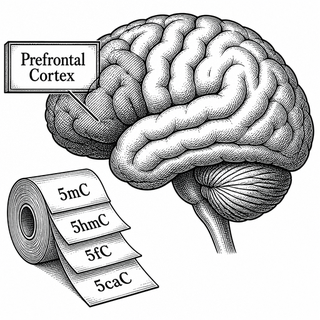
A new Cell Genomics study by Eyring and colleagues looked at those marks in postmortem prefrontal cortex from autistic and neurotypical donors, one nucleus at a time. Not tissue soup. Not a blender smoothie of neurons, glia, and regret. The team profiled more than 60,000 nuclei from 49 people, pairing methylation with gene activity.
The Prefrontal Cortex Has Plumbing Problems
The prefrontal cortex helps with planning, flexibility, attention, social behavior, and other tasks that go sideways when your mental inbox catches fire.
Autism spectrum disorder is not one thing biologically. It is a big umbrella, and the umbrella has been through weather. Genetics matters, but hundreds of genes and pathways can be involved. Recent reviews describe ASD as a convergence problem: many starting points can nudge brain development toward overlapping changes in synapses, cortical circuits, and gene regulation (Willsey et al., 2022).
Methylation sits between fixed DNA sequence and the messy reality of cells. It does not mean "environment causes autism," a sentence that should wear a warning label. It means gene regulation has layers, which may help explain why similar genetic risks play out differently across people, cell types, and ages.
They Found a Lot of Marks, But the Marks Whispered
The team found more than 30,000 differentially methylated regions, or DMRs, associated with ASD. These regions clustered near promoters and regulatory elements, the genomic control panels for gene use. Many stay active across life, because the brain keeps remodeling while pretending everything is fine.
But here is the grown-up part: the ASD-related methylation changes were small. They also did not line up neatly with transcript levels. A methylation difference did not automatically mean the nearby gene was louder or quieter.
That may sound disappointing if you wanted methylation to walk in wearing a trench coat and confess by page three. Biology does not do that. Biology hides the receipts. The study also found that age-associated methylation effects were much larger than ASD-associated effects. Aging, apparently, is still the loudest contractor in the building.
Aging Was Not Background Noise
The study did not treat age as a nuisance variable to shove into a statistical closet. Age mattered. Age-related DMRs showed up strongly in excitatory neurons, the cells that push signals forward and can make cortical circuits feel like a group chat with no mute button.
The researchers also separated CG methylation from non-CG methylation, because neurons use methylation in unusual ways. Prior work shows that methylation shifts as the human cortex develops, especially near genes linked to autism and schizophrenia (Franklin et al., 2025). The new ASD study asks a lifespan question: what if autism-related biology does not look the same at every age?
If reproducible, that could change how researchers design studies. A methylation signal in a young brain and an older brain may not mean the same thing.
Why This Matters Without Turning It Into Sci-Fi
This work does not give us a blood test for autism. It does not prove methylation causes ASD. It does not tell anyone how to "reverse" autism. That framing belongs in a biomedical sinkhole.
What it offers is a sharper map. Earlier work found ASD-related gene-expression changes across the cortex, especially involving excitatory neurons, glia, immune signaling, and synaptic pathways (Gandal et al., 2022). Epigenomic reviews argue that DNA methylation may help connect genetic risk, development, and possible biomarker discovery, while warning that translation is hard and full of confounders wearing fake mustaches (LaSalle, 2023; Williams and LaSalle, 2022).
The new study adds cell-type detail. Instead of asking whether "the autistic brain" has methylation differences, it asks which cells, switches, and ages show the signal. The brain is not uniform gray pudding. It is a badly labeled construction site where electricians, plumbers, inspectors, and someone named Gary are all working at once.
If these findings hold up in larger datasets, they could help researchers understand why ASD biology is so varied, why some molecular changes converge despite different genetic backgrounds, and how aging interacts with neurodevelopmental differences. The payoff would be better targets, better timing, better models, and less pretending that one brain sample can speak for everyone.
References
Eyring KW, Liu C, Elhajjaoui N, Abuhanna KD, Zhang Y, von Behren Z, Tsai MJ, Eskin E, Geschwind DH, Luo C. Single-cell profiling of DNA methylation in autism spectrum disorder prefrontal cortex reveals distinct regulatory and aging signatures. Cell Genomics. 2026. PMID: 42320469. DOI: 10.1016/j.xgen.2026.101278.
Willsey HR, Willsey AJ, Wang B, State MW. Genomics, convergent neuroscience and progress in understanding autism spectrum disorder. Nature Reviews Neuroscience. 2022;23:323-341. DOI: 10.1038/s41583-022-00576-7. PMCID: PMC10693992.
Gandal MJ, Haney JR, Parikshak NN, et al. Broad transcriptomic dysregulation occurs across the cerebral cortex in ASD. Nature. 2022;611:532-539. DOI: 10.1038/s41586-022-05377-7.
LaSalle JM. Epigenomic signatures reveal mechanistic clues and predictive markers for autism spectrum disorder. Molecular Psychiatry. 2023;28:1890-1901. DOI: 10.1038/s41380-022-01917-9.
Williams LA, LaSalle JM. Future Prospects for Epigenetics in Autism Spectrum Disorder. Molecular Diagnosis & Therapy. 2022;26:569-579. DOI: 10.1007/s40291-022-00608-z.
Franklin A, Davies JP, Clifton NE, et al. Cell-type-specific DNA methylation dynamics in the prenatal and postnatal human cortex. Cell Genomics. 2025;5:101010. DOI: 10.1016/j.xgen.2025.101010.
Disclaimer: The image accompanying this article is for illustrative purposes only and does not depict actual experimental results, data, or biological mechanisms.