
Blood Test Spots ALS Signals With Near-Perfect Specificity! Okay, breathe. This is not a vending-machine diagnosis for amyotrophic lateral sclerosis, and nobody should yell "print the lab slips!" across a neurology clinic. But a new study in The Journal of Clinical Investigation suggests that tiny scraps of DNA floating in blood may carry an epigenetic price history of ALS [1].
The Brain Leaves Receipts
Cells shed fragments of DNA into the bloodstream all the time. This cell-free DNA, or cfDNA, is like the paper trail after a company downsizes: shredded memos everywhere, some from accounting, some from the department that should not have bought that espresso machine.
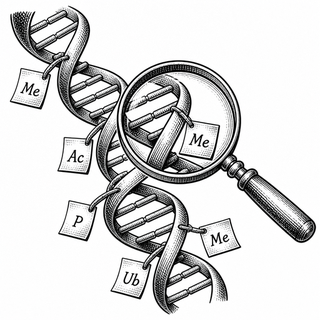
The trick is that DNA fragments do not just say what letters they contain. They also carry chemical markings, especially DNA methylation, that help reveal which genes were dialed up, muted, or awkwardly managed by middle management. Methylation is not a mutation. It is more like a sticky note on the genome saying, "maybe don't read this part right now."
Sebastian Michels and colleagues asked whether those sticky notes in blood-borne cfDNA could distinguish people with ALS from controls. They studied 20 people with sporadic ALS, 10 with C9orf72-associated ALS, 10 asymptomatic C9orf72 repeat expansion carriers, and 21 controls. Then they used targeted enzymatic methyl-sequencing across about 4 million CpG sites, which is auditing the genome with a very intense spreadsheet [1].
ALS Needs Better Market Signals
ALS attacks motor neurons, the cells that let the brain send movement orders to muscles. When that system fails, the body loses voluntary movement, speech, swallowing, and eventually breathing. ALS can be hard to diagnose early because symptoms overlap with other neurological and muscular conditions. The market is noisy. The ticker is glitchy. The analyst report arrives late.
Current biomarkers help, especially neurofilament proteins, which rise when axons are damaged. Think of neurofilament as sawdust on the factory floor: evidence that something structural is breaking, but not always specific about which machine started the mess. Recent reviews argue that blood and CSF biomarkers could speed diagnosis, stratify patients, and make clinical trials less like expensive guessing games [2,3].
The Signal Was Not Subtle
The team found differentially methylated genes in ALS, including genes already implicated in ALS risk and disease biology. Then they combined several epigenetic features into a multimodal signature, not just one lonely genomic address waving for attention. Their classifier reached an average area under the curve of 0.91, and at a false-positive rate of 0%, it detected about 70% of ALS cases [1].
Translation: in this dataset, the test was conservative. When it called ALS, it was rarely crying wolf. But it missed some true cases. In finance terms, this is a portfolio built to avoid bad bets, even if that means leaving some money on the table.
The authors also found methylation patterns that correlated with disease progression and CSF neurofilament levels [1]. That matters because ALS is not one tidy disease track. Some people decline rapidly, others more slowly. A biomarker that estimates the slope of the curve could change trial design, treatment timing, and the tone of some very hard conversations.
The C9orf72 Angle
C9orf72 repeat expansions are one of the best-known genetic causes of ALS and frontotemporal dementia. The researchers included people with C9orf72-associated ALS and asymptomatic carriers, which asks whether the signal tracks disease, genetic risk, or some awkward mix of both. Genetics gives the market exposure, but epigenetics may show whether the portfolio is merely volatile or actively on fire.
Why This Is Promising, With the Usual Lab-Coat Seatbelt
This study fits into a broader push toward blood-based ALS biomarkers. Other recent work has reported ALS-associated cfDNA methylation signatures [4], tissue-informative profiles linked to ALS status and progression [5], and strong evidence that serum neurofilament can help with prognosis in population-based cohorts [6].
The caveats are real. The cohort was small. The samples came from stored serum, not fresh plasma. ALS is heterogeneous, because apparently the nervous system saw simplicity and shorted it. Any clinical test needs validation across centers, ancestries, disease stages, ALS mimics, medications, and sample-handling conditions.
Still, the direction is compelling. A blood test that combines cfDNA epigenetics with neurofilament, genetics, clinical exams, and maybe imaging could become a diversified biomarker index. No single stock carries the whole portfolio. The goal is not one heroic molecule wearing a cape. The goal is a smarter dashboard.
If reproducible, cfDNA methylation could help clinicians spot ALS earlier, estimate progression risk, and match patients to trials before the best therapeutic window has packed up and left. That would not make ALS easy. But it could make the information economy around ALS less chaotic, and time is the most expensive currency.
References
- Michels S, Chen C, Ruf WP, et al. Multimodal analysis of cell-free DNA identifies epigenetic biomarkers for amyotrophic lateral sclerosis diagnosis and progression. J Clin Invest. DOI: 10.1172/JCI191508
- McMackin R, Bede P, Ingre C, Malaspina A, Hardiman O. Biomarkers in amyotrophic lateral sclerosis: current status and future prospects. Nat Rev Neurol. 2023;19:754-768. DOI: 10.1038/s41582-023-00891-2
- Anjum FAF, Bakhuraysah M, Alsharif A, Mohammad T, Shamsi A, Hassan MI. Emerging biomarkers in amyotrophic lateral sclerosis: from pathogenesis to clinical applications. Front Mol Biosci. 2025. DOI: 10.3389/fmolb.2025.1608853
- Jin Y, Conneely KN, Ma W, et al. Whole-genome bisulfite sequencing of cell-free DNA unveils age-dependent and ALS-associated methylation alterations. Cell Biosci. 2025;15:26. DOI: 10.1186/s13578-025-01366-1
- Caggiano C, et al. Epigenetic profiles of tissue informative CpGs inform ALS disease status and progression. Genome Med. 2025;17:115. DOI: 10.1186/s13073-025-01542-5
- Witzel S, et al. Population-based evidence for the use of serum neurofilaments as individual diagnostic and prognostic biomarkers in amyotrophic lateral sclerosis. Ann Neurol. 2024;96:1040-1057. DOI: 10.1002/ana.27054
- Hernan-Godoy M, Rouaux C. From environment to gene expression: epigenetic methylations and one-carbon metabolism in amyotrophic lateral sclerosis. Cells. 2024;13:967. DOI: 10.3390/cells13110967. PMCID: PMC11171807
Disclaimer: The image accompanying this article is for illustrative purposes only and does not depict actual experimental results, data, or biological mechanisms.