
Brain stimulation is suddenly in the news like it unlocked a shiny new tech tree: at-home stimulation devices for depression are rolling toward the market, clinics keep expanding TMS, and now a 2026 Nature Communications study asks a very specific question - what if a magnetic pulse aimed near the brain's decision-and-value circuitry could help schizophrenia symptoms by reorganizing the brain's team chat?
That team chat matters. Schizophrenia is not simply "seeing things" or "hearing voices," though hallucinations and delusions are part of the positive-symptom package. It also often brings attention problems, slower thinking, and cognitive fatigue, which is rude because life already ships with enough difficulty settings. Medications can help many positive symptoms, but cognition often stays stubborn. The boss fight continues after the cutscene.
The Brain Has Guilds
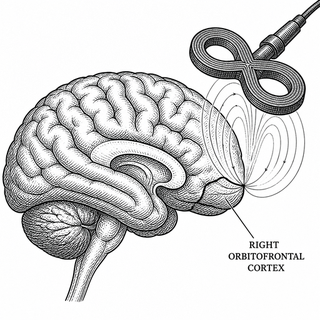
The new paper by Zeng and colleagues focused on the orbitofrontal cortex, or OFC. It sits behind your eyes and helps with value, expectations, emotion, and decision-making. Think of it as the brain's loot evaluator: "Is this reward worth chasing? Is this signal meaningful? Why did I just trust a gas-station sushi burrito?" The OFC is not doing that alone, of course. Brain regions work in networks, and networks can split into modules - semi-independent guilds that handle different jobs.
One important guild is the default mode network, or DMN. It tends to light up when your mind turns inward: remembering, imagining, narrating your life like a documentary nobody commissioned. In schizophrenia, DMN communication can get weirdly sticky or mistimed, especially around internally generated experiences and attention. If the DMN is too bossy, the attention network may struggle to keep the camera pointed at the outside world.
Magnetic Pulses, Not Mind Lasers
The researchers used repetitive transcranial magnetic stimulation, or rTMS. This is noninvasive: a coil sits near the scalp and uses changing magnetic fields to influence electrical activity in the brain. It is not a Professor X helmet. Nobody is uploading calculus. Mostly, the machine goes click-click-click while neuroscientists try to convince very complicated tissue to stop playing jazz in seven time signatures.
In this randomized, double-blind, sham-controlled trial, participants with drug-naive schizophrenia received four weeks of low-frequency rTMS targeting the right OFC, or a sham version. The trial had already met its main clinical endpoint. This paper dug into secondary neuroimaging outcomes using fMRI, asking what changed inside the network machinery.
The answer: after active stimulation, the OFC and DMN became more dynamically modular across time. Translation: the brain's networks seemed better able to form cleaner working groups instead of behaving like one chaotic Discord server where the memory channel, attention channel, and existential dread channel all talk over each other.
The DMN Gets Nerfed
The coolest part is not just "symptoms improved." The paper linked those improvements to a specific network pattern. Stronger OFC-DMN modularization tracked with better positive symptoms and cognitive performance, especially attention and vigilance. The effect centered on DMN regions around the ventromedial prefrontal cortex, another front-of-brain area involved in value, self-related thought, and emotion.
The authors also found that this spatial pattern lined up with schizophrenia-related gene expression and markers of excitatory neurotransmission. That does not mean a gene got "fixed," because biology is not a broken save file. It means the stimulation-related map overlapped with molecular clues already relevant to schizophrenia, which makes the network result feel less like a random fMRI cloud and more like a plausible biological route.
Then comes the game-balance patch: exploratory analyses suggested OFC-induced modularity weakened the DMN's causal influence over downstream attention networks. In normal-person language, the inward-looking network may have stopped grabbing the controller quite so often. For someone dealing with hallucinations, delusions, or attention lapses, that could matter.
Why This Is Interesting
The study points toward a future where schizophrenia treatment is not only "which medication reduces which symptom," but "which circuit is misbehaving in this person, and can we tune it?" That is a big idea. It could help explain why some people respond to rTMS and others do not. It could also push the field toward personalized targeting using brain scans, symptoms, and maybe molecular profiles.
But the hype meter needs a seatbelt. The imaging results were secondary outcomes. The sample and protocol need replication across larger, independent, multi-site trials. rTMS is generally considered well tolerated in schizophrenia, but "safe enough to study seriously" is not the same thing as "ready for everyone on Monday." Also, schizophrenia is not one enemy type. It is a whole dungeon ecosystem with positive symptoms, negative symptoms, cognitive symptoms, medication history, stress, sleep, substance use, and social context all spawning in the same room. Great design, terrible user experience.
Still, this study adds something useful: a mechanism-shaped clue. If low-frequency OFC stimulation can help some patients by making brain networks more modular and less DMN-dominated, clinicians may eventually get a better map for matching treatments to people. Not a magic wand. More like finally getting the minimap after wandering the cave for decades.
References
- Zeng N, Wang M, Zheng H, et al. OFC-induced network modularity improves positive symptoms and attentional alertness in schizophrenia: a combined rTMS-fMRI study. Nature Communications. 2026. https://doi.org/10.1038/s41467-026-72917-4
- Blyth SH, Cruz Bosch C, Raffoul JJ, et al. Safety of rTMS for Schizophrenia: A Systematic Review and Meta-analysis. Schizophrenia Bulletin. 2025;51(2):392-400. https://doi.org/10.1093/schbul/sbae158
- Lorentzen R, Nguyen TD, McGirr A, Hieronymus F, Ostergaard SD. The efficacy of transcranial magnetic stimulation (TMS) for negative symptoms in schizophrenia: a systematic review and meta-analysis. Schizophrenia. 2022;8:35. https://doi.org/10.1038/s41537-022-00248-6
- Sinanaj L, Pallis K, Fazel Dehkordi A, et al. Mapping symptom-general and symptom-specific targets for transcranial magnetic stimulation in schizophrenia: an electric-field modeling meta-analysis. Molecular Psychiatry. 2026;31:1265-1275. https://doi.org/10.1038/s41380-025-03238-z
- Hu Q, Jiao X, Ding Y, et al. The effects of rTMS over orbitofrontal cortex on cognitive functions in first-episode schizophrenia. Psychological Medicine. 2026;56. https://doi.org/10.1017/S0033291726103912
Disclaimer: The image accompanying this article is for illustrative purposes only and does not depict actual experimental results, data, or biological mechanisms.