
The myth is that brain aging is one slow downhill slide, like a retirement account invested entirely in bad decisions. This paper says no: the brain's communication cables do not all mature, peak, or decline together. Some routes hit stride early, some improve into adulthood, and some charge maintenance fees later. The brain chose derivatives.
White Matter Is the Back Office
Most brain talk worships gray matter, the outer layer packed with neuron cell bodies. Very glamorous. Very "I have a podcast." But white matter is the wiring underneath: myelinated axons that help brain regions send signals quickly.
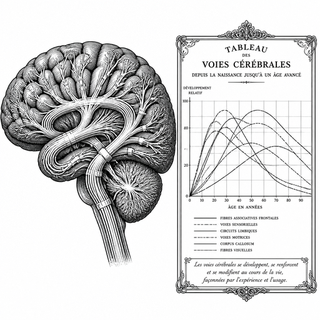
The new work summarized in Nature focuses on white matter growth charts. Kim and colleagues pooled diffusion MRI data from 35,120 people across 50 studies, covering ages 0 to 100, then modeled 72 white-matter pathways using age- and sex-aware centile charts. It is a pediatric height chart, except instead of "your kid is tall," it asks, "is this neural highway delayed or aging ahead of schedule?" Less cute on a fridge.
MRI, But Make It About Water
Diffusion MRI works because water molecules move differently depending on the tissue around them. In organized white matter, water moves along axon bundles more easily than across them. Scientists use that movement to estimate tract organization, volume, length, and shape.
That sounds like spreadsheet sorcery, and honestly, some is involved. But the economic idea is simple: the brain balances speed, energy cost, flexibility, and repair. Myelin helps signals travel efficiently, but wiring is not free. Evolution built a budget committee with electricity.
Different white-matter features followed different life curves. Overall white-matter volume peaked around age 34. Fractional anisotropy, a rough marker of directional organization, peaked around age 24. Other measures bottomed out later, from the early thirties into the mid-forties. Translation: "mature" is not one date. The brain has multiple vesting schedules.
The Point Is Not Diagnosis, Yet
The tempting move is to say: scan someone, check the chart, diagnose the problem. Slow down, Captain Overfit. The authors caution that these charts are not ready for individual diagnosis. MRI data vary by scanner, protocol, population, and pipeline. A centile score is a clue, not a verdict.
As a research tool, though, this matters. Brain imaging had a comparison problem. A scan could show a measurement, but without a reference market, nobody knew whether it was normal volatility or a crash. Normative charts let researchers ask whether white-matter patterns in Alzheimer's disease, developmental disorders, psychiatric illness, or cognitive impairment fall outside age-expected ranges.
A pathway can be healthy at one age and suspicious at another. Calling every deviation "abnormal" without age context is like judging a startup, a mid-career worker, and a retiree by the same cash-flow model. Please do not do that.
Why This Feels Bigger Than One Paper
This study fits into a fast-moving brain-chart ecosystem. A 2022 Nature paper built broad lifespan charts from more than 100,000 MRI scans, showing that brain measurements could be benchmarked like height or weight. Recent work in Scientific Data and Nature Communications has focused on white matter. Together, these studies are turning blobs into accounting.
The clinical upside, if the work keeps reproducing, is not a magic scan. The upside is better risk stratification, trial design, and tracking. If a treatment aims to slow degeneration, researchers could ask whether white matter is drifting less far from the expected curve. If a child has developmental concerns, scientists could study whether pathways are delayed, accelerated, or simply different.
That is the practical magic here: not mind reading, not sci-fi diagnosis, just a better price index for the brain's infrastructure. Nobody appreciates the network until traffic stops.
The Catch
The charts still need validation. MRI datasets overrepresent certain countries, hospitals, scanners, and populations. Diffusion MRI also infers white-matter structure indirectly, so crossing fibers and technical noise can muddy the signal.
Still, the core idea is elegant: compare each brain to what is typical for its age and sex, then look for meaningful departures. The brain is not just aging. It is reallocating assets, closing roads, reinforcing others, and occasionally behaving like a planning board that lost the map in 1997. These charts give researchers a better ledger.
Disclaimer: The image accompanying this article is for illustrative purposes only and does not depict actual experimental results, data, or biological mechanisms.
References
- Kim, M. E. et al. White matter micro- and macrostructure brain charts for the human lifespan. Nature (2026). https://doi.org/10.1038/s41586-026-10454-2
- Growth charts reveal how the brain's 'communication highways' change throughout life. Nature (2026). https://doi.org/10.1038/d41586-026-01318-w
- Bethlehem, R. A. I. et al. Brain charts for the human lifespan. Nature 604, 525-533 (2022). https://doi.org/10.1038/s41586-022-04554-y
- Zhu, A. H. et al. Lifespan reference curves for harmonizing multi-site regional brain white matter metrics from diffusion MRI. Scientific Data 12, 748 (2025). https://doi.org/10.1038/s41597-025-05028-2
- Villalon-Reina, J. E. et al. Lifespan normative modeling of brain microstructure. Nature Communications 17, 4693 (2026). https://doi.org/10.1038/s41467-026-72875-x