
Can your brain get hungry for a meal you have not missed yet? Annoyingly, yes. The new paper in Neuron suggests that, in mice, the brain can flip on a hunger circuit when it predicts future fasting, which is both elegant and deeply on-brand for an organ that likes to panic early and call it planning.
The Hunger Department Has a Forecasting Team
The stars here are AgRP neurons, a small population of cells in the arcuate nucleus of the hypothalamus. They are famous for making animals seek and eat food. When energy runs low, AgRP neurons get active. The usual story is simple: low fuel comes first, hunger signal comes second, sandwich comes third.
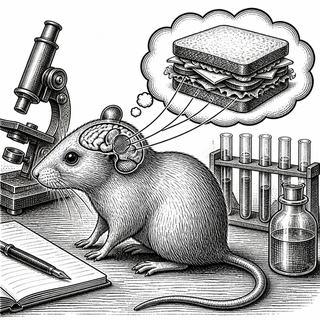
Simple stories are suspicious. Neuroscience sees a tidy model and immediately rearranges the furniture.
We already knew AgRP neurons respond fast to food cues. If a hungry mouse sees or smells food, these neurons can quiet down before calories hit the bloodstream. That makes sense. The brain is not waiting for a stomach receipt. It is making a prediction.
Walker and colleagues asked the mirror-image question: if predicted eating can shut hunger neurons down, can predicted fasting turn them up?
In mice, the answer was yes.
Not Empty Yet. Already Complaining.
The researchers trained mice with environmental context cues that predicted whether food would be available or withheld. Then they watched AgRP neurons. When a cue predicted future fasting, AgRP neurons rapidly activated.
That matters because the mice were not simply responding to a depleted body. The circuit was reacting to information: context, memory, expectation. The tiny internal weather app had seen tomorrow's forecast and started hoarding snacks.
The team traced this effect to neurons in the paraventricular hypothalamus, or PVH, that express the gene Sim2. These PVH^Sim2 neurons sent excitatory input to AgRP neurons. In plain English: one hypothalamic group nudged the hunger neurons awake when the animal had reason to expect an energy shortage.
The PVH^Sim2 cells worked in both directions. They responded to predictions of future energy state, not just current calorie math. When these neurons were chronically silenced, mice ate less over time. That persistent hypophagia suggests the circuit is not decorative wiring. It helps keep animals from drifting into negative energy balance.
The hypothalamus, almond-sized in humans, has always been a control freak. Temperature, hormones, thirst, feeding, stress: it wants a clipboard for all of it. This study adds another job title: metabolic forecaster.
Why This Is More Than Mouse Trivia
No, this does not mean your 3 p.m. vending machine stare is caused by PVH^Sim2 neurons preparing for winter. These are mouse experiments, using tools we do not casually deploy in humans, because ethics committees enjoy sleeping at night.
But the principle is big.
Hunger is not just a fuel gauge. It is a prediction system. Your brain blends body signals with context: time of day, food availability, smells, routines, stress, memory, and probably the cursed glow of a delivery app icon.
That helps explain why appetite can feel so weirdly preemptive. You may feel hungry before a normal mealtime even if your energy stores are not in crisis. Animals need that. Waiting until the tank is empty is a terrible survival strategy.
The Clinical Shadow
This work sits inside a larger push to understand brain circuits behind obesity, weight loss, hypophagia, and hyperphagia. Recent studies have identified hypothalamic BNC2 neurons that respond to leptin and suppress eating, mapped the push-pull between AgRP and POMC neurons, and reviewed how hypothalamic injury can produce severe obesity. Appetite is not one knob. It is a mixing board, and several sliders are sticky.
That is why this circuit is interesting. If future work finds similar forecasting logic in humans, it could sharpen how we think about appetite disorders. Some people may struggle not because they lack willpower, a phrase that should be retired into a volcano, but because their prediction circuits assign threat value to future food scarcity, disrupted routines, or metabolic uncertainty.
The therapeutic fantasy is not "turn off hunger." Hunger keeps you alive. The smarter goal is to learn which circuit does what, when, and in whom. GLP-1 drugs already show that changing appetite biology can change lives, but they also remind us that hunger is tied to reward, mood, and learning. Tug one wire and the chandelier may flicker.
The Takeaway
This paper makes hunger look less like a complaint from the stomach and more like a memo from the future. In mice, PVH^Sim2 neurons can tell AgRP hunger neurons that fasting is coming, and AgRP neurons respond before the body is actually depleted.
The brain, as usual, is not merely reacting. It is guessing. Sometimes brilliantly. Sometimes like a drama student with a glucose meter.
References
- Walker SJ, Lowenstein ED, Douglass AM, et al. A hypothalamic circuit for anticipating future changes in energy balance. Neuron. 2026. PMID: 42235510. DOI: 10.1016/j.neuron.2026.05.010
- Deem JD, Faber CL, Morton GJ. AgRP neurons: regulators of feeding, energy expenditure, and behavior. FEBS Journal. 2022;289(8):2362-2381. PMCID: PMC9040143. DOI: 10.1111/febs.16176
- Berrios J, Li C, Madara JC, et al. Food cue regulation of AGRP hunger neurons guides learning. Nature. 2021;595:695-700. DOI: 10.1038/s41586-021-03729-3
- De Solis AJ, Del Rio-Martin A, Radermacher J, et al. Reciprocal activity of AgRP and POMC neurons governs coordinated control of feeding and metabolism. Nature Metabolism. 2024;6:473-493. PMCID: PMC10963273. DOI: 10.1038/s42255-024-00987-z
- Tan HL, Yin L, Tan Y, et al. Leptin-activated hypothalamic BNC2 neurons acutely suppress food intake. Nature. 2024;636:198-205. PMCID: PMC11618066. DOI: 10.1038/s41586-024-08108-2
- Argente J, Farooqi IS, Chowen JA, et al. Hypothalamic obesity: from basic mechanisms to clinical perspectives. The Lancet Diabetes & Endocrinology. 2025;13(1):57-68. DOI: 10.1016/S2213-8587(24)00283-3
Disclaimer: The image accompanying this article is for illustrative purposes only and does not depict actual experimental results, data, or biological mechanisms.