
On a long June evening, when the light hangs around like it missed the last train home, your body takes orders from clocks you never agreed to own. Hormones rise, immune cells shift patrol routes, nerves hum their small electrical psalms. As Ecclesiastes muttered before neuroscience got a grant budget: there is a time for everything. Cancer, worst sort of opportunist, seems to have read the memo.
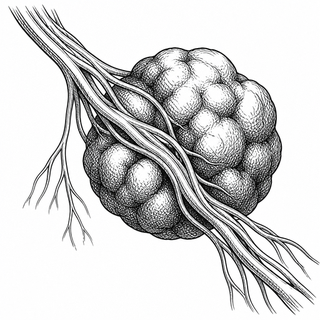
The new Gut commentary by Maria Backhaus, Lorenzo Mainardi, Chiara Raggi, and Kai Markus Schneider asks a sharp question about cholangiocarcinoma: what if the nervous system is not scenery around the tumor, but part of the plot? Their focus runs from perineural invasion to neuroimmune control [1].
The Bile Ducts Were Already Having a Hard Week
Cholangiocarcinoma forms in the bile ducts, the plumbing that carries bile toward the small intestine. It is rare in the way a trapdoor is rare: you do not think about it until the floor vanishes. The American Cancer Society estimates about 8,000 U.S. diagnoses each year, likely an undercount [2].
Surgery can cure some localized cases. For advanced disease, doctors use chemotherapy, immunotherapy, and targeted drugs when tumors carry molecular handles such as FGFR2 or IDH1 changes [3,4]. Still, many cases show up late, like an uninvited guest who ate the cheese and rearranged the furniture.
When Tumors Follow the Wiring
Perineural invasion, or PNI, means cancer cells move into or around nerves. That sounds like a horror-film subplot because biology has no taste. In cholangiocarcinoma, PNI has been linked to recurrence and poor outcomes. A 2026 meta-analysis concluded that PNI predicts worse survival across cholangiocarcinoma locations [5].
For years, people treated nerves near tumors as bystanders. Useful landmarks. Innocent cables. Cancer neuroscience has been busy ruining that innocence. A Nature review by Mancusi and Monje describes how nerves can influence cancer growth, spread, inflammation, and immune evasion, while tumors remodel nervous tissue in return [6].
Schwann Cells: Helpful in Nerves, Suspicious Near Tumors
Schwann cells normally support peripheral nerves. They wrap axons, help repair damage, and behave like competent backstage crew. Near cholangiocarcinoma, they may become accomplices without filing the paperwork.
In 2024, Qian and colleagues reported that Schwann cells can promote cholangiocarcinoma perineural invasion through nerve growth factor, or NGF [7]. Another study found that Schwann-cell signals pushed cholangiocarcinoma cells toward more aggressive traits through TGF-beta signaling [8].
Translated from molecule-speak: tumor cells and nerve-support cells may trade messages that help cancer move, survive, and creep along nerve-rich terrain. The vibe is "neuronal text messages, but all the emojis are knives."
The Immune System Enters, Slightly Out of Breath
The newer twist is that nerves may also shape the immune neighborhood. A 2026 spatial atlas of distal cholangiocarcinoma mapped perineural invasion and found PNI-high tumors enriched for Schwann cells, macrophages, fibroblasts, dendritic cells, and B/plasma cells, with fewer exhausted CD8 T cells nearby [9].
That matters because tumors do not live as lonely lumps. They live in ecosystems. Cancer cells, nerves, immune cells, blood vessels, and fibroblasts pass chemical notes under the desk. Some say "attack." Others say "stand down." Others say "please build scaffolding for this suspicious expansion project."
If researchers decode those notes, doctors might use nerve-related or neuroimmune markers to predict recurrence risk, plan surgical margins, or identify patients who need extra treatment. Therapies might target NGF, TGF-beta pathways, Schwann-cell interactions, or neuroimmune circuits that help tumors hide from immune attack.
Why This Is Intriguing, Beyond the Creepy Nerve Thing
The interesting part is not that cancer "has nerves" metaphorically. We knew that. Cancer has audacity, too, but sadly there is no FDA-approved audacity inhibitor.
This gives researchers another layer of tumor behavior to measure and maybe manipulate. Cholangiocarcinoma has entered the precision-medicine era through genomic testing and targeted therapy. Cancer neuroscience suggests the next questions may be spatial and social: Which nerves are nearby? Which immune cells are recruited or excluded? Who is whispering to whom?
The caveat, because science is a stern aunt with sensible shoes: this work needs validation in larger patient groups and treatment trials. Mechanisms seen in models do not automatically become therapies. Tissue-map biomarkers must prove they can change clinical decisions. The field has a lantern, not a treasure map.
Still, Backhaus and colleagues are pointing toward a richer view of cholangiocarcinoma: not just rogue bile duct cells, but a disease that may exploit wiring, repair cells, immune traffic, and local tissue architecture. A cancer, in other words, that does not merely grow. It listens.
That is why the nervous system belongs in the conversation. Preferably with better boundaries.
Disclaimer: The image accompanying this article is for illustrative purposes only and does not depict actual experimental results, data, or biological mechanisms.
References
- Backhaus M, Mainardi L, Raggi C, Schneider KM. Cancer neuroscience in cholangiocarcinoma: from perineural invasion to neuroimmune control. Gut. 2026 Jun 17. doi: 10.1136/gutjnl-2026-338969. PMID: 42309806.
- American Cancer Society. Statistics About Bile Duct Cancer. https://www.cancer.org/cancer/types/bile-duct-cancer/about/key-statistics.html.
- National Cancer Institute. Bile Duct Cancer Treatment. https://www.cancer.gov/types/liver/bile-duct-cancer/treatment.
- American Cancer Society. Targeted Drug Therapy for Bile Duct Cancer. https://www.cancer.org/cancer/types/bile-duct-cancer/treating/targeted-therapy.html.
- Conti S, Tissera NS, Castet F, et al. Perineural invasion is a prognostic factor in cholangiocarcinoma, regardless of anatomical location: A systematic review and meta-analysis. JHEP Rep. 2026;8(4):101770. doi: 10.1016/j.jhepr.2026.101770. PMCID: PMC13019560.
- Mancusi R, Monje M. The neuroscience of cancer. Nature. 2023;618(7965):467-479. doi: 10.1038/s41586-023-05968-y. PMCID: PMC11146751.
- Qian X, Liu E, Zhang C, et al. Promotion of perineural invasion of cholangiocarcinoma by Schwann cells via nerve growth factor. J Gastrointest Oncol. 2024;15(3):1198-1213. doi: 10.21037/jgo-24-309. PMCID: PMC11231841.
- de Franchis V, Petrungaro S, Pizzichini E, et al. Cholangiocarcinoma malignant traits are promoted by Schwann cells through TGFbeta signaling in a model of perineural invasion. Cells. 2024;13(5):366. doi: 10.3390/cells13050366. PMCID: PMC10930666.
- Ji F, Chen H, Li H, et al. A subcellular spatial atlas illuminates the microenvironmental remodeling of perineural invasion in distal cholangiocarcinoma. J Hematol Oncol. 2026;19(1):6. doi: 10.1186/s13045-025-01773-4. PMCID: PMC12784525.