
The problem with studying cancer neuroscience is that a tumor refuses to behave like a lonely lump of bad cells. It recruits nerves, borrows their chemical language, edits the local immune response, and may even plug into neural circuits. Apparently, uncontrolled growth was not enough. Cancer also wanted Wi-Fi.
The Hostile Takeover Has Actual Hosts
Your nervous system normally coordinates sensation, movement, stress, digestion, and the thousand other jobs you ignore until one stops working. It communicates through electrical impulses and chemical messengers such as norepinephrine, serotonin, glutamate, neuropeptides, and growth factors.
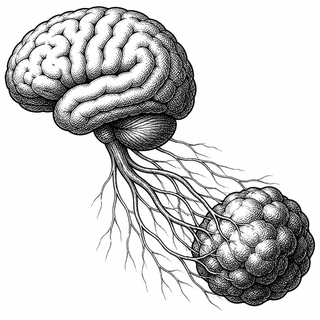
Tumors can exploit that network. Some release molecules that attract new nerve fibers. Those nerves can then deliver signals that support tumor growth, blood-vessel formation, invasion, immune suppression, or treatment resistance. In brain cancers such as glioma, the relationship gets especially intimate: neurons can form working synapses with malignant cells. The tumor is not merely listening through the wall. It has joined the group chat.
This broader field is called cancer neuroscience. A major 2023 review mapped direct synapses, local chemical signaling, whole-body stress pathways, and three-way conversations among nerves, cancer cells, and immune cells (Winkler et al., 2023). Another study showed that glioma cells can strengthen neuron-to-tumor synapses using machinery that healthy brains use for learning and plasticity (Taylor et al., 2023). Cancer, it seems, has studied the syllabus.
Old Pills, New Assignment
Jin and colleagues call this exploitation a neural hijack. Their new review asks a practical question: could drugs already used in neurology, psychiatry, cardiology, or supportive cancer care cut the relevant wires?
The candidates include:
- Beta-blockers, which blunt adrenaline-related signaling. Propranolol, for example, may interfere with pathways linking stress signals to inflammation, blood vessels, and metastasis.
- CGRP antagonists, designed around a neuropeptide best known for migraine, which may also affect tumor-nerve-immune communication.
- NK1 receptor antagonists, including aprepitant, already used to prevent chemotherapy nausea. They block substance P signaling, a pathway implicated in pain, inflammation, and cancer-cell behavior.
- SSRIs, which alter serotonin signaling and may have anticancer effects beyond their day job in depression.
- Anti-seizure drugs, some of which can dampen the electrical or synaptic activity that certain tumors exploit.
Repurposing is appealing because these drugs come with manufacturing methods, dosing experience, and safety records. That can shorten early development. It does not make them proven cancer treatments. A familiar pill can still fail at a new job interview.
That caution matters. A 2025 systematic review found suggestive evidence for propranolol, especially around surgery, but mixed and inconclusive results alongside chemotherapy or radiotherapy (O'Logbon et al., 2025). The correct question is not, “Do beta-blockers cure cancer?” It is, “Which drug, for which neural pathway, in which tumor, at what dose and time?” Oncology enjoys turning one question into five. It keeps everyone employed.
A Wiring Diagram for Each Tumor
The review's sharpest proposal is a neural signature. Instead of treating every tumor as neurologically identical, researchers could combine three kinds of evidence: nerve-fiber density, the receptors expressed by cancer cells, and the local neuro-immune environment.
That profile could identify patients whose tumors genuinely depend on a particular neural signal. It could also spare everyone else an ineffective drug and its side effects. Earlier work found that dense tumor innervation often tracks with aggressive disease, while also warning that nerve effects vary by tissue and nerve type (Gysler and Drapkin, 2021). The wiring diagram matters. Cutting the doorbell wire will not help if the burglar entered through the window.
Disconnect, Then Prove It
If this strategy holds up, “neural disconnection” could become a companion to chemotherapy, immunotherapy, radiation, and targeted drugs. It might slow growth, reduce spread, restore immune activity, ease cancer pain, or make resistant tumors vulnerable again.
But first come prospective trials, validated biomarkers, tumor-specific dosing, and careful monitoring. Researchers must separate a drug's neural effects from its unrelated actions and avoid disrupting nervous-system functions patients need. Evidence from mice, cells, retrospective records, and small trials cannot settle those questions.
The concept is still powerful. A tumor is an ecosystem, not a marble. If nerves help keep that ecosystem hostile, treatment may not need to destroy every wire. It may only need to hang up the right call.
References
- Jin M-Z, Dang H-R, Jin W-L. Disarming the “Neural Hijack”: Repurposing neuroactive drugs for cancer therapy. Pharmacology & Therapeutics. 2026;109051. doi:10.1016/j.pharmthera.2026.109051
- Winkler F, Venkatesh HS, Amit M, et al. Cancer neuroscience: State of the field, emerging directions. Cell. 2023;186(8):1689-1707. doi:10.1016/j.cell.2023.02.002; PMCID: PMC10107403
- Taylor KR, Barron T, Hui A, et al. Glioma synapses recruit mechanisms of adaptive plasticity. Nature. 2023;623(7986):366-374. doi:10.1038/s41586-023-06678-1
- O'Logbon J, Tarantola L, Williams NR, et al. Does propranolol have a role in cancer treatment? A systematic review of the epidemiological and clinical trial literature on beta-blockers. Journal of Cancer Research and Clinical Oncology. 2025;151:212. doi:10.1007/s00432-025-06262-2; PMCID: PMC12255574
- Gysler SM, Drapkin R. Tumor innervation: peripheral nerves take control of the tumor microenvironment. Journal of Clinical Investigation. 2021;131(11):e147276. doi:10.1172/JCI147276; PMCID: PMC8159682
Disclaimer: The image accompanying this article is for illustrative purposes only and does not depict actual experimental results, data, or biological mechanisms.