The clues were odd. A major life event happens, the hormones flare like a brass section hitting the chorus, behavior shifts, circuits retune themselves - and then, long after the obvious commotion dies down, something still lingers backstage. The suspects? Genes, brain cells, maybe the molecular equivalent of old receipts stuffed in a coat pocket. The big reveal, according to a new Nature article by Frances A. Champagne, is that motherhood may leave durable molecular "memories" in the brain - not just emotional ones, but changes in how genes are regulated and expressed over time.1
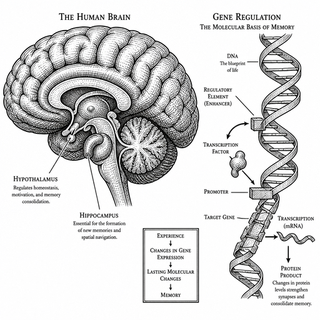
That idea sounds almost suspiciously poetic for molecular neuroscience. But the biology is real, and it is deliciously weird.
Motherhood Is Not Just a Mood Swing With Better PR
Pregnancy and parenting reshape the brain. That part is not exactly breaking news. Researchers have been tracking changes in hormone signaling, neural plasticity, stress responses, and social behavior for years. What makes this article interesting is the emphasis on long-lasting molecular memory - the possibility that becoming a mother leaves behind durable marks in brain tissue that outlast the immediate demands of caring for offspring.1
In plain English: the brain may not simply "bounce back" after motherhood like nothing happened. It may keep a molecular record.
That record likely involves epigenetics, which is the extremely unglamorous name for a very dramatic system. Epigenetic mechanisms help decide which genes get turned up, turned down, or left muttering in the corner. They do not usually change the DNA sequence itself. They change how the genome gets used - like stage lighting changing the whole feel of a concert without swapping out the instruments.
Researchers have increasingly linked maternal experience to changes in gene expression in brain regions involved in caregiving, motivation, stress, and memory.23 That matters because motherhood is one of the most profound natural transitions the adult brain undergoes. It is less "tiny lifestyle tweak" and more "full band changes key mid-song and somehow keeps the groove."
The Brain Keeps the Set List
One of the big ideas here is that maternal experience might leave behind molecular signatures that shape future behavior and brain function. In animal studies, motherhood has been associated with lasting changes in regions such as the hypothalamus, medial preoptic area, hippocampus, and nucleus accumbens - neighborhoods of the brain that handle everything from motivation to memory to the fine art of not ignoring a screaming baby.24
These changes are not just about parenting behavior in the moment. They may alter how the brain responds to stress, social cues, and future reproductive experiences. Some studies suggest that prior maternal experience can affect later cognition and emotional regulation, though the picture is complex and depends on species, timing, and context.45
This is where transcriptomics enters the chat. Transcriptomics looks at which RNA messages cells are making, giving scientists a snapshot of what genes are active. Combine that with epigenetics, and you get a way to ask: what if motherhood leaves not just a memory in the psychological sense, but a durable biological annotation in the brain's operating manual?
Honestly, your neurons are starting to sound like they keep a scrapbook.
Why This Matters Outside a Mouse Nursery
If these long-lasting molecular traces hold up across studies, they could help explain why reproductive history influences brain health, stress biology, and vulnerability to psychiatric symptoms. Pregnancy and the postpartum period are times of major mental health risk for some people, including postpartum depression and anxiety. Understanding how maternal experience rewires gene regulation could eventually sharpen prevention or treatment strategies.6
It could also complicate the old fantasy that the adult brain is a neat, stable machine. It is not. It is more like a jazz ensemble improvising while someone keeps changing the room acoustics.
There is also a broader point here: female biology has often been under-studied or treated as a side quest in neuroscience. Research on maternal brain plasticity pushes back on that. It asks serious mechanistic questions about how major life transitions shape neural function over the long term, instead of pretending the default brain comes in one very boring, non-pregnant edition.
A Few Cautions Before We Start Writing Hallmark Cards for Chromatin
The idea is exciting, but there are limits. First, this Nature piece is a commentary-style article, not a single massive experimental paper unveiling one clean answer.1 It points to an emerging body of work rather than closing the case.
Second, much of the strongest mechanistic evidence comes from animal models. Mice are useful, but they are not tiny suburban moms with calendars and pelvic floor physical therapy appointments. Human brains are more complicated, human lives are messier, and social context matters enormously.
Third, "molecular memory" does not mean destiny. A lasting biological mark is not the same thing as a fixed outcome. Brains remain plastic. Experience still matters. Biology is powerful, but it is not a prophecy machine wearing a lab coat.
The Lovely, Unsettling Takeaway
The most interesting part of this story is not that motherhood changes the brain. We already suspected that. It is that the change may persist in a molecular form, tucked into patterns of gene regulation like a melody that keeps echoing after the band has packed up.
That is a striking idea: one of life's most intense transitions may leave behind a biological aftersound - subtle, durable, and still shaping the performance long after the obvious crescendo ends.
And really, would we expect the brain to treat motherhood like a casual calendar appointment? Please. This is the most dramatic organ in the body. Of course it keeps receipts.
References
Disclaimer: The image accompanying this article is for illustrative purposes only and does not depict actual experimental results, data, or biological mechanisms.
-
Champagne FA. Becoming a mother leaves long-lasting molecular memories. Nature. 2026. doi:10.1038/d41586-026-01327-9 ↩↩↩
-
Stolzenberg DS, Champagne FA. Hormonal and non-hormonal bases of maternal behavior: the role of experience and epigenetic mechanisms. Horm Behav. 2021;131:104991. doi:10.1016/j.yhbeh.2021.104991 ↩↩
-
Kohl J, Dulac C. Neural control of parental behaviors. Curr Opin Neurobiol. 2023;80:102729. doi:10.1016/j.conb.2023.102729 ↩
-
Hillerer KM, Jacobs VR, Fischer T, Aigner L. The maternal brain: an organ with peripartal plasticity. Neural Plast. 2014;2014:574159. PMCID:PMC4103038 ↩↩
-
Barha CK, Galea LAM. Motherhood alters the cellular response to estrogens in the hippocampus later in life. Neurobiol Aging. 2022;109:1-12. doi:10.1016/j.neurobiolaging.2021.09.012 ↩
-
Payne JL, Maguire J. Pathophysiological mechanisms implicated in postpartum depression. Front Neuroendocrinol. 2019;52:165-180. doi:10.1016/j.yfrne.2018.12.001 ↩