
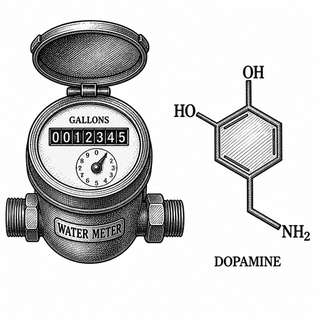
Think about the water meter bolted to the side of a house. It does not care what the water is for - showering, dishes, an ill-advised 2 a.m. attempt at homemade pasta - it just counts molecules of H2O sliding past and turns them into a number. Now imagine a meter so sensitive it could detect a single drop of dye dissolved into an Olympic swimming pool, in real time, while ignoring every other thing floating in the water. That is roughly the trick a team at King Abdullah University of Science and Technology just pulled off, except the "water" is blood and the "dye" is dopamine, the brain's most famous chemical messenger.
A Molecule With a Long Rap Sheet
Dopamine has been quietly running your motivation, movement, and mood since long before anyone could measure it. It was first identified as a neurotransmitter in the late 1950s by Arvid Carlsson, who later won a Nobel Prize for the insight that this molecule was not just a precursor to other chemicals but a messenger in its own right - a discovery that felt, at the time, a bit like learning the office intern had secretly been running the company. When dopamine-producing neurons die off, you get Parkinson's disease. When dopamine signaling drifts in other directions, you find fingerprints of depression, schizophrenia, ADHD, and Alzheimer's. The catch is that the meaningful changes happen at concentrations so tiny they make a needle in a haystack look like a billboard.
The Problem With Counting Something This Small
Here is the headache. Healthy baseline dopamine in the brain hovers around 5 to 20 nanomolar, and the diagnostically interesting shifts happen even lower (Latif et al., 2021). Traditional electrochemical sensors - the gold standard for decades - are genuinely good, but they have two stubborn problems. First, they often need chemical helpers, labels, or special electrolyte "additives" to coax a signal out, which is fussy and not exactly bedside-friendly. Second, dopamine has noisy neighbors. Ascorbic acid (vitamin C) and uric acid sit right next to it chemically and tend to shout over its signal, like two loud relatives photobombing every family picture (Chauhan et al., 2024).
So the field has been stuck wanting three things that rarely come together: extreme sensitivity, real-time speed, and the ability to ignore interference - all in a package smaller than a lab bench.
The Camera That Learned Chemistry
The KAUST team's answer is delightfully sideways. Instead of building a better electrode, they built a better eye. They paired engineered light-scattering membranes with an "optical accelerator" - essentially a tiny computer that does math with light - and bolted the whole thing onto a commercial vision camera (Li et al., 2026). Light bounces through a sample, the scattering pattern encodes what molecules are present, and a machine-learning model trained into the hardware reads that pattern at video rate.
The numbers are the fun part. The platform detects dopamine down to 10⁻⁸ mM - that is around 10 picomolar, roughly a hundred times better than the best previous integrated devices. It holds accuracy across eight orders of magnitude of concentration (R² of 0.9898, which in sensor-speak is suspiciously close to perfect), and it keeps working even with ascorbic and uric acid crashing the party. No reagents, no labels, no additives. Just light, a membrane, and a startlingly clever bit of training.
Why This Is More Than a Neat Gadget
The quiet revolution here is the form factor. An electrochemical workstation is a bulky thing that lives in a lab. A camera is something you can put in a clinic, a wearable, or eventually a continuous monitor. Real-time, additive-free dopamine tracking could turn neurochemistry from an occasional snapshot into a live video feed - letting doctors watch a Parkinson's patient's chemistry respond to medication minute by minute instead of guessing between appointments.
It is worth keeping expectations honest: this is a benchtop-and-blood demonstration, not yet an implant whispering your dopamine levels to your phone, and the optical accelerator's appetite for interfering compounds will need testing against the full chaos of real human samples (Wang et al., 2024). But the same camera-friendly trick is "trainable" for other analytes, which means the brain may just be the first organ this little instrument learns to read.
Carlsson spent years convincing skeptics that dopamine mattered at all. Seventy years later, we are arguing about whether we can watch it in real time. Progress, it turns out, has its own dopamine hit.
References
- Li, N., Wang, Q., He, Z., Burguete-Lopez, A., Xiang, F., & Fratalocchi, A. (2026). Towards real-time additive-free dopamine detection at 10⁻⁸ mM with hardware accelerated platform integrated on camera. Nature Communications. DOI: 10.1038/s41467-026-73932-1 (Preprint: arXiv:2506.13447)
- Latif, S., et al. (2021). Dopamine in Parkinson's disease. Clinica Chimica Acta. PMID: 34389279
- A nanoplasmonic aptasensor for sensitive, selective, and real-time detection of dopamine from unprocessed whole blood. Science Advances (2024). DOI: 10.1126/sciadv.adp7460
- Enhanced Electrochemiluminescence Detection of Dopamine Using Antifouling PEDOT-Modified SPEs for Complex Biological Samples. ACS Measurement Science Au (2024). DOI: 10.1021/acsmeasuresciau.4c00053
Disclaimer: The image accompanying this article is for illustrative purposes only and does not depict actual experimental results, data, or biological mechanisms.