
Genes can remix the brain.
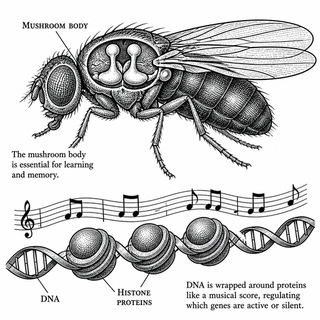
That sounds like sci-fi album copy, but it is also the plot of a new study in The Journal of Clinical Investigation: damaging both copies of DMAP1 can cause a syndromic neurodevelopmental disorder. DMAP1 helps brain cells decide which genetic tracks get played, muted, or auto-tuned into chaos.
The DNA Is Not Just Sitting There
Think of DNA as a massive music library. Every cell has the catalog, but not every cell should play every song. A neuron does not need a liver playlist.
That is where chromatin comes in. DNA is wrapped around proteins and packed into structures that can loosen or tighten. Open chromatin lets genes speak. Closed chromatin says, "not your verse." This control system is part of epigenetics, the layer of regulation that tells cells how to use the genome without rewriting the genome itself.
DMAP1, short for DNA methyltransferase 1-associated protein 1, works in this regulatory world. It interacts with machinery involved in DNA methylation, histone modification, and transcription control. Translation: it helps manage the studio board while development records.
The New Disorder Enters the Chat
Wang and colleagues studied 20 individuals from 16 families with a syndromic neurodevelopmental disorder and harmful variants in both copies of DMAP1. That "biallelic" part matters. One altered copy was not the headline. The disorder appeared when both inherited copies were knocked out or badly weakened, like losing both headphones during a live recording session and pretending the mix is fine.
The key question: are these DMAP1 variants just suspicious passengers, or are they driving the bus?
To test that, the researchers turned to Drosophila, the fruit fly. Yes, tiny flies again. Science keeps handing them clipboards because they are fast, genetically flexible, and useful for understanding human biology. When the team reduced the fly version of DMAP1 in neural tissue, the flies had severe trouble: pupal lethality, abnormal mushroom body structures, shorter dendrites, altered social behavior, and mechanically induced seizures. For a fly brain, the mushroom body is not a farm-to-table restaurant. It is a learning and memory hub.
The Rescue Remix
Then came the rescue remix. Normal human DMAP1 largely rescued the fly problems. Patient-associated variants failed to rescue, or rescued only partly, depending on the variant.
That is a strong functional test. It says the human gene can step into the fly system and do the job, but the patient variants show up to the studio, touch three knobs, and somehow make the snare sound like a wet cardboard box.
The team also looked downstream. Transcriptome profiling of fly brains pointed to Cbl and SF1 as possible targets affected by DMAP1 loss. When those genes were overexpressed, some lethal and mushroom body defects improved. That is not a treatment plan. It is a map sketch: DMAP1 disruption changes gene regulation, which can reshape neural development, behavior, and seizure vulnerability.
The Barcode in the Blood
One clinically sharp piece is the DNA methylation episignature. An episignature is a recurring methylation pattern, almost like a molecular barcode, that can help identify certain genetic disorders. For families stuck in diagnostic limbo, that matters. A genome result can say, "maybe this variant matters?" An episignature can add, "the biology is acting like this known disorder." Very molecular detective. Less trench coat than advertised.
This study found a DMAP1-related methylation signature and used it to support diagnosis in an additional patient. That fits a growing trend: combine sequencing with epigenomic fingerprints, then let the data harmonize instead of forcing one instrument to play the whole song.
Why This One Lands
The big deal is not that one more rare gene joined the neurodevelopmental disorder list. That list already needs its own group chat. DMAP1 expands the set of recessive epigenetic machinery disorders, and gives clinicians and researchers a new target for diagnosis, functional testing, and future mechanistic work.
If these findings hold up in larger cohorts, DMAP1 testing could help diagnose children with unexplained developmental syndromes, especially where recessive inheritance is plausible. The fly data also gives researchers a model to test why the disorder happens and whether any part of the pathway can be nudged back toward normal.
Nobody should read this as "therapy is around the corner." Biology loves corners, then hides six more behind them. But this paper turns DMAP1 from a background character into a named suspect with motive, mechanism, and a convincing trail of evidence.
For families, that can mean an answer. For scientists, it means a new window into how chromatin choreography shapes the developing nervous system. For the rest of us, it is another reminder that the brain is mixed, mastered, edited, muted, reopened, and occasionally sabotaged by microscopic production choices.
References
- Wang Q, Sobering AK, Tirrito C, et al. Biallelic inactivating variants in the chromatin remodeler DMAP1 cause a syndromic neurodevelopmental disorder. J Clin Invest. Published June 11, 2026. doi:10.1172/JCI198229
- Mossink B, Negwer M, Schubert D, Nadif Kasri N. The emerging role of chromatin remodelers in neurodevelopmental disorders: a developmental perspective. Cell Mol Life Sci. 2021;78:2517-2563. doi:10.1007/s00018-020-03714-5 PMCID: PMC8004494
- Valencia AM, Sankar A, van der Sluijs PJ, et al. Landscape of mSWI/SNF chromatin remodeling complex perturbations in neurodevelopmental disorders. Nat Genet. 2023;55:1400-1412. doi:10.1038/s41588-023-01451-6
- Giuili E, Grolaux R, Macedo CZNM, et al. Comprehensive evaluation of the implementation of episignatures for diagnosis of neurodevelopmental disorders (NDDs). Hum Genet. 2023;142:1721-1735. doi:10.1007/s00439-023-02609-2
- Rooney K, Bend EG, Ainsworth P, et al. DNA methylation episignatures in neurodevelopmental disorders associated with large structural copy number variants: clinical implications. Int J Mol Sci. 2022;23(14):7862. doi:10.3390/ijms23147862 PMCID: PMC9324454
Disclaimer: The image accompanying this article is for illustrative purposes only and does not depict actual experimental results, data, or biological mechanisms.