Under the microscope, a zebrafish brain looks like a glass kitchen lit from within, with neurons flashing like stove burners as the animal dodges trouble. Fish and chips? More like choice chips. Sorry. I will see myself out after explaining why this brain is doing something useful: using what just happened to decide what should happen next.
Yesterday's Soup Is Today's Sauce
The paper behind this Nature Research Briefing asked a deceptively simple question: when an animal makes a decision, how much does the previous moment matter? Not in the poetic "your past shapes you" way, although, sure, bring a tiny violin. If a zebrafish larva recently met an obstacle on one side, does its brain keep that information simmering long enough to bias the next escape?
The answer appears to be yes. Zhao and colleagues studied larval zebrafish performing memory-guided evasive maneuvers in virtual reality. Because the larvae are transparent, researchers can watch brain activity at cellular resolution while the animal behaves. It is like entering the kitchen during dinner rush, except every cook is a neuron.
The Thalamus Takes Notes
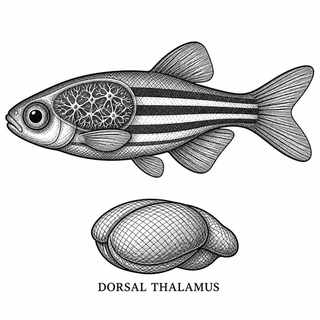
The team found that the dorsal thalamus held the position of the most recent obstacle as a stable activity pattern for roughly 10 to 20 seconds. That may sound short, but for a tiny fish deciding whether to swerve left or right, 20 seconds is practically a memoir.
This carryover is called serial dependence. Your brain does it too. Perception and decisions often lean toward recent experience, which can make the world feel smoother and less jumpy. If every moment were treated as brand-new, reality would be like a badly edited cooking show: bowl appears, whisk disappears, cake is somehow on fire.
In this study, the thalamus acted less like a passive relay station and more like the friend at dinner who remembers who ordered the spicy noodles. It kept a categorical memory: obstacle left, obstacle right. Then a downstream brainstem circuit mixed that memory with current sensory input, turning the recent past into a bias for action.
Brain Velcro, Basically
The researchers describe the thalamic memory system as an attractor network. That means the activity pattern settles into stable states, like a marble rolling into one of a few bowls. In neuron terms, the network says, "left-obstacle state," and keeps that recipe warm.
Why is that useful? Decisions need both stability and flexibility. If the brain forgot everything instantly, the fish would become a tiny aquatic improv troupe. If it clung too hard to the past, it would keep dodging yesterday's obstacle like someone still arguing with a toaster from 2009. The clever bit: the thalamus stores the latest event, while the brainstem folds that memory into the present.
The team also used optogenetics, meaning they controlled selected neurons with light. When they manipulated the dorsal thalamus, they could disrupt or impose the bias. That moves the result beyond "these neurons were active" toward "these neurons help cause the behavior." Otherwise, we are just watching the kitchen staff and guessing who made the soup.
Tiny Fish, Big Brains
Zebrafish are not miniature people with fins and unresolved emails. But they are vertebrates, and their larvae offer something mammalian brains rarely do: whole-brain imaging during behavior at single-cell resolution.
This work fits into a broader wave using zebrafish to link brain-wide activity, circuit structure, and behavior. Recent studies have mapped heading-direction circuits, reconstructed larval brain synapses, and reviewed how serial dependence appears across perception, memory, and action. The picture is not "fish are secretly humans," thank goodness, but "some brain-cooking techniques are old, conserved, and reusable."
The real-world payoff is not that doctors will prescribe zebrafish thalamus smoothies. Please do not make that smoothie. The payoff is conceptual: circuit motifs that balance recent memory with incoming evidence may help researchers understand decision biases in larger brains, including human ones. That matters for attention, perception, motor control, and possibly conditions where the past weighs too heavily on the present.
The Brain Is Always Preheating
The delightful weirdness here is that the brain is not simply reacting. It is preheating the oven. It keeps a little of the last experience bubbling on the back burner, then adds new sensory ingredients when the next choice arrives. Too little history and decisions get noisy. Too much history and you are seasoning today's soup with last week's fish. Again, sorry.
Zhao and colleagues give us a clean circuit-level example of how that balance might work: thalamus for recent memory, brainstem for flexible integration, and behavior as the final plated dish. For a larval zebrafish trying not to bonk into virtual obstacles, that is survival. For neuroscience, it is a compact recipe for turning "what just happened" into "what should I do now?"
References
- Zhao, S., Shan, H., Liu, X. et al. A thalamus-brainstem attractor network drives history-biased decisions. Nature (2026). https://doi.org/10.1038/s41586-026-10623-3
- Nature Research Briefing. How the zebrafish brain weaves recent experiences into future decisions. Nature (2026). PMID: 42310201. https://doi.org/10.1038/d41586-026-01756-6
- Cicchini, G. M., Mikellidou, K. & Burr, D. C. Serial dependence in perception. Annual Review of Psychology 75, 129-154 (2024). https://doi.org/10.1146/annurev-psych-021523-104939
- Manassi, M. & Whitney, D. Continuity fields enhance visual perception through positive serial dependence. Nature Reviews Psychology 3, 352-366 (2024). https://doi.org/10.1038/s44159-024-00297-9
- Petrucco, L., Lavian, H., Wu, Y. K. et al. Neural dynamics and architecture of the heading direction circuit in zebrafish. Nature Neuroscience 26, 765-773 (2023). https://doi.org/10.1038/s41593-023-01308-5
- Svara, F. et al. Automated synapse-level reconstruction of neural circuits in the larval zebrafish brain. Nature Methods 19, 1357-1366 (2022). https://doi.org/10.1038/s41592-022-01621-0
Disclaimer: The image accompanying this article is for illustrative purposes only and does not depict actual experimental results, data, or biological mechanisms.