
For about a century, the road map of brain science pointed in exactly one direction: into a small, quiet, brightly lit room. Pin the animal down, control every variable, run the same boring trial ten thousand times. It got us somewhere, sure. But it was the scientific equivalent of studying traffic by parking one car in an empty garage and watching the wheels not move. A new review in Nature Reviews Neuroscience says the field took a wrong turn back there, and it is time to back the truck out of the garage and drive into the wild.
Let me break this down.
The Lab Was a Demolished Job Site
Here is what you need to know. The classic neuroscience setup is a head-fixed mouse staring at a screen, pressing a lever for a sip of water. Clean. Repeatable. And about as natural as asking a carpenter to build a house while strapped to a chair with one arm.
The problem is structural. A brain is not a machine that sits still. It evolved to solve real problems: find food, dodge the thing that wants to eat you, remember where home is, and not fall off stuff. Take all that away and you are inspecting a building with the power shut off and the tenants evicted. The lights look fine because nothing is running. You miss the whole point of the place.
That is the core argument of "Heading into the wild." When you bolt an animal down, you do not just lose a little data. You lose the load-bearing behaviors the brain was actually built to support, and you do not even know which beams you knocked out.
New Tools, Same Old Brain
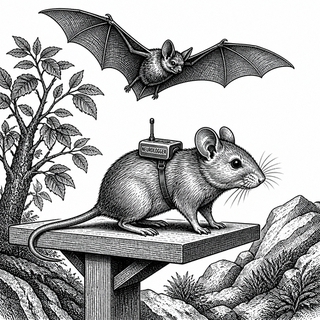
So why now? Because the gear finally caught up. For decades you could not record a neuron unless the wires were nailed to a bench. Now you can. Wireless "neurologgers" ride on an animal's back like a tiny hard hat with a data recorder inside, logging brain activity while the critter runs, climbs, and forages wherever it wants (Chung et al., 2022, Sensors, PMC9502354).
Pair that with machine vision and machine learning that can track every twitch of an animal's body, and you can finally watch the wiring and the behavior at the same time. It is the difference between reading a blueprint and standing on the site while the crew actually pours the foundation.
The Bats That Blew the Plans Apart
Want proof the lab was hiding things? Look at bats. Researchers strapped wireless recorders to Egyptian fruit bats and let them fly around freely, then watched the hippocampus, the brain's mapping department (Forli and Yartsev, 2025, Nature, PMC12460160).
In rats running on flat tracks, the textbook said memory "replay" rides on a brain rhythm called theta. Solid finding. Held up for years. Then the bats took off and the whole drawing fell off the wall. Their brains ran the same fast mapping sweeps with no theta rhythm at all. Instead the sweeps locked onto the beat of their own wings. The rule we thought was poured in concrete turned out to be a feature of the test rig, not the brain. Knock down the artificial walls and the building looks completely different.
You Do Not Have to Move to the Jungle
Now, before you picture neuroscientists hacking through rainforest with EEG caps, relax. The review is not saying torch the lab. Most of this work takes the middle ground, a stepping-stone approach: keep enough control to measure things cleanly, but loosen the worst restrictions so the animal can actually move and behave (Dennis et al., 2021, Journal of Neuroscience).
Think of it as a renovation, not a teardown. You keep the good framing and rip out the walls that were boxing everything in.
Why This Matters to Your Skull
Here is the payoff. Your brain is not a lab animal either. It runs in a messy, moving, unpredictable world, and the disorders we care about most, memory loss, anxiety, movement breakdowns, show up in that mess, not on a lever-press task. Build the science on cardboard and your house of treatments sits on cardboard. Pour a real foundation and what you build on top might actually hold weight.
The crew is finally heading outside. About time, because that is where the brain has been working all along.
Disclaimer: The image accompanying this article is for illustrative purposes only and does not depict actual experimental results, data, or biological mechanisms.
References
- Beetz, M. J. (2026). Heading into the wild: setting the course to natural neuroscience. Nature Reviews Neuroscience. DOI: 10.1038/s41583-026-01059-9. PMID: 42310406
- Forli, A., & Yartsev, M. M. (2025). Replay and representation dynamics in the hippocampus of freely flying bats. Nature. DOI: 10.1038/s41586-025-09341-z. PMCID: PMC12460160
- Dennis, E. J., El Hady, A., Michaiel, A., Clemens, A., Tervo, D. G. R., Voigts, J., & Datta, S. R. (2021). Systems Neuroscience of Natural Behaviors in Rodents. Journal of Neuroscience, 41(5), 911-919. DOI: 10.1523/JNEUROSCI.1877-20.2020
- Chung, J., et al. (2022). A Review of Neurologgers for Extracellular Recording of Neuronal Activity in the Brain of Freely Behaving Wild Animals. Sensors. PMCID: PMC9502354