
Alright, let us talk about something wild. Scientists stuck people in an fMRI scanner and had them watch a signed version of The Fall of the House of Usher - because apparently Edgar Allan Poe and brain imaging make a lovely, slightly haunted cocktail. What they found is both reassuring and weird: your brain seems to process stories in a layered way no matter whether language arrives through ears or eyes, but sign language also recruits a few extra neural characters that do not usually get top billing in speech studies.
Your brain likes stories in chunks, not as a sad pile of words
One of the big ideas in language neuroscience is that the brain does not treat language like a flat stream of noise. It builds meaning across different timescales. Some regions care about fast, local stuff - words and short phrases. Others hold onto information long enough to track sentences, scenes, and the whole plot. Think of it like a bar staff during a chaotic Saturday night: one person grabs glasses, another mixes drinks, and one long-suffering manager somehow remembers who started a tab an hour ago.
That layered setup has shown up before in studies of spoken stories. But sign languages are not just spoken languages in a different outfit. They use handshape, movement, facial expression, and space itself to pack in meaning and grammar. So the obvious question is: does the brain handle signed narratives with the same hierarchy, or does it switch to a different playbook?
Poe, but make it neuroscience
In this study, native signers watched a 20-minute Polish Sign Language interpretation of The Fall of the House of Usher while researchers measured brain activity with fMRI. They also watched scrambled versions of the story, where the narrative structure got progressively broken apart.
That scrambling trick matters. If a brain region only responds when the full story hangs together, it probably tracks longer chunks of meaning - sentences, events, plot. If it still responds when the story gets chopped into smaller bits, it may be tuned to more local language features.
The researchers found a familiar backbone. Frontotemporal language regions tracked sentence-level structure, while the Default Mode Network - a set of regions often linked to meaning, memory, and internally organized thought - tracked longer narrative structure, like the unfolding plot. In other words, the brain seems to keep the same general storytelling architecture whether language comes in through sound or sight. Nice. Elegant. Slightly rude to anyone hoping the brain would be simpler.
The universal stuff - and the sign-specific plot twist
Here is the cool part. Alongside that shared language hierarchy, the study found two patterns that have not shown up the same way in spoken-language narrative work.
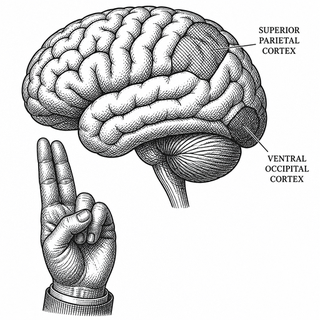
First, the superior parietal cortex synchronized over long discourse timescales. That region often helps with spatial attention and visually guided action. Which makes sense, honestly. Sign language uses space as part of grammar and meaning, so the brain may be tracking story structure partly through a spatial medium. It is not just "language, but with hands." It is language using the visual-spatial toolkit at full power.
Second, the ventral occipital cortex responded at word- and sentence-level timescales. That area is heavily involved in visual processing, so this suggests that in sign language, some of the machinery handling visually complex input stays deeply involved in parsing linguistic structure. Basically, the visual system is not just handing the package to "language areas" and clocking out. It is still in the group chat.
Why this matters beyond a neat scanner picture
This study adds to a growing point that should not be controversial by now but somehow still needs repeating: sign languages are full human languages, with rich structure and narrative depth, not some simplified backup mode. The brain treats them that way.
It also helps neuroscience stop being so speech-centric. A lot of classic language research quietly assumes that language is mostly an auditory problem. But if you only study spoken language, that is like claiming you understand cocktails after sampling exactly one warm beer. Signed languages let researchers separate what is fundamental to language from what is just specific to hearing and speech.
Real-world impact could show up in several places if this line of work keeps holding up. It could shape better educational tools for Deaf signers, improve clinical assessments after brain injury, and sharpen theories of how the brain builds meaning across time. It may also help designers of translation tech and brain-computer interfaces avoid making the very annoying mistake of treating all language as if it arrives through the ears.
The bigger tab this paper opens
This work fits with recent research arguing that the brain organizes language over nested timescales and that naturalistic stories are a powerful way to study it in the wild-ish rather than in the usual sterile lab sentence zoo. Reviews on language networks and temporal receptive windows have pushed this idea for years, and newer work has expanded it across modalities and populations.
The challenge, of course, is that fMRI is great for broad maps but not perfect for catching fast neural details. The sample here was also modest, which is common in intensive imaging studies. So nobody should spike the football just yet. But the pattern is compelling: the storytelling brain seems to have a universal skeleton, while sign language reveals some extra visual-spatial muscle wrapped around it.
And honestly, that is a lovely result. Same species, same deep language game, different sensory route in. The brain is not running one rigid script. It is improvising with the tools on hand - literally, in this case.
References
Zimmermann M, Tomaszewski P, Marchewka A, Szwed M, Bedny M. Sign language narrative reveals universal and modality-specific features of cortical timescale hierarchy. Nat Commun. 2026;17:Article pending. doi:10.1038/s41467-026-73895-3
Lerner Y, Honey CJ, Silbert LJ, Hasson U. Topographic mapping of a hierarchy of temporal receptive windows using a narrated story. J Neurosci. 2011;31(8):2906-2915. doi:10.1523/JNEUROSCI.3684-10.2011 PMCID:PMC6621327
Blank I, Fedorenko E. No evidence for differences among language regions in their temporal receptive windows. Neuroimage. 2020;219:116925. doi:10.1016/j.neuroimage.2020.116925 PMCID:PMC7436823
DiNicola LM, Braga RM, Buckner RL. Parallel distributed networks dissociate episodic and social functions within the individual. J Neurophysiol. 2020;123(3):1144-1179. doi:10.1152/jn.00529.2019 PMCID:PMC7092979
Emmorey K, Mehta S, Grabowski TJ. The neural correlates of sign versus word production. Neuroimage. 2007;36(1):202-208. doi:10.1016/j.neuroimage.2007.02.040 PMCID:PMC2745548
Campbell R, MacSweeney M, Waters D. Sign language and the brain: a review. J Deaf Stud Deaf Educ. 2008;13(1):3-20. doi:10.1093/deafed/enm035
Disclaimer: The image accompanying this article is for illustrative purposes only and does not depict actual experimental results, data, or biological mechanisms.