
In five years, this discovery might mean your doctor can spot the one weird cell in a tissue sample that is about to become a problem, instead of averaging it into invisibility like a bad group project. That is the promise behind single-cell proteomics, and this review in Trends in Biochemical Sciences says the technology is growing out of its awkward "please clap" phase.
The Cell Is Not a Smoothie
For years, proteomics mostly worked like this: mash a bunch of cells together, measure the proteins, and report the average. Useful? Absolutely. But also a little like reviewing a concert by blending the band, audience, and nachos into one smoothie.
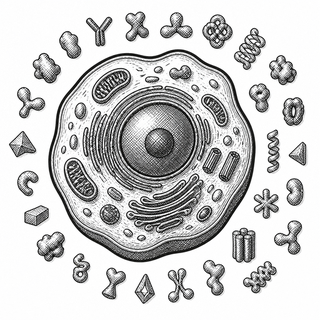
Single-cell proteomics asks: what proteins are inside this one cell, right now?
That matters because proteins are the cell's working parts. DNA is the recipe book. RNA is the grocery list. Proteins are the chefs, bouncers, smoke alarms, and one guy muttering about calcium.
Hu, Montes, and Walley review how mass spectrometry-based single-cell proteomics has improved across the pipeline: tiny sample prep, peptide separation, data acquisition, and interpreting molecular confetti. The field is now measuring cellular heterogeneity in cancer, development, neuroscience, and multiomics, where proteins get compared with DNA and RNA (Hu et al., 2026).
Why This Was So Annoyingly Hard
Proteins are not like DNA. You cannot amplify them with a molecular photocopier and say, "Great, now we have a billion copies." A single mammalian cell contains only a tiny amount of protein, and some proteins show up like celebrities while others slip in through the side door.
Mass spectrometry has to identify peptides by weight and fragmentation patterns from comically small samples. The machine is basically being asked to name every ingredient in one crumb of cake. Respectfully, rude.
Recent advances have made this less impossible. Reviews in Cell Genomics and Nature Methods highlight better microfluidics, robotic sample handling, multiplexing, data-independent acquisition, smarter software, and benchmarking standards so labs can compare results (Momenzadeh and Meyer, 2025; Gatto et al., 2023).
The Brain Enters the Chat
For neuroscience, this is especially juicy. The brain is less one organ than a crowded nightclub where every cell type has its own playlist and questionable life choices. Neurons, astrocytes, oligodendrocytes, microglia, developing progenitors - they all run different protein programs.
Single-cell RNA sequencing already showed that brain cells are wildly diverse. But RNA does not always predict protein abundance, and proteins carry modifications that can flip behavior like a tiny biochemical light switch. A 2026 Nature Biotechnology study mapped single-cell proteomes in the developing human brain, pointing toward protein-level maps of neural identity and maturation (Wu et al., 2026).
Another example hits closer to disease. In ALS, bulk tissue studies can blur motor neuron signals with everything else in the sample. A Cell Reports study used laser capture and nanoPOTS single-cell mass spectrometry to profile postmortem spinal motor neurons stratified by TDP-43 pathology. The team measured 2,238 proteins and found changes tied to respiration, RNA splicing, translation, and vesicle transport (Guise et al., 2024). Translation: sick neurons may wave protein-level distress flags earlier than bulk tissue can show.
The Real-World Payoff, If the Tech Keeps Behaving
If these methods become cheaper, faster, and more reproducible, the payoff could be big. Cancer researchers could find rare drug-resistant cells before they throw a molecular surprise party. Developmental biologists could watch cell states change as tissues form. Neuroscientists could compare vulnerable and resilient neurons without averaging the drama away.
Clinical use is not here yet for routine single-cell mass spec. The field still has hard problems: missing data, cost, throughput, sample loss, normalization, and boring-but-essential standards. Science loves a flashy instrument, but it survives on reproducibility, the lab equivalent of doing your taxes correctly.
Still, the direction is clear. A 2025 Nature review framed mass spectrometry-based proteomics as moving toward clinical applications, including precision medicine and biomarkers (Guo et al., 2025). Meanwhile, Nature Methods named spatial proteomics its 2024 Method of the Year, a sign that researchers want not just parts lists, but maps of where those parts live (Nature Methods, 2024).
Tiny Samples, Big Gossip
The charm of single-cell proteomics is that it treats cells as individuals. Not vibes. Not averages.
That is a big deal because biology often hides the plot in the outliers. The rare immune cell. The stubborn tumor cell. The motor neuron that looks normal until its protein machinery starts sending "this is fine" memes while the room fills with smoke.
Hu and colleagues are not claiming the work is finished. They are saying single-cell proteomics is no longer just a technical flex. It is becoming a way to ask sharper biological questions. In neuroscience, where every cell has a side quest, sharper questions are the point.
References
- Hu R, Montes C, Walley JW. Mass spectrometry-based single-cell proteomics technologies, trends, and biological insights. Trends in Biochemical Sciences. 2026. DOI: 10.1016/j.tibs.2026.04.011
- Momenzadeh A, Meyer JG. Single-cell proteomics using mass spectrometry. Cell Genomics. 2025;5(9):100973. PMCID: PMC12534698. DOI: 10.1016/j.xgen.2025.100973
- Gatto L, Aebersold R, Cox J, et al. Initial recommendations for performing, benchmarking and reporting single-cell proteomics experiments. Nature Methods. 2023;20(3):375-386. PMCID: PMC10130941. DOI: 10.1038/s41592-023-01785-3
- Guise AJ, Misal SA, Carson R, et al. TDP-43-stratified single-cell proteomics of postmortem human spinal motor neurons reveals protein dynamics in amyotrophic lateral sclerosis. Cell Reports. 2024;43(1):113636. PMCID: PMC10926001. DOI: 10.1016/j.celrep.2023.113636
- Wu T, Jiang L, Mukhtar T, et al. Single-cell proteomic landscape of the developing human brain. Nature Biotechnology. 2026. DOI: 10.1038/s41587-025-02980-7
- Guo T, Steen JA, Mann M. Mass-spectrometry-based proteomics: from single cells to clinical applications. Nature. 2025;638(8052):901-911. DOI: 10.1038/s41586-025-08584-0
- Method of the Year 2024: spatial proteomics. Nature Methods. 2024;21:2195-2196. DOI: 10.1038/s41592-024-02565-3
Disclaimer: The image accompanying this article is for illustrative purposes only and does not depict actual experimental results, data, or biological mechanisms.