
You used to think brain inflammation was basically one big cellular fire alarm, but then microglia showed up with a whole incident-command spreadsheet, color-coded tabs, and the quiet confidence of someone who has ruined a group project before.
That is the fun little problem at the heart of a new Cell Reports study on demyelination, the process where myelin, the fatty insulation around nerve fibers, gets damaged. Myelin is not glamorous, but it keeps electrical signals from traveling like a buffering video from 2008. In diseases such as multiple sclerosis, myelin damage can scramble sensation, movement, vision, and cognition. The wires still exist, but the insulation is having a very bad week.
The new paper, from Félix Distéfano-Gagné and colleagues, asks a sharper question: when microglia respond to demyelination, are they all doing the same job? The answer: definitely not. Possibly committees. Maybe a few Slack channels nobody wants to be in.
The Brain's Tiny Cleanup Crew Gets Complicated
Microglia are the resident immune cells of the brain and spinal cord. They patrol, nibble debris, respond to injury, and generally act like the nervous system's suspicious building inspectors. The basic idea is simple: they are the central nervous system's main active immune defenders, and they constantly monitor their surroundings.
But modern neuroscience has made that story messier in a useful way. Microglia are not just "on" or "off." They slide through many states depending on disease, age, location, and incoming signals.
Two Flavors of Inflamed
Using a mouse model of demyelination, the researchers sorted and profiled microglia with flow cytometry, microscopy, and RNA sequencing. They found two major inflammatory microglia states marked by Clec7a and CD229, then split by CD11c.
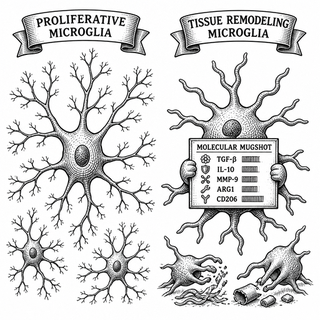
One group, Clec7a+CD229+CD11c-negative microglia, leaned toward proliferation and expressed genes such as Fn1 and Vegfa. Translation: these cells looked more like they were expanding the workforce and changing the local tissue environment.
The other group, Clec7a+CD229+CD11c-positive microglia, expressed genes tied to tissue remodeling and antigen presentation. That sounds dry until you realize antigen presentation is basically the immune system putting suspicious molecular mugshots on the wall. "Have you seen this protein? Last spotted near damaged myelin."
This matters because demyelination is not one cellular event. Damaged myelin has to be detected, debris cleared, inflammatory signals controlled, and repair made possible. Treating "microglia activation" as one blob is like trying to fix a server outage by yelling at the entire internet.
Chromatin: The Genome's Bouncer
The paper's real twist is that these states were not controlled only by surface receptors or passing inflammatory signals. The genome itself changed access rules.
DNA is packed around proteins called histones, forming chromatin. When chromatin opens, genes become easier to read. When it closes, genes get shoved behind the velvet rope. The researchers found broad nucleosome remodeling shaped by transcription factors including PU.1, AP-1, C/EBP, MEF2, and EGR2.
They also found an H3K27me3-based gatekeeping mechanism. H3K27me3 is a repressive histone mark, a molecular "not tonight" stamp on gene expression. In this study, that gate helped control regulators such as Egr2. The team then validated roles for Trem2, Mef2a, and Egr2, linking outside signals to inside-the-nucleus decision-making.
That is a systems story: receptors collect inputs, transcription factors process them, chromatin sets permissions, and microglia execute programs. Somewhere, a software engineer just whispered, "Finally, an architecture diagram."
Why MS Researchers Care
Multiple sclerosis affects about 2.8 million people worldwide, and progressive disease remains especially hard to treat. Current therapies can reduce immune attacks, but repairing damage and slowing neurodegeneration are tougher beasts. Microglia attract attention because they can worsen inflammation, clear myelin debris, support remyelination, or do several of those things depending on context.
Human MS tissue studies point the same way. A 2024 Nature Communications paper found that microglia nodules in MS tissue carried lesion-associated inflammatory genes, lipid-metabolism changes, complement activation, and signs of local immune crosstalk. In plain English: these clusters were not random bystanders. They looked like active neighborhood drama.
The new mouse study adds a mechanism for how such states might be coordinated. If researchers can map which programs damage tissue and which help clean up or repair it, future therapies might tune the response instead of flattening it.
The Fine Print, Because Brains Love Fine Print
This is still mouse work. The exact states, markers, and timing may not map cleanly onto human MS lesions. Also, chromatin regulation is powerful but risky as a therapy target, because genes are not light switches so much as a nightclub soundboard operated during a power outage.
Still, the study gives the field a better wiring diagram. Demyelination-associated microglia are shaped by layered signals, transcription factors, and chromatin gates. Diseases like MS are not caused by one bad molecule wearing a tiny villain cape. They emerge from networks. And if you want to fix a network, you first need to know which nodes are routing the traffic, which ones are dropping packets, and which ones are somehow still using Internet Explorer.
References
- Distéfano-Gagné F, Belhamiti N, Saxon W, Bitarafan S, Xavier AM, Fiola S, Rivest S, Gosselin D. Multi-tier signaling and chromatin remodeling coordinate microglia inflammatory states and activities associated with demyelination. Cell Reports. 2026;45(7):117569. doi:10.1016/j.celrep.2026.117569
- Distéfano-Gagné F, Bitarafan S, Lacroix S, Gosselin D. Roles and regulation of microglia activity in multiple sclerosis: insights from animal models. Nature Reviews Neuroscience. 2023;24(7):397-415. doi:10.1038/s41583-023-00709-6
- Scholz R, Brösamle D, Yuan X, Beyer M. Epigenetic control of microglial immune responses. Immunological Reviews. 2024;323(1):209-226. doi:10.1111/imr.13317
- McNamara NB, Munro DAD, Bestard-Cuche N, et al. Microglia regulate central nervous system myelin growth and integrity. Nature. 2023;613(7942):120-129. doi:10.1038/s41586-022-05534-y, PMCID:PMC9812791
- van den Bosch AMR, van der Poel M, Fransen NL, et al. Profiling of microglia nodules in multiple sclerosis reveals propensity for lesion formation. Nature Communications. 2024;15:1667. doi:10.1038/s41467-024-46068-3
Disclaimer: The image accompanying this article is for illustrative purposes only and does not depict actual experimental results, data, or biological mechanisms.