
Monday: normal brain. Tuesday: still normal. Wednesday: everything changed. That is the tiny tragedy and comedy of brain development: a system can look like it is merely assembling wires, when in fact it is staging Plato's cave with proteins, synapses, and a lighting crew that has lost the manual.
Fragile X syndrome starts with one missing script. The gene is FMR1, and when it gets silenced, the brain loses a protein called FMRP. FMRP is not glamorous; it is more like the stern librarian of the neuron, shushing certain messenger RNAs before they start making proteins at the wrong time. Without it, protein production gets weird, synapses get moody, and neural circuits can begin behaving like a symposium where everyone brought a microphone and no one brought a moderator.
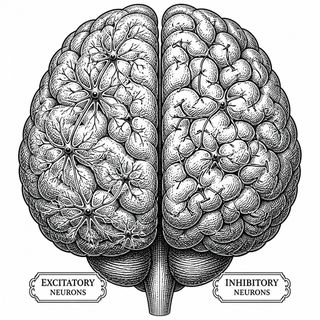
The Brain's Ancient Argument: Go or Stop?
One big idea in fragile X research is excitation/inhibition balance. Excitatory neurons are the "go" signals. Inhibitory neurons are the "please stop before this becomes a group chat disaster" signals. Your cortex needs both, because thought is not just activity; it is activity with manners.
In the new Neuron study, Suresh and colleagues asked what happens inside two major cortical neuron types in fragile X mice: excitatory Camk2a neurons and inhibitory Pvalb neurons. Instead of measuring all RNA in a blended brain smoothie, they used cell-type-specific translatome profiling, meaning they looked at the messages actively queued for protein production in particular neuron classes. This matters because the brain is not a democracy; a change in one cell type can mean the opposite thing in another.
And that is exactly what they found. Many molecular pathways shifted in opposing directions in excitatory versus inhibitory neurons. If the cortex were a ship of Theseus, fragile X would not simply replace one plank; it would replace planks on the left side with heavier wood and on the right side with feathers, then ask why steering feels haunted.
Enter EPAC2, Stage Left, Looking Suspicious
Among 184 genes dysregulated in both neuron types, one candidate stood out: Rapgef4, also called EPAC2. EPAC2 was upregulated in the fragile X mice, is enriched in brain tissue, sits near synapses, connects to neurodevelopmental disorders, and is an FMRP target. That is a lot of suspicious behavior for one molecule; at some point the detective has to stop saying "interesting" and start checking alibis.
The team then blocked EPAC2, including with a specific antagonist. In the fragile X mouse model, that intervention helped restore abnormal cortical circuit activity and improved several behavioral phenotypes, including tactile defensiveness, social behavior, and seizure susceptibility. This does not mean anyone has found a human treatment yet. Mice are useful, but they are not tiny patients in lab coats, no matter how much grant writing sometimes makes them sound that way.
Still, the result is intriguing because fragile X has been a hard clinical nut. The condition is a leading single-gene cause of intellectual disability and autism, and because its root mutation is known, researchers have long hoped for targeted therapies. Yet trials aimed at downstream pathways have often looked better in animals than in people. The universe, being rude, insists that a human brain contains more variables than a crossword written by a committee of caffeinated philosophers.
Why This Could Matter
EPAC2 offers a different kind of foothold. The study suggests that even when excitatory and inhibitory neurons go wrong in opposite molecular directions, they may share a druggable pressure point. That is the practical beauty here: not "fix every disrupted pathway," which sounds like repairing a cathedral during an earthquake, but "find the shared lever that moves the circuit back toward sanity."
There is another wrinkle. UCLA's research summary notes that EPAC2 levels appear to rise as the brain matures, raising the possibility that an EPAC2-based approach might matter beyond early childhood. That would be a major conceptual shift if it holds up, because many neurodevelopmental therapies carry an unspoken hourglass: intervene early or watch the window close. Here, the window may at least be cracked open later than expected.
The sober caveat is that this is preclinical work. Researchers still need replication, dose studies, safety testing, better understanding of EPAC2's normal jobs, and eventually human trials. Blocking a brain-enriched synaptic protein is not like muting an annoying notification; sometimes the notification was warning you the stove was on.
But as a map of fragile X biology, this study gives us a sharper route. It says the disorder is not merely "too much excitation" or "too little inhibition." It is a more philosophical mess: the same missing molecular guardian can push different neuron types in opposite directions, yet still leave behind a common signature. The brain, naturally, answers a simple question with a paradox. Wednesday changed everything; Thursday wants peer review.
References
- Suresh A, Kourdougli N, Nomura T, et al. Translatome profiling reveals opposing alterations in inhibitory and excitatory neurons of fragile X mice and identifies EPAC2 as a therapeutic target. Neuron. 2026. https://doi.org/10.1016/j.neuron.2026.04.032
- Seo SS, Louros SR, Anstey N, et al. Excess ribosomal protein production unbalances translation in a model of Fragile X Syndrome. Nature Communications. 2022;13:3236. https://doi.org/10.1038/s41467-022-30979-0
- Hale CR, Sawicka K, Mora K, et al. FMRP regulates mRNAs encoding distinct functions in the cell body and dendrites of CA1 pyramidal neurons. eLife. 2021;10:e71892. https://doi.org/10.7554/eLife.71892
- Nomura T. Interneuron dysfunction and inhibitory deficits in autism and fragile X syndrome. Cells. 2021;10(10):2610. https://doi.org/10.3390/cells10102610
- Watkins LV, Moon S, Burrows L, Tromans S, Barwell J, Shankar R. Pharmacological management of fragile X syndrome: a systematic review and narrative summary of the current evidence. Expert Opinion on Pharmacotherapy. 2024;25:301-313. https://doi.org/10.1080/14656566.2024.2323605
- Protic D, Hagerman R. State-of-the-art therapies for fragile X syndrome. Developmental Medicine & Child Neurology. 2024;66(7):863-871. https://doi.org/10.1111/dmcn.15885
Disclaimer: The image accompanying this article is for illustrative purposes only and does not depict actual experimental results, data, or biological mechanisms.