
We still don't know how the brain turns a messy intention - I want to make this shape - into a clean sequence of movements. But this paper gets us closer. And honestly, it does so with monkeys that "draw," which is already a stronger opening than most neuroscience gets.
A new Nature report looks at a deceptively simple question: how does the brain build complex actions out of smaller parts? Not just "move arm now," but "combine this movement with that one, then adjust on the fly." If you've ever tried to sign your name on a touchscreen and produced something that looked like a distressed earthworm, you've run into this problem personally.
The brain may be using Lego bricks, not whole blueprints
The big idea here is that the motor system might not store every possible action as its own separate command. That would be absurdly inefficient - like keeping a separate recipe for every sandwich instead of learning what bread, cheese, and "put it together" mean. Instead, the brain may use reusable action components that can be combined into larger behaviors.
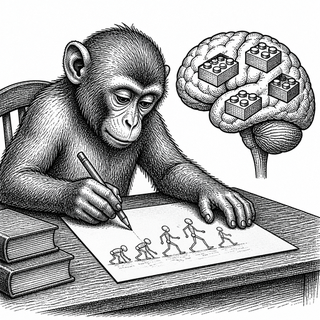
That is what this study claims to find: a neuronal population that encodes combinable actions. In other words, some neurons may represent movement pieces that can be mixed and matched to produce more complicated outputs, including drawing-like behaviors in monkeys.
This matters because movement is one of those things the brain makes look insultingly easy. You reach for a glass, tie a shoelace, scribble a note, and your nervous system handles the choreography without demanding applause. Under the hood, though, it's a circus run by electrically excitable spaghetti.
Why get monkeys to "draw"?
Because drawing is a nice stress test for motor control. It requires planning, sequencing, direction, curvature, timing, and error correction. A straight reach is useful, but a drawn shape asks the brain to chain actions together in a more structured way.
Researchers have long known that motor cortex and related regions don't simply map one neuron to one muscle like some tiny biological keyboard. Population activity matters - groups of neurons work together to represent movement goals, trajectories, force, and learned skills. Recent work has pushed the field toward a more dynamic view, where the brain generates movement through evolving patterns rather than static commands alone.
This new paper appears to fit that shift. The exciting part is not just that neurons fire during movement - congratulations to neurons for continuing to do their jobs - but that some may encode building blocks that can be recombined across different drawing actions.
Tiny action syllables
A useful way to think about it is language. You don't memorize every sentence you'll ever say. You recombine words, and words themselves are built from smaller units. This study suggests the motor system may do something similar with action.
That idea has been floating around in neuroscience for a while. Studies of motor cortex have shown that skilled movements can be broken into motifs, synergies, or low-dimensional control patterns rather than endless one-off commands. Reviews in recent years have argued that movement emerges from flexible population dynamics spread across cortical and subcortical circuits, not from a single bossy region barking orders like a middle manager on espresso [1-4].
If that framework holds up here, then the "drawing" monkeys are not just a cute headline. They are evidence that the brain may organize action in a compositional way - assembling movement from reusable neural parts.
Why you should care, even if you are not a monkey with artistic ambitions
This kind of result could matter for brain-computer interfaces, stroke rehabilitation, and disorders that disrupt skilled movement.
For brain-computer interfaces, decoding reusable action components could be more powerful than decoding only specific trained movements. If the brain really works with combinable modules, future systems might generalize better - letting a device infer a new movement from familiar parts rather than needing endless retraining. That's a big deal if you want prosthetic control to feel less like programming a fax machine from 1997.
For rehabilitation, the work hints that lost skills might be rebuilt by targeting the component actions underneath them. Instead of training one exact task over and over, clinicians might eventually train the pieces that support many tasks.
And for basic neuroscience, this study chips away at one of the oldest headaches in the field: how thought becomes action without the brain needing a separate command for every possible wiggle.
The usual scientific buzzkill - what we still need to know
As promising as this is, one paper does not settle the issue. We need replication, clearer mechanistic detail, and evidence that these combinable codes show up across tasks, contexts, and maybe even species. We also need to know whether this coding scheme is specific to drawing-like movements or reflects a broader motor principle.
There is also a healthy chance that the truth is messier than the headline. The brain loves hybrid solutions. It may use compositional building blocks and task-specific tuning and dynamical population states all at once, because apparently simplicity was never on the menu.
Still, the study is intriguing because it pushes the field toward a more elegant picture of motor control. Not a lookup table of every action, but a system with reusable pieces - closer to grammar than brute-force storage.
And that's a lovely thought. Somewhere in a monkey brain, neurons may be combining movement fragments into a drawn form. Which means the motor system might be less like a piano with labeled keys and more like jazz. Structured, flexible, and occasionally mysterious enough to make scientists squint at spike trains for years.
References
-
Vyas S, Golub MD, Sussillo D, Shenoy KV. Computation through neural population dynamics. Annu Rev Neurosci. 2020;43:249-275. doi: 10.1146/annurev-neuro-092619-094115
-
Saxena S, Cunningham JP. Towards the neural population doctrine. Curr Opin Neurobiol. 2019;55:103-111. doi: 10.1016/j.conb.2019.02.002 | PMCID: PMC6615473
-
Shenoy KV, Sahani M, Churchland MM. Cortical control of arm movements: a dynamical systems perspective. Annu Rev Neurosci. 2013;36:337-359. doi: 10.1146/annurev-neuro-062111-150509 | PMCID: PMC4400371
-
Gallego JA, Perich MG, Miller LE, Solla SA. Neural manifolds for the control of movement. Neuron. 2017;94(5):978-984. doi: 10.1016/j.neuron.2017.05.025 | PMCID: PMC7007364
-
Monkeys that "draw" reveal a neuronal population that encodes combinable actions. Nature. 2026. doi: 10.1038/d41586-026-00928-8
Disclaimer: The image accompanying this article is for illustrative purposes only and does not depict actual experimental results, data, or biological mechanisms.