
Motherhood can make your brain feel like it put the car keys in the refrigerator, and at the very same time it may be writing long-term molecular notes in permanent marker. Rude? Absolutely. But biology has never been known for its bedside manner.
That is the paradox inside Frances Champagne's recent Nature News & Views piece: becoming a mother does not just change schedules, sleep, and the number of tiny socks haunting the laundry. It may leave durable molecular traces in the brain. The brain, apparently unable to keep a normal diary, annotates itself.
The Hippocampus Gets a Parenting App
The research Champagne discusses studied mice that had gone through pregnancy, birth, lactation, and pup care. The team mapped gene activity across the brain and found a standout region: the dorsal hippocampal formation, a memory-and-navigation hub that helps animals track space, novelty, and context.
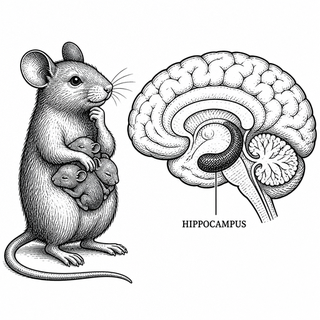
In plain English, this is useful if you need to remember where things are and what in your environment matters. In mouse-mom English: Where is the nest? Where are the pups? Why does that corner smell suspicious? Who moved my cheese?
The striking part was persistence. Pregnancy and postpartum hormones already do dramatic things, because the body apparently hired a pyrotechnics crew. But some brain changes lasted beyond the immediate hormonal storm. The maternal brain was keeping a molecular receipt.
Dopamine, But Make It Genomic
The researchers linked these changes to dopamine, the motivation-and-learning chemical currently blamed for everything from TikTok scrolling to falling emotionally in love with pastries. Here, dopamine helped regulate gene expression through a histone modification called H3 dopaminylation.
Tiny translation: DNA wraps around proteins called histones. Chemical tags on histones help tune which genes get turned up, turned down, or left on read. H3 dopaminylation is like dopamine leaving a sticky note on the genome saying, "Please adjust the parenting settings."
This does not mean there is one magical "mom gene." Brains are not IKEA furniture. There is never just one screw. Dopamine seems to be one player in a larger network involving hormones, experience, stress, and cellular plasticity.
Stress Walks In Wearing Muddy Shoes
The team also tested chronic postpartum stress by separating mouse mothers from pups. That stress disrupted hippocampal adaptations, dopamine dynamics, and gene-expression patterns tied to reproductive experience.
Postpartum stress in real life is not a cute plot device. It can involve isolation, sleep loss, medical complications, money pressure, depression, anxiety, and the cultural fantasy that new parents should survive on vibes and casserole. The mouse model is not a human life, but it asks a sharper question: what happens inside the maternal brain when stress interferes with adaptation?
The answer, at least here, is that stress may not simply pile on top of maternal brain changes. It may reroute them.
Humans Are Not Big Mice, But Still
The researchers also examined human dorsal subiculum tissue, part of the hippocampal formation, and found parity-related patterns that echoed the mouse findings. Intriguing, yes. The same as watching a living human brain update molecule by molecule after childbirth? Not yet.
Still, it fits a broader wave of maternal-brain research. Recent human imaging studies show pregnancy and postpartum brain remodeling, including changes in cortical volume, thickness, white matter measures, and network organization.
So no, "mom brain" is not just a sitcom bit where someone pours orange juice into coffee. It may be a sloppy nickname for matrescence: the becoming-a-mother version of adolescence, except with more laundry and fewer people asking whether you need a nap.
Why This Could Matter
If these findings hold up, they could move maternal health from shrug-based guessing toward measurable biology. Researchers may eventually identify molecular signs of healthy adaptation, stress disruption, or vulnerability to postpartum mood disorders.
The challenge is enormous. Mouse parenting is not human parenting. Human motherhood is shaped by bodies, culture, sleep, medical care, identity, relationships, and whether anyone has washed the bottles. But this gives scientists a map of where to look.
The deeper message is simple: becoming a mother is not just an emotional event or lifestyle change. It is a biological renovation. The brain is not falling apart. It is adapting under extreme conditions, with dopamine, genes, and epigenetic sticky notes all trying to keep the tiny human alive. No pressure.
References
- Champagne FA. Becoming a mother leaves long-lasting molecular memories. Nature. 2026;654:327-328. https://doi.org/10.1038/d41586-026-01327-9
- O'Chan JC, Di Salvo G, Cunningham AM, et al. Dopamine drives persistent remodelling of the maternal brain. Nature. 2026;654:465-475. https://doi.org/10.1038/s41586-026-10509-4
- Orchard ER, Rutherford HJV, Holmes AJ, Jamadar SD. Matrescence: lifetime impact of motherhood on cognition and the brain. Trends in Cognitive Sciences. 2023;27(3):302-316. https://doi.org/10.1016/j.tics.2022.12.002
- Paternina-Die M, Martinez-Garcia M, Martin de Blas D, et al. Women's neuroplasticity during gestation, childbirth and postpartum. Nature Neuroscience. 2024;27:319-327. https://doi.org/10.1038/s41593-023-01513-2
- Pritschet L, Taylor CM, Cossio D, et al. Neuroanatomical changes observed over the course of a human pregnancy. Nature Neuroscience. 2024;27:2253-2260. https://doi.org/10.1038/s41593-024-01741-0
Disclaimer: The image accompanying this article is for illustrative purposes only and does not depict actual experimental results, data, or biological mechanisms.