
Can you measure dopamine without dumping extra chemical helpers into the sample? Can you do it while annoying look-alike molecules, like uric acid and ascorbic acid, are also crashing the party? Can you shrink the job from bulky lab gear into something closer to a camera? And can you do all that fast enough that the brain's chemical gossip might one day be watched in real time? That is the wild promise behind a new Nature Communications paper from Li and colleagues, and honestly, dopamine just got itself a very fussy bartender with excellent eyesight [1].
Dopamine Is Not Just the "Feel-Good" Shot
Dopamine gets marketed like the brain's party liquor, which is unfair and also very on-brand for the internet. It is involved in reward, sure, but it also helps tune movement, motivation, attention, learning, and a whole lot of "should I do this thing or stay on the couch like a sentient blanket?" decisions.
That is why measuring dopamine matters. Parkinson's disease, addiction, schizophrenia, depression, ADHD, and other brain conditions all intersect with dopamine biology in different ways. Dopamine is not the single villain twirling a mustache. Brain chemistry is more like a crowded bar where everyone keeps changing seats.
The problem is that dopamine often shows up in tiny amounts, surrounded by molecules that look chemically similar enough to confuse sensors. Uric acid and ascorbic acid are the regulars who sit too close to dopamine at the bar and order the same drink. A sensor has to tell them apart without blinking.
The Usual Sensor Problem: Too Much Gear, Too Much Waiting
Researchers already have powerful ways to measure dopamine, including electrochemical sensors and fast-scan cyclic voltammetry. Those tools can be excellent, but they bring tradeoffs: implanted electrodes can irritate tissue, some approaches need surface coatings, and many systems are not built for cheap, portable, continuous monitoring.
Recent work has been pushing hard on this problem. A 2024 Nature Communications study designed an anti-inflammatory electrochemical dopamine sensor using an engineered iron single-atom catalyst [2]. Another team reported a nanoplasmonic aptasensor that detected dopamine directly from unprocessed whole blood, the diagnostic equivalent of making a cocktail without reorganizing the whole liquor cabinet [3]. A 2022 graphene aptasensor study showed ultrasensitive dopamine detection in tiny biological samples, including mouse cerebrospinal fluid [4].
So the field is not asleep. It is very awake, possibly over-caffeinated.
This Paper's Trick: Let Light Do the Sorting
Li and colleagues took a different route. Instead of relying on a classic electrochemical workstation, they built an optical platform around engineered light-scattering membranes and a hardware accelerator integrated with a commercial monochrome camera [1].
In plain English: they shine light through or onto a sample, let a nanostructured surface scramble that light in dopamine-sensitive ways, and then use camera-integrated hardware plus machine-learning-style feature extraction to interpret the pattern. It is like asking the sample to sing one note, then hiring a very picky audio engineer.
The system uses physical optical structures to perform part of the computation before the signal reaches ordinary software. Real-time sensing is not just about sensitivity. It is also speed, size, cost, and whether your device can stop being a lab refrigerator with a PhD.
The headline number is the attention-grabber: dopamine detection below 10^-8 mM, which is 10^-11 M, or about 10 picomolar. The authors report detection in buffer and in the presence of uric acid and ascorbic acid, two classic interference headaches. They also describe video-rate operation and estimate the manufacturing cost below $1000 [1].
Why "Additive-Free" Is a Big Deal
Additives can help sensors recognize targets, but they can also create instability, contamination, extra preparation steps, and the scientific equivalent of "some assembly required" at 2 a.m. Additive-free detection means the platform aims to read dopamine without enzymes, aptamers, polymers, or other helper ingredients in the sample.
That does not magically solve every problem. Real biological fluids are rude. They contain proteins, salts, metabolites, cells, debris, and molecular freeloaders nobody invited. A sensor that behaves beautifully in controlled samples still has to prove it can handle real clinical chaos.
Still, additive-free real-time detection is a serious goal. If this approach holds up across labs, sample types, and long-term use, it could support better research tools, faster diagnostic workflows, or compact monitoring systems for neurological and psychiatric care. That is the dream: less "send it away and wait" and more "read the chemistry while it is happening."
The Sober Bit Before Last Call
Real talk: this is early-stage technology. The paper is impressive, but it is not a Parkinson's diagnostic you can buy next Tuesday, and nobody should start wearing a dopamine camera like a smartwatch. Nature also notes that the manuscript is an unedited early-access version [1].
The next questions are practical. Does it work with messier human samples? Can it stay calibrated? Does the surface age gracefully, or does it get weird after repeated use? Can different labs reproduce the sensitivity? Can clinicians interpret the readout in a way that improves decisions, rather than generating another dashboard everyone politely ignores?
But as a concept, this is deliciously clever: a camera-based optical system trained to spot tiny dopamine changes without chemical crutches. The brain has been running a microscopic cocktail bar forever. This paper suggests we may be getting a better way to see what is on tap.
References
- Li N, Wang Q, He Z, Burguete-Lopez A, Xiang F, Fratalocchi A. Towards real-time additive-free dopamine detection at 10^-8 mM with hardware accelerated platform integrated on camera. Nature Communications. 2026. DOI: https://doi.org/10.1038/s41467-026-73932-1
- Gao X, Wei H, Ma W, et al. Inflammation-free electrochemical in vivo sensing of dopamine with atomic-level engineered antioxidative single-atom catalyst. Nature Communications. 2024;15:7915. DOI: https://doi.org/10.1038/s41467-024-52279-5
- Biswas A, Lee S, Cencillo-Abad P, Karmakar M, Patel J, Soudi M, Chanda D. Nanoplasmonic aptasensor for sensitive, selective, and real-time detection of dopamine from unprocessed whole blood. Science Advances. 2024;10:eadp7460. DOI: https://doi.org/10.1126/sciadv.adp7460. PMCID: PMC11373595
- Abrantes M, Rodrigues D, Domingues T, et al. Ultrasensitive dopamine detection with graphene aptasensor multitransistor arrays. Journal of Nanobiotechnology. 2022;20:495. DOI: https://doi.org/10.1186/s12951-022-01695-0. PMID: 36424623
- Kim Y, Park S. In vivo multimodal neurochemical interfaces for real-time decoding of brain circuit. Nature Reviews Neuroscience. 2026;27:178-195. DOI: https://doi.org/10.1038/s41583-025-01003-3. PMID: 41381720
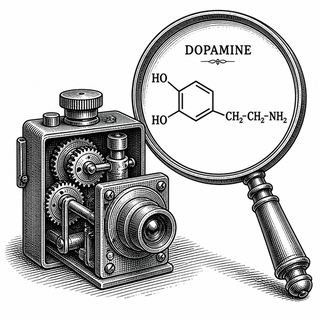
Disclaimer: The image accompanying this article is for illustrative purposes only and does not depict actual experimental results, data, or biological mechanisms.