
Right now, as your eyes skim these words, little electrical squabbles are popping off across your cortex, your attention is trying to stay on task like one competent cousin at a chaotic family reunion, and somewhere deeper down, your brain is quietly managing the stuff you never volunteered to supervise - breathing, arousal, timing, memory, the whole unruly household. Which is what makes this new study so eyebrow-raising: researchers built a skin-attached patch that can both listen to the sleeping brain and gently nudge a deep brain structure with ultrasound. While you sleep. On purpose. Science really has stopped asking permission before getting weird.
A sleep patch with ambition
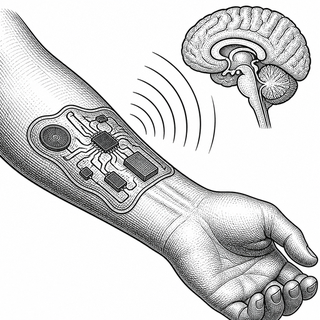
The paper describes NEUSLeeP, a flexible bioadhesive patch that sticks to the skin and combines two jobs in one device: it records electrophysiology and delivers transcranial focused ultrasound to a deep brain target, the subthalamic nucleus, during natural sleep Tang et al., 2026.
That is a pretty spicy combo. Sleep tech usually lives in one of two neighborhoods: devices that monitor you, or devices that stimulate you. This one tries to do both, in real time, overnight, while staying attached to a moving human head for hours. If you have ever had an earbud fall out while lying perfectly still, you already understand the engineering drama here.
In a study of 28 participants, the device increased REM sleep duration by 4.6% and shortened REM latency by 24%. In plain English: people got to REM sleep faster, and spent a bit more time there.
Not bad for what is basically a very overachieving sticker.
Why REM gets so much attention
REM sleep is the glamorous, chaotic shift in your nightly sleep schedule - vivid dreaming, high brain activity, muscle paralysis, and a general vibe of "the theater department took over the nervous system." But it is not just dream confetti. REM has been linked to emotional processing, memory integration, and mental health. Disruptions in REM show up in conditions like depression, PTSD, and sleep disorders.
That is why this matters. If researchers can safely and noninvasively steer specific sleep stages, they are not just making sleep tracking fancier. They are opening the door to actually shaping sleep in targeted ways.
And no, this does not mean we are one product cycle away from downloading French in our sleep. The brain is complicated, suspicious, and rarely that cooperative.
Ultrasound: not just for peeking at babies anymore
Focused ultrasound is exactly what it sounds like: sound waves aimed with enough precision to reach tissue deep inside the brain without surgery. Unlike electrical stimulation from the scalp, which tends to spread out and get a bit sloppy, ultrasound can target deeper structures more selectively. That is a big deal in neuromodulation research.
Recent reviews have highlighted focused ultrasound as a promising tool for noninvasive brain stimulation because of its depth and spatial precision, though big questions remain about mechanisms, dosing, and long-term safety [Blackmore et al., 2019; Reznik and Fomenko, 2024].
The target here, the subthalamic nucleus or STN, is a small deep brain structure better known for its role in movement and in Parkinson's disease treatment. But the STN also participates in broader brain-state regulation through its connections with cortical and subcortical networks. So aiming at it during sleep is not random. It is more like tapping the manager who keeps CC'ing half the office and hoping the whole workflow changes.
The clever part is not just the zap
What makes this study interesting is not merely "ultrasound affects the brain." We knew that was on the table. The clever bit is the closed-loop-ish wearable format: soft, skin-attached, stable overnight, able to monitor sleep signals while delivering targeted stimulation.
That addresses a real bottleneck. Sleep studies often happen in labs with a spaghetti situation of wires, gel, sensors, and enough equipment to make you sleep exactly like a person in a lab full of wires - meaning, not normally. Wearable systems that can operate comfortably and continuously could push sleep research closer to real life.
This fits into a broader movement toward flexible bioelectronics and home-based neurotechnology [He et al., 2023; Bao et al., 2024].
So should we all slap on brain patches at bedtime?
Not so fast. This was an early human study with 28 participants, and the reported changes, while intriguing, are modest. We also need replication, better understanding of who benefits, and careful safety testing across longer periods. Sleep is one of those systems where "small adjustment" can be helpful - or can accidentally become "why do I now feel like a haunted raccoon."
There is also the bigger scientific question: what exactly is the ultrasound doing at the cellular and network levels? Researchers are still sorting that out. Reviews in the field keep making the same point - promising technology, yes, but the mechanisms and optimal parameters need much tighter definition [Folloni et al., 2019; Reznik and Fomenko, 2024].
Why this one sticks in the mind
Still, the idea is compelling. A soft patch that can both watch sleep unfold and intervene with precision gets us closer to personalized sleep medicine that does more than score your bedtime like a judgmental smartwatch. If future studies hold up, tools like this could matter for insomnia, PTSD, depression, or neurological disorders where sleep architecture goes sideways.
The broader appeal is simple: sleep is when the brain does some of its strangest and most necessary housekeeping. If we can learn to gently tune that process without surgery, giant machines, or waking people up every five minutes, that is worth paying attention to.
The sleeping brain has always looked quiet from the outside. Internally, of course, it is running a night shift full of drama, maintenance, and mysterious decision-making. This patch suggests we may finally be learning how to knock on the door without barging in.
References
Tang KWK, Baird B, Moscoso-Barrera WD, et al. Skin-attached bioadhesive patch enabling ultrasound deep brain stimulation and real-time electrophysiological monitoring for REM sleep enhancement. Nat Commun. 2026;17: Article pending. DOI: 10.1038/s41467-026-73787-6
Blackmore J, Shrivastava S, Sallet J, Butler CR, Cleveland RO. Ultrasound neuromodulation: A review of results, mechanisms and safety. Neuron. 2019;103(5):761-783. DOI: 10.1016/j.neuron.2019.05.024
Folloni D, Verhagen L, Mars RB, Fouragnan E, Constans C, Aubry JF, et al. Manipulation of subcortical and deep cortical activity in the primate brain using transcranial focused ultrasound stimulation. Neuron. 2019;101(6):1109-1116.e5. DOI: 10.1016/j.neuron.2019.10.026
Reznik A, Fomenko A. Focused ultrasound neuromodulation in humans: current state and future directions. Front Hum Neurosci. 2024;18:1352049. PMCID: PMC11289644
He X, Wang F, Nie B, et al. Soft bioelectronics for sleep monitoring and modulation. Nat Rev Mater. 2023;8: review article. DOI: 10.1038/s41578-023-00583-2
Bao Z, Chen X, Someya T, et al. Wearable bioelectronics for continuous health monitoring. Nat Mater. 2024;23: review article. DOI: 10.1038/s41563-024-01885-9
Disclaimer: The image accompanying this article is for illustrative purposes only and does not depict actual experimental results, data, or biological mechanisms.