
There are two types of people: the ones who hit the pillow and vanish into sleep like a laptop closing, and the ones who spend the night doing a full improvisational performance with their own nervous system. If you’re in the second group - staring at the ceiling, waking at odd hours, or treating REM sleep like a rare bird that never quite lands - this new study might make you raise an eyebrow. Scientists built a soft patch that sticks to the skin, listens to the sleeping brain, and uses focused ultrasound to nudge deep brain circuits while you snooze. Which is a sentence that would have sounded completely made up about five minutes ago.
A sleep patch that does more than just judge your bedtime
The device is called NEUSLeeP, and it’s not your standard wellness gadget with a smug app and an optimism problem. It’s a flexible, bioadhesive patch designed to stay on overnight while doing two jobs at once: recording electrophysiological signals and delivering transcranial focused ultrasound to a deep brain target, the subthalamic nucleus or STN Tang et al., 2026.
That matters because most noninvasive brain stimulation tools face an annoying tradeoff. EEG can monitor brain activity, but it doesn’t change much on its own. Electrical stimulation can modulate the brain, but it spreads broadly, like trying to water one tomato plant with a fire hose. Focused ultrasound is interesting because it can reach deeper structures with much better spatial precision - more dartboard, less sprinkler system.
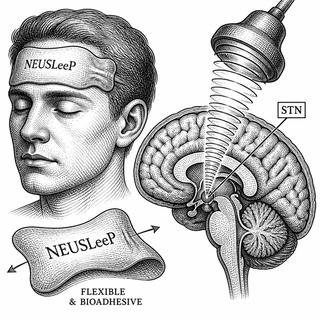
In this study, the patch combined a tunable concentric-ring ultrasound array with soft hydrogel electrodes and stretchy interconnects so people could wear it through natural sleep. No small thing, considering the human body treats “comfortable overnight device” as more of a challenge than a design brief.
Why poke the subthalamic nucleus at bedtime?
The STN is usually discussed in movement disorders, especially Parkinson’s disease, where deep brain stimulation has made it a bit of a celebrity in neurology circles. But it also sits in networks involved in arousal, motor control, and sleep-wake regulation. In other words, it’s not just a movement hub - it’s part of the brain’s broader backstage crew.
The researchers wanted to see whether precisely targeting the STN during sleep could influence REM sleep, the stage associated with vivid dreams, memory processing, and emotional regulation. REM is the brain’s strange late-night shift - lots of activity, temporary muscle paralysis, and dream plots written by what appears to be an unsupervised committee.
In a 28-participant study, the patch increased REM duration by 4.6% and reduced REM latency by 24%, meaning people reached REM faster and spent a bit more time there Tang et al., 2026. That’s not “you wake up as a sleep god” territory, but it is a meaningful proof of concept.
Why researchers are paying attention
This paper lands in a larger wave of interest around noninvasive neuromodulation - tools that can influence brain circuits without surgery. Focused ultrasound has become especially exciting because it offers depth and precision that other techniques struggle to match. Recent reviews in high-impact journals have described low-intensity focused ultrasound as a promising approach for circuit-specific neuromodulation, though questions remain about mechanisms, dosing, and long-term safety [Blackmore et al., 2019; Folloni et al., 2023].
Sleep itself is also having a bit of a scientific main-character moment. Reviews over the past few years have emphasized that REM sleep is tied not just to dreaming, but also to memory integration, emotional processing, and psychiatric health [Scarpelli et al., 2021; Peever and Fuller, 2017]. So if you can safely and noninvasively tune REM, that opens some very interesting doors.
And yes, those doors include possible future applications for insomnia, trauma-related sleep disruption, depression, and disorders where REM architecture goes off-script. Not tomorrow. Not next Tuesday. But the direction is clear.
The cool part - and the “let’s not get carried away” part
What makes this study especially clever is the closed-loop feel of the system. It’s not just blasting ultrasound into the void and hoping for the best. It monitors electrophysiology in real time while delivering targeted stimulation. That combination - sensing plus modulation - is where a lot of next-generation neurotechnology is heading.
Still, a few caveats deserve a seat at the bar.
First, this was a relatively small study. Twenty-eight participants is enough to be interesting, not enough to settle everything. Second, boosting REM is not automatically good in every context. Sleep is an ecosystem, not a video game stat you max out without consequences. Third, the field still needs replication, optimization, and longer-term safety data, especially for repeated home use.
There’s also the basic challenge that the brain is absurdly complicated. You can target one region and still be affecting networks that ripple outward in ways we don’t fully understand. Neuroscience remains the art of learning that the thing you thought was a simple knob is actually attached to twelve hidden pulleys and one raccoon.
So what’s the big picture?
The big picture is that we may be getting closer to wearable brain interfaces that do something genuinely sophisticated: read the sleeping brain and gently steer it, without surgery, wires in the skull, or a lab full of intimidating hardware. That’s a big leap from sleep trackers that mostly tell you, in polished fonts, that your night was “suboptimal.” Thanks, gadget. Very healing.
If this line of work holds up, the future version could be a soft patch that helps tune specific sleep stages for specific clinical needs. That’s a tantalizing idea - not because it sounds futuristic, but because it sounds weirdly practical. A stick-on system that nudges deep brain circuits while you sleep? Science fiction has officially been mugged by biomedical engineering.
References
Tang KWK, Baird B, Moscoso-Barrera WD, et al. Skin-attached bioadhesive patch enabling ultrasound deep brain stimulation and real-time electrophysiological monitoring for REM sleep enhancement. Nat Commun. 2026;17. doi:10.1038/s41467-026-73787-6
Blackmore J, Shrivastava S, Sallet J, Butler CR, Cleveland RO. Ultrasound neuromodulation: A review of results, mechanisms and safety. Neuron. 2019;103(4):556-573. doi:10.1016/j.neuron.2019.05.038
Folloni D, Verhagen L, Mars RB, Fouragnan E. Low-intensity focused ultrasound neuromodulation: an emerging tool for probing and influencing brain circuits. Trends Cogn Sci. 2023;27(4):306-322. PMCID:PMC10066287
Scarpelli S, Alfonsi V, Gorgoni M, et al. REM sleep in mental disorders: a review of the literature. Brain Sci. 2021;11(4):487. doi:10.3390/brainsci11040487
Peever J, Fuller PM. The biology of REM sleep. Nat Rev Neurosci. 2017;18(8):459-472. doi:10.1038/nrn.2017.65
Disclaimer: The image accompanying this article is for illustrative purposes only and does not depict actual experimental results, data, or biological mechanisms.