
What if the ache that appears after weeks of stress is not your body being dramatic, but your brain forwarding the wrong memo to the pain department? Counterintuitively, a mouse study suggests the problem may begin not in sore tissue, but in a stress circuit telling the nervous system, with questionable diplomacy, that ordinary touch now deserves a formal complaint.
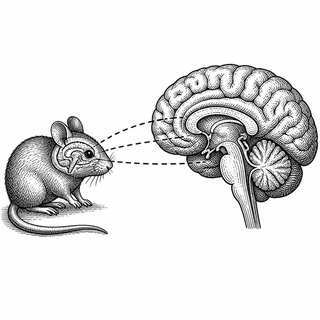
The paper, published in Cell Reports, maps a pathway from the central amygdala to the locus coeruleus and onward to the lateral periaqueductal gray. That sounds like someone dropped a neuroanatomy textbook.
Meet the Usual Suspects
The central amygdala, or CeA, helps turn threat signals into bodily responses. If the amygdala were a household, the CeA would be the person who hears one floorboard creak and immediately checks every window.
The locus coeruleus, or LC, is a small brainstem nucleus whose name means "blue spot," because early anatomists noticed its pigment before they knew it was a tiny stress-and-alertness broadcaster. It is the brain's main source of norepinephrine. The periaqueductal gray, or PAG, helps control pain and defensive behaviors.
What the Researchers Found
Wei and colleagues used mice exposed to chronic restraint stress, a standard model for prolonged stress. These mice developed allodynia, meaning normally harmless touch became painful, and they also showed aversion-related behaviors. In plain English: the nervous system started treating gentle input like it had arrived wearing brass knuckles.
The team found that noradrenergic LC neurons helped drive both pain sensitization and aversion. GABAergic neurons from the central amygdala that project to the LC became more active under chronic stress. When researchers inhibited that CeA-to-LC pathway, the mice showed less pain sensitization and less aversion. This did not fix depression-like behaviors. The brain is not running one big "bad mood and pain" switch. It is running several fussy little circuits, each with its own clipboard.
Then came the next relay. LC neurons receiving CeA input activated glutamatergic neurons in the lateral PAG. Put together, the study proposes a CeA -> LC -> lateral PAG pathway that helps convert chronic stress into pain and aversion in mice (Wei et al., 2026).
Why This Is More Than Brain Cartography
Chronic pain is not rare background noise. CDC data estimate that in 2023, 24.3% of U.S. adults had chronic pain, and 8.5% had high-impact chronic pain that limited life or work. This is not a niche problem hiding in the footnotes. It is more like a national group chat nobody asked to join.
Clinicians already know that pain and stress can reinforce each other. Pain worsens sleep, mood, movement, and social life. Stress can heighten vigilance, tension, inflammation, and fear of pain. A review called this a mutually reinforcing cycle, polite academic language for "the system keeps feeding itself snacks after midnight."
The new study adds a sharper biological sketch. Instead of saying stress affects pain in some grand cloudy way, it points to a named circuit and shows that dialing it down changes behavior in mice. It also suggests that some pieces can be separated: pain sensitization and aversion traveled through this CeA-LC-PAG route, while depression-like behavior did not.
The Catch, Because Biology Enjoys Humbling Everyone
This is a mouse study. Mice are useful, but they are not small humans with tails and tiny opinions about workplace stress. Chronic restraint stress is also a model, not a replica of human life, where pain can involve injury, immune signaling, sleep loss, medication history, and the quiet despair of insurance paperwork.
Still, the circuit logic is valuable. Other work has highlighted the LC as a modular hub in pain, stress, aversive learning, and arousal. Recent Neuron, Nature, and Science Advances papers also show how specific circuits split arousal, aversion, anxiety, and bodily stress responses into separate lanes. Pain is not just a volume knob. It is a committee meeting, and several members arrived overcaffeinated.
Where This Could Lead
If future studies reproduce and extend these findings, the payoff could be better targeted treatments for stress-linked pain: drugs aimed at norepinephrine receptors, neuromodulation, behavioral treatments timed to calm threat circuits, or combinations that treat pain and aversion without flattening every emotional system in sight.
The most intriguing idea is not that scientists have found "the pain switch." They have not, and anyone selling you one should be watched carefully. The better idea is that chronic stress may recruit distinct neural routes for different parts of suffering. Pain, aversion, and depression-like states may overlap, but they are not identical twins.
For people living with chronic pain, that distinction matters. It hints at a future where treatment can ask, "Which part of this system is keeping the alarm going?" That is a useful question. Also a far less smug one.
References
Wei J, Liu A, Cao Y, Fang JM, Chen Q, Ma J, Zhu X, Zhang Z, Song ZH, Meng Q. A central amygdala-locus coeruleus pathway mediating pain under chronic stress. Cell Reports. 2026;45(7):117570. doi:10.1016/j.celrep.2026.117570
Suarez-Pereira I, Llorca-Torralba M, Bravo L, Camarena-Delgado C, Soriano-Mas C, Berrocoso E. The role of the locus coeruleus in pain and associated stress-related disorders. Biological Psychiatry. 2022;91(9):786-797. doi:10.1016/j.biopsych.2021.11.023
Li D, Li YC, Zhu ZY, Zhang FC, Zhao QY, Jiang JH, Shen B, Tang Y, Xu GY. The paraventricular thalamus mediates visceral pain and anxiety-like behaviors via two distinct pathways. Neuron. 2025;113(14):2310-2324.e7. doi:10.1016/j.neuron.2025.04.019
Seo DO, Zhang ET, Piantadosi SC, Marcus DJ, Motard LE, Kan BK, Gomez AM, Nguyen TK, Xia L, Bruchas MR. A locus coeruleus to dentate gyrus noradrenergic circuit modulates aversive contextual processing. Neuron. 2021;109(13):2116-2130.e6. doi:10.1016/j.neuron.2021.05.006 PMCID: PMC8754261
Luskin AT, Li L, Fu X, Martin MM, Barcomb K, Girven KS, Blackburn T, Wells BA, Thai ST, Li EM, et al. Heterogeneous pericoerulear neurons tune arousal and exploratory behaviours. Nature. 2025;643(8071):437-447. doi:10.1038/s41586-025-08952-w PMCID: PMC12240712
Zhao WJ, Lu YX, Fan GD, Zhou J, Tan CY, Huang PP, Ye B, Xie F, Zhu Y, Wang BH, et al. A central CeA-LC-PVH circuit mediates stress-induced osteopenia via skeletal sympathetic nerves in male mice. Science Advances. 2025;11(49):eadz9329. doi:10.1126/sciadv.adz9329 PMCID: PMC12680053
Rikard SM, Strahan AE, Schmit KM, Guy GP Jr. Chronic pain among adults - United States, 2019-2021. MMWR Morbidity and Mortality Weekly Report. 2023;72(15):379-385. doi:10.15585/mmwr.mm7215a1
CDC National Center for Health Statistics. Chronic pain and high-impact chronic pain in U.S. adults, 2023. Data Brief No. 518. 2024. https://www.cdc.gov/nchs/products/databriefs/db518.htm
Disclaimer: The image accompanying this article is for illustrative purposes only and does not depict actual experimental results, data, or biological mechanisms.