
Across the studies Lakra and colleagues review, the recurring surprise was not that aging brain tissue looked chaotic. The surprise was that the chaos had a zip code. Genes were not simply turning up or down like moody dimmer switches. They were doing it in neighborhoods, next to plaques, blood vessels, immune cells, tired neurons, and other microscopic residents who apparently believe property values depend on inflammation.
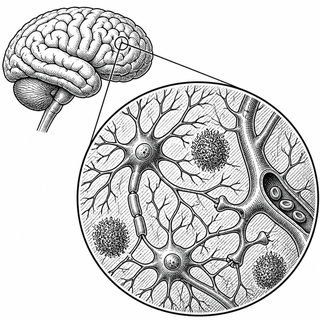
That is the point of spatial transcriptomics. It asks a very blunt question: where, exactly, is the molecular weirdness happening?
Old-school bulk transcriptomics took a piece of tissue, blended the signal, and reported an average. Useful, yes. Also a little like reviewing a restaurant by pureeing the appetizer, steak, and receipt. Single-cell sequencing fixed part of that problem by identifying individual cell types. But it often lost the map. Spatial transcriptomics keeps the tissue architecture intact while reading RNA, so researchers can see which genes are active and where those cells sit in the original tissue [Lakra et al., 2026].
The Brain Is Not Soup
Neurodegenerative diseases do not hit the brain evenly. Alzheimer’s disease, Parkinson’s disease, ALS, and related disorders have favorite targets, because apparently even cellular collapse has preferences. One region frays early. Another resists longer. A third starts calling in immune cells like a neighborhood watch with poor boundaries.
That spatial pattern matters. A neuron near an amyloid plaque may behave differently from the same neuron a few millimeters away. Microglia, the brain’s resident immune cells, may look helpful in one patch and overcaffeinated in another. Blood vessels, glial cells, inhibitory neurons, and extracellular junk all join the conversation. It is less “one bad gene did it” and more “the group chat has become unmanageable.”
Lakra and colleagues argue that spatial transcriptomics fills the gap between molecular discovery and clinical use by preserving the tissue’s geography while measuring gene activity at high resolution. Add multi-omics, meaning layers such as transcriptomics, epigenomics, proteomics, metabolomics, imaging, and clinical data, and the result becomes less like a snapshot and more like a crime board. Red string optional. Sanity not guaranteed.
Plaques Have Neighbors
Recent Alzheimer’s work shows why this matters. A 2026 Nature Communications study used two spatial transcriptomics platforms in mouse models and found vulnerable subtypes of parvalbumin interneurons in the retrosplenial cortex, an area affected early in Alzheimer’s pathology. The researchers saw reduced signals in genes linked with inhibitory neuron function, including Dner, Gad1, and Pvalb [Seo et al., 2026].
Another 2025 spatial study of human Alzheimer’s tissue mapped multiple cortical regions near amyloid beta plaques. It found region-specific responses involving inhibitory neurons, endosomal and lysosomal trafficking, metallothionein genes, blood-brain barrier dysfunction, vascular repair, and cell-cell communication [Bayaraa et al., 2025]. Translation: the plaque is not the whole story. The neighborhood response may decide whether tissue bends, breaks, or quietly files a complaint with biology.
This helps explain why neurodegeneration is so hard to treat. The disease is not just a blob of pathology. It is a shifting microenvironment. Cells react to nearby damage, to age, to immune signals, to vascular stress, and to each other. A therapy that looks brilliant in a dish may walk into the actual brain and discover that the local politics are hostile.
Biomarkers Need Addresses
Biomarkers are often discussed like magic labels: find the right molecule, diagnose the disease, cue the elegant music. Reality is less polite. A useful biomarker may depend on cell type, disease stage, brain region, and whether it sits next to a pathological structure. Location can turn a vague signal into a sharper one.
That is where spatial multi-omics could earn its keep. If researchers can connect spatial RNA patterns with proteins, metabolites, imaging findings, and clinical symptoms, they may identify earlier disease signatures or separate patients into more meaningful subgroups. Not “Alzheimer’s, broadly.” More like “this person has a vascular-inflammatory-plaque-adjacent pattern that suggests a different risk path.” Less catchy. More useful.
The same logic extends beyond Alzheimer’s. A 2025 Brain study in Parkinson’s disease linked atrophy patterns to both network spread and local vulnerability, showing that neurodegeneration follows geography as well as biology [Vo et al., 2025]. Spatial omics gives researchers a way to inspect that geography at molecular scale.
The Catch, Because Science Charges Rent
None of this is plug-and-play medicine yet. Spatial platforms vary in resolution, gene coverage, cost, tissue compatibility, and computational demands. Human brain samples are precious, uneven, postmortem, and often come with clinical histories that look like someone spilled coffee on the metadata. Integrating spatial transcriptomics with proteomics, imaging, and patient outcomes is powerful, but it also creates a data mountain wearing a lab coat.
Still, the direction is clear. The aging brain is not failing as a uniform organ. It is failing through local neighborhoods of stressed cells, confused immune responses, fragile circuits, and damaged infrastructure. Spatial transcriptomics lets researchers stop asking only what changed and start asking where the change became dangerous.
That is a better question. Also a more annoying one. Biology loves those.
References
Lakra A, Singh N, Vashisth S, Ambasta RK, Kumar P. Spatial transcriptomics and multi-omics approach to decipher age-related tissue microenvironments and therapeutics in neurodegeneration and aging. Ageing Research Reviews. 2026;119:103189. https://doi.org/10.1016/j.arr.2026.103189
Seo H, Terstege DJ, Ren Y, Liu S, Goring KR, Ahn BY, Epp JR. Dual platform spatial transcriptomics reveals parvalbumin interneuron subtype vulnerability in mouse models of Alzheimer's disease. Nature Communications. 2026. https://doi.org/10.1038/s41467-026-73474-6
Bayaraa O, Aksu M, DeBose-Scarlett E, et al. Multi-region spatial transcriptomics reveals region specific differences in response to amyloid beta plaque induced changes in Alzheimer's disease. Human Genomics. 2025;20:2. PMCID: PMC12772032. https://doi.org/10.1186/s40246-025-00875-x
Vo A, Tremblay C, Rahayel S, et al. Global network and local vulnerabilities underlie brain atrophy across Parkinson's disease stages. Brain. 2025. https://doi.org/10.1093/brain/awaf432
Disclaimer: The image accompanying this article is for illustrative purposes only and does not depict actual experimental results, data, or biological mechanisms.