
Down in the fly's ventral nervous system, the nerve-cord corridor below the brain where movement commands get routed like parcels on a conveyor belt, how early does a locomotion circuit have to start ticking? According to a new Cell Reports study, some key timekeepers are dopaminergic neurons born in the embryo. They do not clock out after larval life. They keep showing up through metamorphosis and adulthood, like the one employee who still knows where the old fuse box is.
A Walking Machine With a Childhood Memory
Fruit flies are useful here because they do something scientifically generous: they rebuild themselves. A larva crawls as a soft little tube with ambitions, then seals itself into a pupa, remodels the nervous system, and emerges as an adult fly with legs, wings, and a new behavioral operating system.
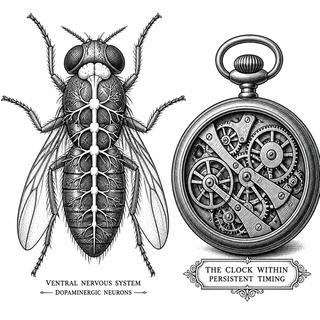
That makes the central question deliciously weird. How does an animal keep moving when its nervous system is being renovated with the enthusiasm of a contractor who found extra budget?
Padmanabhan and colleagues focused on dopamine neurons, often abbreviated DANs. In humans, dopamine is famous for movement, motivation, reward, and headlines it did not ask for. In flies, dopamine also tunes behavior, sensory processing, and locomotion. The fly nervous system is compact enough to manipulate, but complex enough to avoid being a toy model with delusions of grandeur.
The Same Clockwork, Different Body
The team used stage-specific behavior tests, optogenetics, in vivo imaging, and fluorescent tracking. Translation: they watched flies move, used light to nudge selected neurons, measured neural activity, and followed cells as the animal changed form. If the brain is a Rube Goldberg machine, this is checking the marble, the gear, the spring, and the suspicious lever labeled "probably dopamine."
The surprise was not just that dopamine mattered. The surprise was continuity. A subset of ventral nervous system DANs established during embryonic development helped control locomotion across larval stages, pupal transition, and adult life. Interfere with them, and locomotion suffered. Activate them, and movement changed.
Metamorphosis is not a gentle software update. It is more like taking apart a pocket watch, replacing half the cogs, polishing the case, and expecting it to still keep time on Monday morning. These embryonic DANs appear to provide a persistent timing element while the body reconfigures around them.
Developmental Genes Refuse to Retire
The study also found that these neurons keep expressing developmental transcription factors. These molecular switches help cells decide what genes to use. During development, they are the foremen telling cells, "You, become this. You, wire over there. No, not like that."
Here, the foremen stayed on the job. When the researchers knocked down certain factors in post-mitotic VNS dopamine neurons, especially Antp and Pdm2, adult flies showed reduced neurite arborization and worse locomotion. Neurites are the branching cellular cables neurons use to connect and communicate. Less arborization means the wiring tree gets scrawnier, and the movement machine starts missing beats.
The neurons are not frozen in embryonic amber. They persist, but they also remodel. The cell identity program acts less like a birth certificate and more like a maintenance manual. Keep these instructions active, and the neural gear teeth mesh. Lose them, and the mechanism grinds.
Why Tiny Fly Footwork Matters
Nobody is claiming this is a treatment map for human movement disorders. A fruit fly is not a tiny person with wings and poor snack hygiene. But the principle is worth watching: early neural activity may leave durable marks on circuits that survive developmental change.
Recent work makes this context richer. Drosophila connectome studies have mapped huge portions of the fly nervous system, including the ventral nerve cord, at synaptic resolution. Other studies have imaged neural dynamics during walking. The field is moving from "which neuron exists?" toward "which neuron keeps the machine running when the chassis changes?"
That shift matters for developmental neuroscience, movement disorders, and aging. Many conditions involve circuits that form early, remodel, compensate, and eventually fail. If persistent developmental programs help neurons maintain adult function, they might reveal why some circuits stay resilient while others wobble out of rhythm. The fly gives researchers a living clockwork where every gear can be labeled, nudged, and occasionally blamed.
The Takeaway Gear
This paper argues that locomotion is not rebuilt from scratch at each life stage. Some embryonic dopamine neurons act like durable timing gears, keeping movement coordinated while the animal trades crawling for walking. Their activity matters, their branches matter, and their developmental gene programs keep mattering long after development was supposed to have left the building.
The brain, as usual, has declined to be simple. But it left us a readable mechanism: early-born dopamine neurons, lifelong movement, and genetic instructions that keep the locomotor watch ticking.
Disclaimer: The image accompanying this article is for illustrative purposes only and does not depict actual experimental results, data, or biological mechanisms.
References
- Padmanabhan A, Rahman D, Zhu R, et al. Embryonic dopaminergic neuron activity sustains lifelong locomotion in Drosophila. Cell Reports. 2026. DOI: 10.1016/j.celrep.2026.117524. PMID: 42319821.
- Siju KP, De Backer JF, Grunwald Kadow IC. Dopamine modulation of sensory processing and adaptive behavior in flies. Cell and Tissue Research. 2021;383:207-225. DOI: 10.1007/s00441-020-03371-x. PMCID: PMC7873103.
- Mark B, Lai SL, Zarin AA, et al. A developmental framework linking neurogenesis and circuit formation in the Drosophila CNS. eLife. 2021;10:e67510. DOI: 10.7554/eLife.67510. PMCID: PMC8139831.
- Carreira-Rosario A, York RA, Choi M, Doe CQ, Clandinin TR. Mechanosensory input during circuit formation shapes Drosophila motor behavior through patterned spontaneous network activity. Current Biology. 2021;31:5341-5349.e4. DOI: 10.1016/j.cub.2021.08.022. PMCID: PMC8665011.
- Brezovec BE, Berger AB, Hao YA, Chen F, Druckmann S, Clandinin TR. Mapping the neural dynamics of locomotion across the Drosophila brain. Current Biology. 2024;34:710-726.e4. DOI: 10.1016/j.cub.2023.12.063. PMID: 38242122.
- Azevedo A, Lesser E, Phelps JS, et al. Connectomic reconstruction of a female Drosophila ventral nerve cord. Nature. 2024;631:360-368. DOI: 10.1038/s41586-024-07389-x.