
A storm doesn't announce itself with a single thunderclap. It rolls in as a thousand small signals: a drop in pressure, a shift in the wind, the particular hush before the rain. Your body reads its own weather the same way. Right now, without looking, you know where your hand is. You know your foot is crossed over your knee. You know you're slouching (sorry). That quiet, constant forecast of where your limbs are and how fast they're moving has a name, proprioception, and a new review in eLife argues that the instruments playing it are far more numerous than anyone bothered to count.
The Sense You Forgot You Had
Proprioception is the unsung sixth sense, the one that lets you touch your nose with your eyes closed or walk down stairs without staring at your feet like a newborn giraffe. It runs on specialized neurons buried in your muscles and tendons, sensors that whisper to your spinal cord about stretch, tension, and motion. Lose it, as a handful of rare patients have, and you have to watch every limb to control it, conducting your own body by sight alone. It's exhausting in a way that makes you appreciate how much your nervous system normally handles backstage.
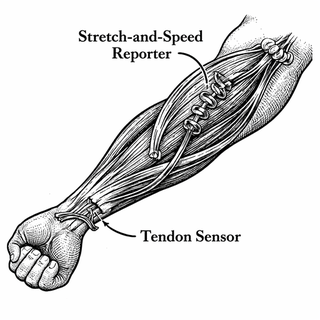
For decades the textbook kept it simple. Three players. Type Ia and type II neurons wrap around muscle spindles (think of them as stretch-and-speed reporters), and type Ib neurons sit in the Golgi tendon organs, clocking how hard a muscle is pulling. Three sections, one tidy ensemble, end of story.
Plot Twist: It's a Whole Symphony
Here's where the new review by Lallemend, Techameena, and Hadjab picks up the thread, and where the music gets interesting. When researchers started reading these neurons one cell at a time, profiling their genes with single-cell sequencing, the neat trio fell apart into something richer. Those three "cardinal classes" turned out to hum in many distinct voices, each switching on its own set of molecular markers like sections of an orchestra tuning to slightly different notes.
The review pulls these scattered findings into one score. The authors map functional molecular markers onto specific subtypes and sketch out a working taxonomy, a first attempt at naming all the players. Some Ia neurons crank up a glutamate-loading protein called VGLUT2. A receptor called CHRM4 shows up only in one flavor of type II neuron. Another marker, NPY1R, marks the tendon-tension crowd and a type II subtype. The melody you thought you knew has counter-melodies you never noticed.
And these aren't just chemical labels for the sake of labels. The hunch, supported by earlier work showing distinct proprioceptor subtypes tuning different aspects of movement, is that each molecular signature lines up with a different job, a different wiring diagram, a different rhythm of firing. One subtype may obsess over the speed of a stretch while another keeps a steady drone on position. Same orchestra, different parts, and the brain reads the full arrangement to know what your body is doing.
Why Should You Care About Mouse Leg Neurons?
Fair question. Riff on it for a second. Every smooth motion you make, catching a glass before it tips, adjusting your grip on a railing, the unconscious sway that keeps you upright, depends on this stream of information arriving correctly and on time. When it degrades, life gets harder fast: stroke and spinal injury, aging, and neurodegenerative disease all scramble the signal.
The trouble is, you can't fix an instrument you can't name. If "type II neuron" actually covers four or five different cell types doing different things, then treatments aimed at the whole group are blunt by design. A precise parts list, the kind this review is trying to assemble, is what lets future work target the right cell for the right deficit. It's also the blueprint engineers will need to build prosthetics and brain-machine interfaces that don't just move but actually feel where they are, restoring the closed loop between body and brain.
Still Tuning Up
The honest note to end on: this taxonomy is, in the authors' own words, tentative. Much of it comes from mouse muscle and from matching genes to function by educated inference rather than direct proof. The hard work ahead is confirming that each molecular subtype really does play the part its markers suggest, then tracing how those parts harmonize inside the spinal circuits that run movement. But you can't conduct an orchestra you've never fully counted. This review finally hands us the roster, and that's where the real performance begins.
Disclaimer: The image accompanying this article is for illustrative purposes only and does not depict actual experimental results, data, or biological mechanisms.
References
-
Lallemend F, Techameena P, Hadjab S. Functional and molecular insights into muscle proprioceptors. eLife. 2025. DOI: 10.7554/eLife.106803. PMID: 41313231. Full text
-
Wu H, Petitpré C, Fontanet P, et al. Distinct subtypes of proprioceptive dorsal root ganglion neurons regulate adaptive proprioception in mice. Nature Communications. 2021;12:1026. DOI: 10.1038/s41467-021-21173-9. PMCID: PMC7884389
-
Oliver KM, Florez-Paz DM, Badea TC, et al. Molecular correlates of muscle spindle and Golgi tendon organ afferents. Nature Communications. 2021;12:1451. DOI: 10.1038/s41467-021-21880-3. PMCID: PMC7977083
-
Wang Y, Wu H, Zelenin P, et al. MS and GTO proprioceptor subtypes in the molecular genetic era: Opportunities for new advances and perspectives. PMID: 35792479