
People say the brain is like a computer. It's not. Computers wait politely for commands. Your motor cortex is more like a crowded kitchen where one chef is yelling "fire the pasta," another is hiding the matches, and somehow your hand still reaches for the coffee without turning the mug into modern art.
That tiny miracle is movement initiation. Not movement itself. The start of movement. The suspicious gap between "I am about to do the thing" and "the thing is now happening, please do not drop it."
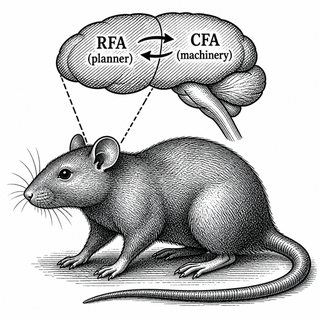
In a new Cell Reports study, Alyahyay and colleagues went after that gap in rats, focusing on two forelimb regions: the rostral forelimb area, or RFA, which works like premotor cortex, and the caudal forelimb area, or CFA, which works more like primary motor cortex. Think of RFA as the planner with a clipboard. CFA is the machinery floor.
The Awkward Beauty of Not Moving
Before you move, your motor system gets busy. Neurons change firing patterns. Plans form. Options narrow. Yet your arm does not launch across the room every time you think about reaching for chips.
This is where the "movement-null" space enters. Some neural activity can prepare a movement without pushing the muscles into action. It is the brain's version of rehearsing a speech silently instead of accidentally proposing a toast at the dentist.
The complementary state is "movement-potent" activity. That is the stuff that can drive output. Work from Churchland, Shenoy, Kaufman, and others made this framework hard to ignore. The annoying question remained: what circuit flips preparation into action?
Follow the Wire
The team traced projections from RFA into CFA and asked what those axons were doing before and during forelimb movement. RFA-to-CFA projections mostly carried pre-movement activity. In plain English: the planner was talking before the machinery started moving.
Then the researchers used optogenetics to inhibit those projections. Optogenetics is the method where scientists make selected neurons sensitive to light and then use light to control them, because apparently "very tiny neural flashlight" was a legitimate career path.
Blocking the RFA-to-CFA pathway disrupted behavior about as much as inhibiting RFA or CFA themselves. The connection was not decorative wiring. It was part of the start button.
The Same Signal Changes Its Mind
During preparation, RFA inputs did not simply excite CFA. They enhanced some CFA neurons and suppressed others in a balanced way. That pattern lined up with CFA's preparatory dimension, the neural zone where the system can get ready without accidentally punching the air.
During movement, the influence shifted. RFA inputs became mostly excitatory and aligned with CFA's movement-potent dimension. The same pathway changed its functional meaning depending on timing. It went from "hold, hold, hold" to "fine, now."
If brain regions had office Slack channels, RFA would be the person who types three paragraphs, deletes two, then sends: "Proceed."
Why This Is More Than Rat Arm Trivia
This study links a big mathematical idea to actual circuit behavior. Neural state space can sound like something invented to frighten graduate students. Here it maps onto a real projection between two cortical areas, with different effects before and during movement.
That gives researchers a better model of how the brain avoids two bad outcomes: paralysis by planning and chaos by over-eagerness. You need preparation, but not premature action. You need action, but not a nervous system that behaves like a toddler near an elevator button.
The clinical angle is still early. This was a rat study, not a human therapy. But the principle could matter for stroke rehabilitation, motor recovery, brain stimulation, and brain-machine interfaces. Future therapies may need to target not just "motor cortex activity," but the timing of communication between planning and execution circuits.
That is a more precise target. Also a more irritating one, because biology enjoys adding knobs.
The Takeaway
Movement begins before movement begins.
Alyahyay and colleagues show that premotor projections into motor cortex help shape the quiet preparatory state, then shift toward driving movement when action starts. The brain does not merely send a command. It changes the conversation so the same network can first plan without moving, then move without re-planning itself into a puddle.
Elegant? Yes. Weird? Obviously. Useful? Very possibly.
The brain is not a computer. It is a committee with timing.
References
-
Alyahyay M, Ammer JJ, Kalweit G, Zhu H, Adzemovic A, Kalweit M, et al. Mechanisms of premotor-motor cortex interactions during movement initiation. Cell Reports. 2026. DOI: 10.1016/j.celrep.2026.117542
-
Churchland MM, Shenoy KV. Preparatory activity and the expansive null-space. Nature Reviews Neuroscience. 2024;25:213-236. DOI: 10.1038/s41583-024-00796-z
-
Giordano N, Alia C, Fruzzetti L, Pasquini M, Palla G, Mazzoni A, et al. Fast-spiking interneurons of the premotor cortex contribute to initiation and execution of spontaneous actions. Journal of Neuroscience. 2023;43(23):4234-4250. DOI: 10.1523/JNEUROSCI.0750-22.2023
-
Fleischmann R, Triller P, Brandt SA, Schmidt SH. Human premotor corticospinal projections are engaged in motor preparation at discrete time intervals: a TMS-induced virtual lesion study. Frontiers in Neuroergonomics. 2021;2:678906. DOI: 10.3389/fnrgo.2021.678906 PMCID: PMC10790911
-
Kirk EA, Hope KT, Sober SJ, Sauerbrei BA. An output-null signature of inertial load in motor cortex. Nature Communications. 2024;15:7309. DOI: 10.1038/s41467-024-51750-7
Disclaimer: The image accompanying this article is for illustrative purposes only and does not depict actual experimental results, data, or biological mechanisms.