
The problem with studying white matter is that it behaves less like a neat bundle of cables and more like fog rolling through a city at dawn: everywhere, essential, and hard to measure without the scientific equivalent of squinting. Gray matter gets the glamour, because neuron cell bodies are dramatic little divas. White matter does the quieter work, carrying messages between brain regions through myelinated axons, like a transit system where every train is late only if biology says so.
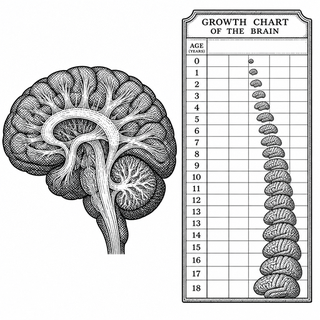
When white matter changes, the effects can show up in development, aging, disease, and the mystery novel we call "why did I walk into this room?"
Growth Charts, But Make Them Brainy
Doctors have used growth charts for height and weight for ages. A kid lands on the 70th percentile for height, and everyone nods instead of summoning a committee. Brain imaging has wanted something similar: a way to ask whether a scan looks typical for someone's age and sex, instead of comparing it to a vague mental picture of "normal," which is really just a shrug wearing a lab coat.
In 2022, researchers built large-scale brain charts using more than 120,000 MRI scans across the human lifespan, showing that the idea could work for brain anatomy (Bethlehem et al., 2022). But white matter needed its own map. Diffusion MRI tracks how water moves through tissue. In white matter, water tends to move along axon bundles, so its motion gives clues about microstructure. It is less "Google Maps for thoughts" and more "weather radar for microscopic road conditions."
The New Study: 35,120 Scans Walk Into a Scanner
In the new Nature paper, Kim and colleagues processed and standardized 35,120 brain scans from 50 imaging studies, covering people from birth to 100 years old (Kim et al., 2026). Their goal was to build reference charts for white matter macrostructure, such as volume, and microstructure, including diffusion measures like fractional anisotropy, mean diffusivity, axial diffusivity, and radial diffusivity.
If those terms sound like a committee of physicists named a rainstorm, the gist is simple: each measure hints at how organized, mature, or worn-down white matter pathways appear.
The team found that white matter changes rapidly early in life, then follows different timing depending on the feature and pathway. Some features peak or bottom out at different ages. The brain, apparently, refuses to mature as a single unit because that would be too convenient and might make neuroscience smug.
Why This Is More Than a Pretty Curve
The real promise is context. A single MRI scan can show anatomy, but a brain chart asks a sharper question: compared with thousands of people at a similar life stage, is this white matter measurement expected, unusually high, unusually low, or taking a suspicious side street?
That matters because white matter alterations appear across developmental disorders, Alzheimer's disease, multiple sclerosis, traumatic brain injury, and psychiatric illness. A reference chart will not diagnose someone by itself. Brains are not sourdough starters where one weird bubble tells the whole story.
But if these charts are replicated, expanded, and tested clinically, they could help researchers compare disease effects, track change over time, and spot patterns that small studies miss. Another recent Nature Communications study built a normative model of white matter microstructure using 54,583 people and showed how deviations could be visualized in mild cognitive impairment, Alzheimer's disease, and 22q11.2 deletion syndrome (Villalon-Reina et al., 2026).
The Catch, Because Science Has Rent to Pay
The hard part is harmonization. MRI scanners differ. Protocols differ. Processing pipelines differ. Even a well-behaved scanner can introduce its own little personality, like a barista who insists your name is "Bran." Zhu and colleagues showed how diffusion MRI white matter reference curves can be harmonized across public datasets, underscoring that scanner and site differences are not background noise - they are part of the problem to solve (Zhu et al., 2025).
There is also the problem of lifespan coverage. Babies, older adults, and underrepresented populations are harder to sample well. Cross-sectional charts can miss how individuals change over time, a warning raised by longitudinal brain-chart work (Di Biase et al., 2023). A chart built from many people is powerful, but your brain is still annoyingly yours.
The Wiring Gets a Weather Report
This study gives white matter a reference frame. Not a final answer. More like an atlas of the brain's communication highways across a human life.
And that is the intriguing part. The brain is a storm system of signals, habits, repairs, delays, and detours. White matter is the infrastructure beneath the weather. With charts like these, scientists may finally be able to tell when the fog is ordinary morning mist and when it hints at a storm worth watching.
References
- Kim ME, Gao C, Ramadass K, et al. White matter micro- and macrostructure brain charts for the human lifespan. Nature. 2026. https://doi.org/10.1038/s41586-026-10454-2
- Bethlehem RAI, Seidlitz J, White SR, et al. Brain charts for the human lifespan. Nature. 2022;604:525-533. https://doi.org/10.1038/s41586-022-04554-y
- Zhu AH, Nir TM, Javid S, et al. Lifespan reference curves for harmonizing multi-site regional brain white matter metrics from diffusion MRI. Scientific Data. 2025;12:748. https://doi.org/10.1038/s41597-025-05028-2
- Villalon-Reina JE, et al. Lifespan normative modeling of brain microstructure. Nature Communications. 2026;17:4693. https://doi.org/10.1038/s41467-026-72875-x
- Di Biase MA, Tian Y, Bethlehem RAI, et al. Mapping human brain charts cross-sectionally and longitudinally. Proceedings of the National Academy of Sciences. 2023;120:e2216798120. https://doi.org/10.1073/pnas.2216798120
Disclaimer: The image accompanying this article is for illustrative purposes only and does not depict actual experimental results, data, or biological mechanisms.