The year is 2026. A neuroengineer in Davis just noticed something strange. A man with ALS was not just using a brain implant during tidy lab demos with researchers hovering nearby like nervous stage parents. He was using it at home, nearly every day, to talk, text, browse, work, and generally commit the suspicious act of living his life.
That is the plot twist in the Nature news story by Miryam Naddaf, which highlights a new Nature Medicine report on long-term home use of an intracortical brain-computer interface, or BCI. If a BCI sounds like a prop from a cyberpunk detective show, fair. The basic idea is simple: tiny electrodes listen to brain activity, software decodes the pattern, and a computer turns that pattern into action. The body may be locked down by disease, but the brain is still filing reports from headquarters.
The Case Of The Missing Voice
Motor neuron disease, including amyotrophic lateral sclerosis, damages the neurons that control voluntary muscles. That can mean weakness, paralysis, and severe trouble speaking. The cruelty is bureaucratic: the mind can still have plenty to say, but the delivery department has gone on strike.
Traditional assistive communication tools can help, but they often depend on eye tracking, residual movement, caregiver setup, or slow scanning systems. Useful? Absolutely. Effortless? Not exactly. Imagine trying to join a family argument through airport security. By the time your sentence gets out, someone has blamed the dishwasher.
BCIs try to bypass the broken motor pathway. Instead of asking the hand, tongue, or eyes to do the job, they ask the brain signal directly: what was the person trying to say or do?
What The New Study Actually Did
The Nature Medicine study followed one man with paralysis and severe dysarthria from ALS who used a multimodal intracortical BCI at home for 19 months. The system decoded attempted speech into text and also supported cursor control, meaning the same broad setup helped with both communication and computer use.
The numbers are where the detective drops the coffee. The participant used the system for more than 3,800 hours at home without researchers present. He produced 183,060 sentences, totaling 1,960,163 words, at an average rate of 56 words per minute. In formal testing, attempted speech was decoded with more than 99% word accuracy using a 125,000-word vocabulary Card et al., 2026.
That does not mean the device read his private thoughts like a nosy landlord. These systems decode intentional attempted speech or movement patterns during use. Still, yes, the ethics department has every right to keep its coffee strong.
Why This Feels Different
BCI research has had dramatic lab victories before. Researchers have decoded attempted handwriting into text Willett et al., 2021, decoded attempted speech at speeds approaching natural conversation Willett et al., 2023, and linked speech decoding to a digital avatar Metzger et al., 2023. More recent work has pushed toward real-time, expressive voice synthesis Littlejohn et al., 2025; Wairagkar et al., 2025.
But a lab demo is not a life. A lab demo is a crime scene photo. Home use is the neighborhood canvass, the receipts, the grainy security footage, the part where the evidence has to survive Tuesday.
That is why this report matters. It attacks the boring problems that decide whether technology becomes medicine: setup, reliability, recalibration, fatigue, independence, and whether the system works when nobody in a lab coat is there to whisper encouragement at the laptop.
The Real-World Door This Opens
If results like this hold up in more people, the impact could be huge. Communication is not a luxury app. It is how you ask for water, argue about politics, keep a job, tell a joke badly enough that your family groans, and remind people that you are still in the room.
For people with ALS, brainstem stroke, spinal cord injury, or other severe motor impairments, a dependable home BCI could shift assistive technology from emergency workaround to daily infrastructure. The dream is not to look futuristic. The dream is boring in the best way: wake up, turn it on, send a message, do your work, talk to your family, and have the computer behave itself like a well-trained accomplice.
The Suspect Is Still At Large
Now for the caution tape. This is one participant. Intracortical implants require brain surgery. Electrode stability, infection risk, hardware durability, cost, training burden, privacy, regulatory approval, and access all remain serious obstacles. ALS varies, brains vary, and neural signals are tiny electrical whispers recorded in a biological thunderstorm. Anyone selling instant miracles should be asked to step outside and explain themselves.
Still, this study is a big clue. It suggests high-performance BCIs can leave the lab and survive real life, which is where assistive technology either earns its badge or gets quietly filed under “cool, but exhausting.”
The brain, as usual, has been acting suspicious. Even when muscles go silent, the intent to speak can remain encoded in neural activity. With enough engineering patience and a decoder that knows where to listen, those signals can become words again. Not perfect science fiction. Something better: a practical tool with fingerprints all over everyday life.
References
Card, N. S., Singer-Clark, T., Peracha, H., et al. Long-term independent use of an intracortical brain-computer interface for speech and cursor control. Nature Medicine (2026). https://doi.org/10.1038/s41591-026-04414-6
Naddaf, M. At-home brain implant gives man with motor neuron disease his daily life back. Nature (2026). https://doi.org/10.1038/d41586-026-01863-4
Willett, F. R., Avansino, D. T., Hochberg, L. R., Henderson, J. M., & Shenoy, K. V. High-performance brain-to-text communication via handwriting. Nature 593, 249-254 (2021). https://doi.org/10.1038/s41586-021-03506-2
Willett, F. R., Kunz, E. M., Fan, C., et al. A high-performance speech neuroprosthesis. Nature 620, 1031-1036 (2023). https://doi.org/10.1038/s41586-023-06377-x
Metzger, S. L., Littlejohn, K. T., Silva, A. B., et al. A high-performance neuroprosthesis for speech decoding and avatar control. Nature 620, 1037-1046 (2023). https://doi.org/10.1038/s41586-023-06443-4
Littlejohn, K. T., et al. A streaming brain-to-voice neuroprosthesis to restore naturalistic communication. Nature Neuroscience 28, 902-912 (2025). https://doi.org/10.1038/s41593-025-01905-6
Wairagkar, M., Card, N. S., Singer-Clark, T., et al. An instantaneous voice-synthesis neuroprosthesis. Nature 644, 145-152 (2025). https://doi.org/10.1038/s41586-025-09127-3
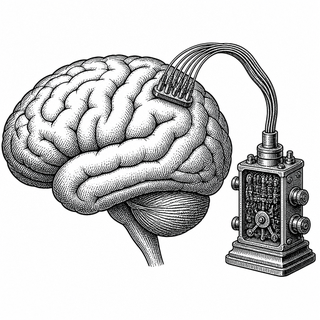
Disclaimer: The image accompanying this article is for illustrative purposes only and does not depict actual experimental results, data, or biological mechanisms.