
Twenty people, one 20-minute Gothic story, and roughly 86 billion neurons per person gives you about 1.72 trillion neurons trying to make sense of Edgar Allan Poe in Polish Sign Language. That is either neuroscience or the strangest book club in Warsaw. In a new Nature Communications study, Zimmermann and colleagues asked: when language comes through eyes and hands instead of ears and mouth, does the brain still build a story the same way?
Short answer: mostly yes. Longer answer: yes, but the visual-manual system brings its own wiring to the party, because apparently the brain cannot resist a custom plugin.
The Brain Has a Story Stack
When you follow a story, you are not collecting words like loose receipts in a junk drawer. You are building layers. A word means something. A sentence snaps words into structure. A paragraph updates who did what to whom, where the haunted mansion is, and whether anyone should have left three chapters ago.
Neuroscientists call this a cortical timescale hierarchy. Some brain areas track fast pieces, like words or phrases. Other areas integrate longer stretches, like plot, character goals, and the general vibe of "this house has real estate problems." Prior spoken-narrative work found that language areas and the default mode network, tied to memory, social thinking, and world-modeling, help stitch the story together.
The new study asked whether that hierarchy depends on speech. That matters because sign languages are full natural languages, not mime with better grammar. They use hands, face, body position, and signing space to carry meaning. Sign language can pack information visually and spatially, like a data dashboard with cheekbones.
Poe, But Make It fMRI
The researchers scanned 20 native signers while they watched a Polish Sign Language interpretation of The Fall of the House of Usher. They also watched scrambled versions. If a brain region responds similarly across people during the intact story, but not when the story gets chopped into linguistic confetti, that region is probably tracking shared narrative structure.
The key result was synchronization. Signers' brains lined up in hierarchical networks as they watched the signed story. Frontotemporal language regions tracked sentence-level structure. The default mode network tracked the larger plot. Even without sound, the brain still ran the story pipeline: tokens in, structure up, plot model out.
Speech, text, sign: different input ports, same need to assemble meaning before the narrative server times out.
The Universal Bits
The universal part is the big deal. The study supports the idea that language comprehension is not welded to sound. That fits with work showing that reading and listening share cortical maps for language timescales, and with reviews arguing that language networks care more about structure and meaning than about whether the signal arrived by air pressure, ink, pixels, or hands.
This pushes back against the lazy misconception that spoken language is the default operating system and sign language is an accessibility add-on. Nope. The brain builds linguistic narratives using abstract machinery that can run on multiple sensory platforms. Very elegant. Also rude, given that we still forget why we opened the fridge.
The Sign-Specific Surprises
The paper also found two signatures not previously reported in speech studies. First, the superior parietal cortex synchronized over long discourse timescales. That makes sense because sign languages use space richly: locations can represent people, objects, and relations. If a signer sets up "the brother over here" and "the haunted house over there," the brain has to keep that spatial grammar alive while the plot dances.
Second, ventral occipital cortex responded to word- and sentence-level processing. That is the visual system getting pulled into language work, the kind of cross-department collaboration the brain loves but every office manager fears. In sign, visual regions appear to participate in the linguistic stack.
Why This Matters Outside the Scanner
If these findings replicate and expand, they could sharpen language mapping in Deaf signers, especially in clinical contexts such as presurgical planning. They also make a strong case for studying natural language as people use it. Not isolated syllables. Not weird lab sentences about the cousin of the baker. Real stories, with plot, timing, memory, and enough ambiguity to keep the cortex employed.
The challenges are real. The sample was small, as fMRI studies often are. Polish Sign Language has its own structure, so other sign languages need testing. fMRI also measures blood-flow changes, not neurons texting each other directly, so interpretation requires care. Still, the design gives us a rare look at how a signed story unfolds in shared neural time.
The takeaway is simple: language is not sound wearing a lab coat. It is a system for building meaning across time. Whether the story arrives through ears or eyes, the brain still has to turn signals into a world you can inhabit. And if that world is Poe's crumbling mansion, maybe bring a flashlight.
References
Zimmermann M, Tomaszewski P, Marchewka A, Szwed M, Bedny M. Sign language narrative reveals universal and modality-specific features of cortical timescale hierarchy. Nature Communications. 2026. DOI: 10.1038/s41467-026-73895-3
Chang CHC, Nastase SA, Hasson U. Information flow across the cortical timescale hierarchy during narrative construction. Proceedings of the National Academy of Sciences. 2022;119(51):e2209307119. DOI: 10.1073/pnas.2209307119, PMCID: PMC9907070
Chen C, Dupré la Tour T, Gallant JL, Klein D, Deniz F. The cortical representation of language timescales is shared between reading and listening. Communications Biology. 2024;7:284. DOI: 10.1038/s42003-024-05909-z, PMCID: PMC11245628
Emmorey K. New perspectives on the neurobiology of sign languages. Frontiers in Communication. 2021;6:748430. DOI: 10.3389/fcomm.2021.748430, PMCID: PMC9648159
Tuckute G, Kanwisher N, Fedorenko E. Language in brains, minds, and machines. Annual Review of Neuroscience. 2024;47:277-301. DOI: 10.1146/annurev-neuro-120623-101142
Heilbron M, Armeni K, Schoffelen JM, Hagoort P, de Lange FP. A hierarchy of linguistic predictions during natural language comprehension. Proceedings of the National Academy of Sciences. 2022;119(32):e2201968119. DOI: 10.1073/pnas.2201968119, PMCID: PMC9371745
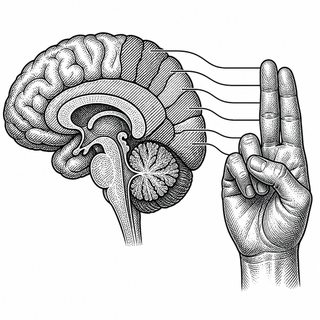
Disclaimer: The image accompanying this article is for illustrative purposes only and does not depict actual experimental results, data, or biological mechanisms.