A non-surgical way to nudge deep brain circuits is starting to look less like science fiction and more like an engineering problem with a very fussy client: the human skull. Let me explain how we got here.
Deep brain stimulation, or DBS, has long been one of medicine's more dramatic bargains. For Parkinson's disease, essential tremor, dystonia, obsessive-compulsive disorder, and some forms of epilepsy, doctors can implant electrodes into deep brain structures and send controlled pulses into misbehaving circuits. It can help. It can also mean surgery, hardware, infection risk, and the emotional ambiance of someone saying, "We are going to put wires in your brain."
That is why transcranial temporal interference stimulation, mercifully shortened to tTIS, has been causing a weather shift in neuromodulation research. In a 2026 perspective in Nature Biomedical Engineering, Pierre Vassiliadis and colleagues argue that tTIS may offer a route toward focal, non-invasive stimulation of deep regions such as the hippocampus and striatum [1]. Not a magic wand. More like a very ambitious tuning fork.
Two Frequencies Walk Into a Brain
The idea is elegant enough to make engineers look briefly smug. Instead of sending one low-frequency current through the scalp, tTIS sends two high-frequency currents through head electrodes. Each is too fast for neurons to follow well alone. But where the fields overlap, they create a slower "beat" frequency, like two musical notes producing a pulse beneath the sound.
Neurons, those damp little divas, may respond to that slower envelope. By adjusting electrode positions and strengths, researchers hope to make the strongest beat appear in a deep target while sparing the cortex above it. Conventional stimulation can be like shouting through apartment walls: the people closest to you hear everything first.
The dream is to reach one deep circuit without waking every cortical neighbor on the way down.
The Hippocampus Gets a Visitor
The human evidence is young, but it is no longer just a pretty simulation wearing a lab coat. In 2023, Violante and colleagues used modeling, cadaver measurements, fMRI, and behavior to show that temporal interference stimulation could target the human hippocampus and modulate memory-related activity [2]. The hippocampus, famous for memory and navigation, is the brain's overworked archivist.
Other studies pushed into nearby territory. Wessel and colleagues reported that striatal tTIS increased striatal activity and improved motor learning, especially in older adults [3]. A later study disrupted reinforcement learning of motor skills, which sounds rude until you remember that disruption can reveal causality [4]. Neuroscience often learns how the orchestra works by making the violin section play jazz.
Beanato and colleagues also showed that stimulation of the hippocampal-entorhinal complex could alter spatial navigation behavior [5]. In plain English: researchers may be learning to tap on the brain's internal map room from outside the building.
Why Clinicians Are Paying Attention
If this approach holds up, the clinical possibilities are obvious enough to make everyone cautiously lean forward. Deep circuits sit at the center of movement, memory, motivation, mood, reward, and seizure networks. A non-invasive tool that can selectively test them could help scientists map disease mechanisms, personalize targets, and perhaps one day treat symptoms without implants.
Parkinson's disease is a natural candidate because DBS already targets deep motor circuits. Epilepsy, depression, traumatic brain injury, dementia-related cognitive problems, and stroke recovery also hover nearby. A 2024 Nature Reviews Neurology perspective framed non-invasive deep brain stimulation as a promising way to target deep structures involved in neurological disorders [6]. Promising is the key word. Not proven. Not ready for a mall kiosk.
The Fog Has Not Cleared Yet
tTIS still has storms to sail through. Human heads vary wildly. Skull thickness, brain shape, tissue conductivity, and electrode placement can all move the field. The brain, inconsiderate as ever, refuses to be shaped like the diagrams.
Researchers also need better answers about mechanism. Do neurons respond mainly to the envelope? Do networks amplify weak signals? Which cell types care? Early safety work is encouraging, but long-term effects and patient-specific protocols need more testing.
That is the real message of the Vassiliadis paper: the field has crossed from "could this possibly work?" into "now we need to prove when, where, how, and for whom." That may sound less cinematic than a miracle cure, but in science, the fog lifting by one inch is still a plot twist.
For now, tTIS is a thrillingly practical idea: use interference, timing, and modeling to reach circuits that used to demand surgery. If it succeeds, brain stimulation may look less like drilling a doorway and more like learning how to knock so precisely that only one room answers.
References
- Vassiliadis P, Beanato E, Wessel MJ, Hummel FC. Temporal interference stimulation for deep brain neuromodulation in humans. Nature Biomedical Engineering. 2026. DOI: 10.1038/s41551-026-01665-z
- Violante IR, et al. Non-invasive temporal interference electrical stimulation of the human hippocampus. Nature Neuroscience. 2023;26:1994-2004. DOI: 10.1038/s41593-023-01456-8
- Wessel MJ, et al. Noninvasive theta-burst stimulation of the human striatum enhances striatal activity and motor skill learning. Nature Neuroscience. 2023;26:2005-2016. DOI: 10.1038/s41593-023-01457-7
- Vassiliadis P, et al. Non-invasive stimulation of the human striatum disrupts reinforcement learning of motor skills. Nature Human Behaviour. 2024;8:1581-1598. DOI: 10.1038/s41562-024-01901-z. PMCID: PMC11343719
- Beanato E, et al. Noninvasive modulation of the hippocampal-entorhinal complex during spatial navigation in humans. Science Advances. 2024;10:eado4103. DOI: 10.1126/sciadv.ado4103. PMCID: PMC11524170
- Hummel FC, Wessel MJ. Non-invasive deep brain stimulation: interventional targeting of deep brain areas in neurological disorders. Nature Reviews Neurology. 2024;20:451-452. DOI: 10.1038/s41582-024-00990-8
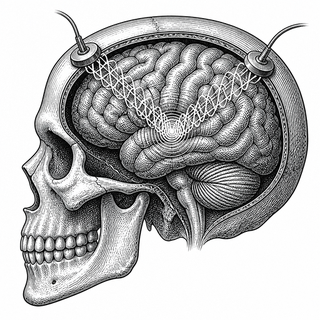
Disclaimer: The image accompanying this article is for illustrative purposes only and does not depict actual experimental results, data, or biological mechanisms.