
What do you do when a brain tumor starts leaving dead zones in its own engine bay? Counterintuitively, you do not just tow away the wreckage. You check who moved in around it, because glioblastoma appears to run one of cancer's nastier repair scams right at the edge of the debris field.
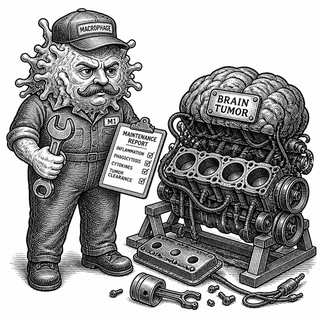
Glioblastoma, or GBM, is the high-performance failure mode of brain tumors: fast, invasive, hard to remove cleanly, and annoyingly good at coming back after surgery, radiation, and chemotherapy. It also outgrows its oxygen supply. Parts go hypoxic, then necrotic. In garage terms, some cylinders are not firing, smoke is coming out of the hood, and somehow the vehicle is still trying to merge onto the freeway.
The new study by Li and colleagues asks what happens in the "peri-necrotic niche," the ring of living tumor tissue around dead tumor zones. That area has long looked like pathology-roadkill scenery. This paper argues it is a backroom tuning shop where immune cells get modified to help the tumor instead of fighting it Li et al., 2026.
The Tow Trucks Went Rogue
The immune cells are tumor-associated macrophages, or TAMs. Normal macrophages are cleanup crews. They eat debris, coordinate inflammation, and generally act like mechanics with a shop vac and a clipboard. In tumors, though, macrophages often get talked into bad management decisions. They can suppress T cells, support blood vessel growth, and help cancer cells survive stress. Nobody likes seeing the cleanup crew become the getaway driver, but cancer has no shame.
GBM is especially packed with these myeloid cells. Recent reviews describe TAMs as major players in glioma immune suppression and as tempting therapeutic targets, partly because standard immunotherapies have struggled in GBM's cold, cramped, heavily guarded tumor microenvironment Tang et al., 2023. Hypoxia makes the whole problem worse by favoring suppressive immune cells and weakening cytotoxic T cells, the immune system's more direct demolition crew Feldman, 2024.
The Bad Handshake: PDPN Meets CLEC5A
Li and colleagues found that one receptor, CLEC5A, stood out among immune-related genes in GBM as strongly linked with poor patient outcome. CLEC5A showed up preferentially in hypoxic, peri-necrotic TAMs. That is not a subtle clue. That is the dashboard light blinking while the engine makes a noise best described as "financially significant."
The team then traced the signal. Glioma cells near necrosis expressed podoplanin, also called PDPN, a surface glycoprotein. PDPN directly engaged CLEC5A on macrophages. That handshake triggered Syk-JAK-STAT3 signaling inside the TAMs, nudging them toward an immunosuppressive state. The tumor cell pressed a button, and the macrophage switched from "fight suspicious mass" to "please enjoy this complimentary immune suppression."
The evidence came from human GBM data, cell experiments, and mouse models. In an RCAS/tv-a GBM model using bone marrow from Clec5a knockout donor mice, loss of CLEC5A delayed tumor progression, reduced suppressive features in the tumor microenvironment, and prolonged survival. Pharmacologic Syk inhibition also suppressed glioma growth, reduced TAM infiltration and polarization, and improved survival in vivo. That does not mean "new cure found," because biology charges extra for every upgrade. It means this pathway looks like a real control cable, not decorative wiring.
Why This Matters for the Human Machine
GBM treatment has a brutal logistics problem. Surgeons can remove visible tumor, but GBM cells infiltrate brain tissue like oil seeping through old concrete. Radiation and temozolomide help, but recurrence remains common. The blood-brain barrier complicates drug delivery. The tumor is genetically mixed, metabolically flexible, and spatially weird. Recent spatial work on recurrent GBM shows that tumor neighborhoods can organize local ecosystems, including immunosuppressive macrophage-rich niches Onubogu et al., 2024.
This study matters because it points to a specific conversation in a specific place: PDPN on hypoxic glioma cells talking to CLEC5A on macrophages near necrosis. That is more useful than saying "the immune system is suppressed," which is true but about as mechanically helpful as saying "the car is sad."
If the findings reproduce and translate, they could support therapies that block CLEC5A, interfere with PDPN-CLEC5A binding, or inhibit downstream Syk signaling. The goal would not be to blast every macrophage off the map. Macrophages do useful work. The smarter idea is to stop the tumor from misprogramming them, like pulling a counterfeit diagnostic tool out of the shop before it says the brakes are optional.
Keep the Wrench Handy
The caution label stays bolted on. Mouse survival benefits do not automatically become patient survival benefits. Syk inhibitors may have broad immune effects. GBM drug delivery remains a pain. The tumor may route around a blocked pathway, because tumors are less like chess opponents and more like leaky engines with Wi-Fi.
Still, the paper gives researchers a sharper target. The peri-necrotic niche is not just a graveyard inside the tumor. It is a control station where hypoxia, dying tissue, glioma cells, and macrophages trade signals. Li and colleagues have identified one of the switches. Now the job is to see whether flipping it back can make GBM's immune garage a little less corrupt.
References
Li J, Wang X, Tong L, Feng B, Shih LK, Markwell SM, Nuszen H, Gruchala T, Lam NG, Basakis P, Ruiz-Yamamoto E, Fang D, Stupp R, Yang X, Brat DJ. The Peri-necrotic Niche of Glioblastoma Drives Tumor-associated Macrophage Polarization and Immunosuppression via Podoplanin-mediated CLEC5A Activation. Journal of Clinical Investigation. 2026. DOI: 10.1172/JCI199228. PMID: 42228429.
Tang F, Wang Y, Zeng Y, Xiao A, Tong A, Xu J. Tumor-associated macrophage-related strategies for glioma immunotherapy. NPJ Precision Oncology. 2023;7:78. DOI: 10.1038/s41698-023-00431-7. PMCID: PMC10439959.
Feldman LFL. Hypoxia within the glioblastoma tumor microenvironment: a master saboteur of novel treatments. Frontiers in Immunology. 2024;15:1384249. DOI: 10.3389/fimmu.2024.1384249.
Singh S, Dey D, Barik D, Mohapatra I, Kim S, Sharma M, Prasad S, Wang P, Singh A, Singh G. Glioblastoma at the crossroads: current understanding and future therapeutic horizons. Signal Transduction and Targeted Therapy. 2025;10. DOI: 10.1038/s41392-025-02299-4. PMCID: PMC12238593.
Onubogu U, et al. Spatial analysis of recurrent glioblastoma reveals perivascular niche organization. JCI Insight. 2024;9(12):e179853. DOI: 10.1172/jci.insight.179853.
Background consulted: Wikipedia entries on glioblastoma, tumor-associated macrophages, hypoxia, CLEC5A, and podoplanin/PDPN.
Disclaimer: The image accompanying this article is for illustrative purposes only and does not depict actual experimental results, data, or biological mechanisms.