
There was a crime scene, and the body of evidence was incomplete. For decades, neuroscientists charting the brain's wiring have produced gorgeous maps of the long-distance cables running cortex-to-cortex - the superhighways everyone photographs. But the deep interior tracts, the ones connecting the thinking surface of the brain to the ancient command bunkers buried at its core, kept showing up smudged, missing, or flat-out wrong. The suspects were obvious. The deep tracts are thin, they twist, they cross enemy fire from a dozen other bundles. The reveal, courtesy of a team writing in eLife, is that we were not failing to find these tracts because they hide well. We were failing because nobody had drawn a usable map of where to look.
The Terrain Nobody Wanted to Survey
Diffusion MRI tractography is the closest thing we have to spying on the brain's wiring without cutting it open. It tracks how water molecules drift along myelinated axons, then reverse-engineers the cable routes from those movements. For the big cortico-cortical bundles, it works well enough. For the cortico-subcortical tracts - the lines feeding the caudate, putamen, amygdala, thalamus, and hippocampus - it has been a reconnaissance failure. These structures sit deep, the fibers are slim, and the surrounding white matter is a knot of crossing traffic. Mapping them is like trying to trace one phone wire through a city where every cable is bundled into the same conduit.
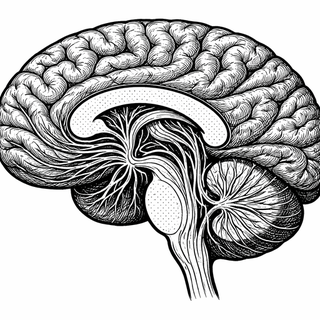
That gap matters more than it sounds. These deep tracts are the brain's actual chain of command. The amygdalofugal pathway, for instance, is the rapid-response line carrying threat signals out of the amygdala to the prefrontal cortex - the circuit that decides whether the shadow in the alley is a mugger or a coat rack. The cortico-striatal bundles running through the external capsule and the Muratoff bundle feed the machinery of habit, reward, and movement. Leave them off the map and you are planning a campaign with half the supply lines invisible.
One Set of Orders, Two Species
Here is where the team got clever. They built standardised tractography protocols - think of them as fixed operating procedures for finding each tract - and they wrote those orders for two brains at once: human and rhesus macaque. Twenty-three tracts, defined in MNI152 template space for humans and F99 space for monkeys, run through FSL's XTRACT pipeline. Same doctrine, two armies.
Why drag a monkey into it? Because the macaque is the one place we have ground truth. You can inject a chemical tracer into a living monkey brain and watch exactly where it travels, axon by axon - the gold standard tractography can only ever approximate. The catch is you cannot do that to people, for reasons that should not require explanation. So the macaque becomes the calibration target. If the protocol's reconstructed tracts in the monkey obey the same topographic rules the tracers already revealed, the method has earned trust. Then you point the matched protocol at the human brain and translate the findings across the species line.
The Map Held Under Fire
The reconstructions did follow the tracer-derived topography in the macaque, and those organizing principles carried over to the human brain. More usefully, the protocols proved robust against bad data - they held up when image quality dropped, which matters because real-world scans are rarely pristine. They also preserved individual variability that tracked with family structure in the human subjects, meaning the method picks up genuine biological differences between people rather than smearing everyone into one generic template. That is the difference between a map and a stencil.
The payoff is comparative firepower. With species-matched protocols, the team could line up homologous grey matter regions - the same functional turf in cortex and subcortex - across humans and monkeys. That is the connective tissue of translational neuroscience: the assurance that the monkey circuit you studied corresponds to the human circuit you actually care about.
Why This Is More Than Cartography
Sound the practical note. Cortico-subcortical tracts are battlegrounds in Parkinson's, in obsessive-compulsive disorder, in addiction, in mood disorders - conditions where the conversation between cortex and the deep nuclei breaks down. You cannot study a circuit you cannot reliably trace, and you cannot build a treatment around a wire you keep losing in the noise. Standardised, reproducible, cross-species protocols give researchers a shared coordinate system to argue over the same anatomy instead of each lab improvising its own.
It is a quiet kind of advance - no glowing brain photo, no headline cure. It is logistics. But every campaign that ever mattered was won by the side that knew where its supply lines ran. The brain's deepest cables just got their first reliable map, drawn the same way in two species so we can finally compare notes.
Disclaimer: The image accompanying this article is for illustrative purposes only and does not depict actual experimental results, data, or biological mechanisms.
References
Primary source:
Assimopoulos S, Warrington S, Folloni D, Bryant K, Mohammadi-Nejad AR, Tang W, Jbabdi S, Heilbronner SR, Mars RB, Sotiropoulos SN. (2025). Cross-species standardised cortico-subcortical tractography. eLife. DOI: 10.7554/eLife.107012. PMID: 41324261. PMC12668672
Related reading:
-
Folloni D, Sallet J, Khrapitchev AA, Sibson N, Verhagen L, Mars RB. (2019). Dichotomous organization of amygdala/temporal-prefrontal bundles in both humans and monkeys. eLife, 8:e47175. DOI: 10.7554/eLife.47175
-
Maier-Hein KH, et al. (2017). The challenge of mapping the human connectome based on diffusion tractography. Nature Communications, 8:1349. DOI: 10.1038/s41467-017-01285-x
-
Schilling KG, et al. (2021). Diffusion MRI and anatomic tracing in the same brain reveal common failure modes of tractography. NeuroImage, 243:118502. DOI: 10.1016/j.neuroimage.2021.118502. PMID: 34171498
-
Donahue CJ, et al. (2016). Using diffusion tractography to predict cortical connection strength and distance: a quantitative comparison with tracers in the monkey. Journal of Neuroscience, 36(25):6758-6770. DOI: 10.1523/JNEUROSCI.0493-16.2016. PMC4916250
-
Schilling KG, et al. (2022). Tractography dissection variability and a taxonomy of the brain's white matter: twenty-one major tracts for the 21st century. Cerebral Cortex, 32(20):4524-4548. DOI: 10.1093/cercor/bhab500