
We still don't know how the brain turns yesterday's knowledge into tomorrow's clever shortcut. But this paper gets us closer. Somewhere inside your skull, familiar pieces get rearranged into new plans, like a forest recycling fallen leaves into next spring's absurdly ambitious mushroom situation.
That trick is called compositionality. It is why you can understand a sentence you have never heard before, follow a new recipe, or combine "airport," "coffee," and "forgot passport" into one very specific emotional weather system. The brain does not store every possible scenario. It reuses parts.
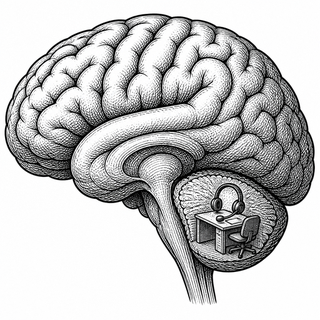
The new study by Tan and colleagues in Cell Reports asks a sharp question: when we recombine old mental ingredients into new cognitive meals, which parts of the brain help do the cooking? Their answer is not just "the cortex," long treated as the brain's executive lounge. The cerebellum appears to be in the meeting too, wearing a tiny headset and pretending it was invited all along.
The Lego Problem, But Squishier
The researchers scanned 87 people with task-based fMRI while they performed a compositional task. In plain English, participants had to use known rules in new combinations. fMRI does not read thoughts, despite what every sci-fi thriller keeps trying to sell us. It measures blood-flow changes linked to neural activity, more like watching which neighborhoods turn their lights on during a citywide power surge.
Tan's team used dimensionality reduction, a mathematical way of finding simpler patterns inside messy brain data. Think of it as taking a jungle of activity and asking, "Is there a footpath in here, or are we just admiring vines?" They also trained recurrent neural networks for comparison.
The key split was between two processes. First, component processing: handling task parts, like color, rule, response, or category. Second, recombination: knitting those parts into a new usable whole.
Component work showed up in domain-specific cortical areas and anterior cerebellar regions. Recombination leaned on a broader cortico-cerebellar network. The brain keeps specialized tools in separate drawers, but when it needs a new contraption, it calls a distributed workshop.
The Cerebellum Wants Better PR
For decades, the cerebellum got typecast as "the movement thing." Useful, yes.
But modern neuroscience keeps finding cerebellar involvement in language, working memory, social thought, emotion, prediction, and learning. A 2026 review in PLOS Biology says scientists know a great deal about cerebellar wiring, but still lack a clean theory of what it contributes to cognition (Diedrichsen & McDougle, 2026). That is like owning a beautifully labeled toolbox and still not knowing whether it belongs to a carpenter, a clockmaker, or someone assembling IKEA furniture in a mood.
This new paper helps because it does not merely ask whether the cerebellum "lights up." It asks what kind of computational role it might play: helping the brain combine ingredients across contexts without rebuilding the recipe every time.
Why This Matters Beyond Brain Trivia Night
If these findings hold up, they matter for three big reasons.
First, they sharpen our picture of intelligence. Human thinking is not just memory. It is reuse with taste, even when the sheep are metaphorical.
Second, the results connect neuroscience with artificial intelligence. Neural networks in the study developed similar signatures, suggesting that low-dimensional recombination may be a general trick for flexible task learning. Recent AI work also shows that neural networks can improve systematic generalization through compositional meta-learning (Lake & Baroni, 2023). The humans-versus-machines debate has gone on long enough to need snacks, but the overlap is useful.
Third, this could eventually reshape clinical thinking. Cerebellar disorders can affect processing speed, language, social cognition, executive function, attention, and working memory (Reumers et al., 2025). That does not mean this paper gives us a treatment. It means the cerebellum deserves a seat at the cognitive clinic table, not just the balance-and-coordination table with the wobbly chair.
A Brain Is Not a Filing Cabinet
The most charming part of this study is also the most humbling: flexible thought may depend on a low-dimensional network. That phrase sounds like a tax form for mathematicians, but the idea is friendly. Instead of using separate activity patterns for every task, the brain may compress recombination into a shared space.
Nature loves this move. Rivers branch and rejoin. Seasons remix sunlight, water, and seed without needing a fresh planet every March. Your brain, overachieving little ecosystem that it is, may do something similar with ideas.
The caveat: fMRI is indirect, modeling choices matter, and this is one study in healthy adults doing a specific task. The next steps are replication, causal tests, richer tasks, and clinical work. Still, the paper gives us a better map of the brain's remix department. Apparently the cerebellum has been there for years, quietly arranging the chairs.
References
Tan JB, Orlando IF, Kim J, Cueva CJ, Jeganathan J, Baracchini G, Wong R, Muller EJ, O'Callaghan C, Shine JM. Compositional recombination is facilitated by a distributed cortico-cerebellar network. Cell Reports. 2026. https://doi.org/10.1016/j.celrep.2026.117572
Diedrichsen J, McDougle SD. How does the cerebellum contribute to cognitive functions? PLOS Biology. 2026;24(3):e3003688. https://doi.org/10.1371/journal.pbio.3003688
Lake BM, Baroni M. Human-like systematic generalization through a meta-learning neural network. Nature. 2023;623:115-121. https://doi.org/10.1038/s41586-023-06668-3
Mill RD, Cole MW. Dynamically shifting from compositional to conjunctive brain representations supports cognitive task learning. Nature Communications. 2025;16:10084. https://doi.org/10.1038/s41467-025-65041-2
Reumers SFI, Bongaerts FLP, de Leeuw FE, van de Warrenburg BPC, Schutter DJLG, Kessels RPC. Cognition in cerebellar disorders: What's in the profile? A systematic review and meta-analysis. Journal of Neurology. 2025;272:250. https://doi.org/10.1007/s00415-025-12967-8
Disclaimer: The image accompanying this article is for illustrative purposes only and does not depict actual experimental results, data, or biological mechanisms.