A flock of starlings and a school of herring solve the same problem in the same way. Both hold a coherent shape across the sky or the sea while no single member stays put. Birds swap positions, fish trade places, and yet the murmuration keeps its silhouette and the school keeps its glittering wall. Nobody is in charge, everybody is replaceable, and the form somehow survives the turnover. Your auditory cortex, it turns out, runs on the same trick. Play the same note twice and a different crowd of neurons answers the door each time, yet you hear the identical sound. New tenants, same building.
The Blueprint That Keeps Redrawing Itself
Here is the structural puzzle that has bothered neuroscientists for years. In sensory cortex, information is carried by small, sparse groups of neurons called ensembles. Sparse is good - it is cheap, like lighting only the rooms you are using. But the auditory cortex takes it further: repeat the exact same tone and you get a different ensemble firing every time (Carrillo-Reid & Yuste, 2020). It is as if the blueprint for a single room got redrawn on every visit, and yet the room always looked the same when you walked in.
So how does a building stay standing when the load-bearing walls keep moving? That is the question HiJee Kang, Travis Babola, and Patrick Kanold set out to answer in eLife (Kang et al., 2026), and their answer is one of those findings that makes the brain look less like a fixed structure and more like a floor that re-levels itself the instant you put a heavy couch on one side.
Poking the Foundation On Purpose
To watch the renovation happen in real time, the team needed to do two things at once: see the whole network and shove part of it around. They used two-photon calcium imaging to film neurons lighting up in awake mice, then added holographic optogenetics - a technique precise enough to switch on individually chosen cells with a sculpted beam of light (Marshel et al., 2019). Think of it as having both the security-camera feed of an entire office and a way to tap specific employees on the shoulder and say "you, work harder."
Their move was elegant. They played a pure tone - so the neurons tuned to that frequency naturally perked up - and simultaneously used light to crank up a small subset of those co-tuned cells. They added load to one corner of the floor on purpose, then watched to see whether the rest of the structure would notice.
The Floor Re-Levels
It noticed. When the team boosted a handful of neurons sharing a frequency preference, the other co-tuned neurons - the ones nobody touched with light - quietly turned their own responses down to that same tone. The network behaved like a structural engineer who feels one beam take on extra weight and immediately eases the others, keeping the total load inside a safe range.
The precision is the part worth admiring. Neurons tuned to a different frequency shrugged and carried on, completely unbothered. The rebalancing followed the wiring of shared tuning, not mere physical proximity - and the co-tuned and uninterested cells were intermingled in the same patch of tissue, like two HVAC systems threaded through one ceiling without ever crossing wires. The effect was also sharpest in the pickiest neurons, the ones most narrowly devoted to a single frequency. And it was fast. Not days of slow remodeling, but a correction visible from the very first trial.
Why a Self-Correcting Cortex Matters
This is homeostasis caught in the act on a timescale most of us never associate with the word. Classic homeostatic plasticity - the brain's long-term thermostat - usually plays out over hours or days, nudging synaptic strengths to keep activity near a set point (Turrigiano, 2012). What Kang and colleagues describe is faster and more local: a network that rebalances on the fly, ensemble by ensemble, to keep its total output steady. It is the difference between a thermostat that adjusts overnight and a floor that springs back the moment you step off it.
It also offers a tidy explanation for that starling-and-herring trick we opened with. If the network is constantly redistributing activity to hold a roughly constant total, then it does not matter which specific neurons answer on any given trial - the shape of the response stays stable even as the membership churns (Rupasinghe et al., 2021). The percept is the facade. The neurons are just bricks that quietly rotate behind it.
There is a clinical floor under all this too. Conditions from tinnitus to hyperacusis to the runaway excitation of seizures are, in part, failures of the cortex to keep its activity in balance. Knowing that the auditory cortex has a fast, frequency-specific self-correction system - and eventually how it is wired - gives researchers a real beam to inspect when the building starts to lean.
For now, the lesson is satisfyingly architectural: your brain is not a monument carved once and left alone. It is a structure that re-levels itself thousands of times a second, swapping its own bricks while you remain blissfully convinced the wall never moved.
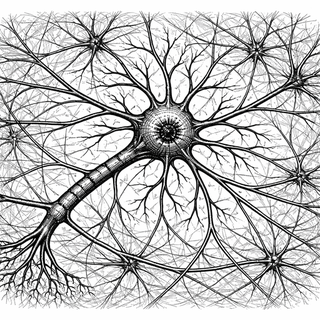
Disclaimer: The image accompanying this article is for illustrative purposes only and does not depict actual experimental results, data, or biological mechanisms.
References
- Kang, H. J., Babola, T. A., & Kanold, P. O. (2026). Rapid rebalancing of co-tuned ensemble activity in the auditory cortex. eLife. https://doi.org/10.7554/eLife.104242 (PMID: 41359365)
- Marshel, J. H., et al. (2019). Cortical layer-specific critical dynamics triggering perception. Science, 365(6453). https://doi.org/10.1126/science.aaw5202
- Carrillo-Reid, L., & Yuste, R. (2020). Playing the piano with the cortex: role of neuronal ensembles and pattern completion in perception and behavior. Current Opinion in Neurobiology, 64, 89-95. https://doi.org/10.1016/j.conb.2020.02.007
- Rupasinghe, A., Francis, N., Liu, J., Bowen, Z., Kanold, P. O., & Babadi, B. (2021). Direct extraction of signal and noise correlations from two-photon calcium imaging of ensemble neuronal activity. eLife, 10, e68046. https://doi.org/10.7554/eLife.68046 (PMCID: PMC8354639)
- Turrigiano, G. (2012). Homeostatic synaptic plasticity: local and global mechanisms for stabilizing neuronal function. Cold Spring Harbor Perspectives in Biology, 4(1), a005736. https://doi.org/10.1101/cshperspect.a005736