
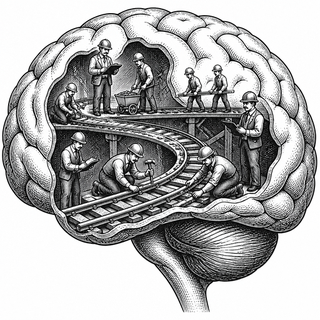
The sentence does not roll out of your mouth fully assembled, wearing a little hard hat and carrying a clipboard. Before you say a word, your brain is already laying track, switching rails, checking grammar, loading meaning, and somehow not setting the whole language roller coaster on fire. Okay, buckle up: scientists have now watched individual human neurons do part of that work in real time, which is rude of the brain, frankly, because it has been pretending this was all effortless.
Before Words Hit the Air
The Nature news piece by Max Kozlov highlights a new study from Jing Cai and colleagues that recorded single neurons while people produced natural, unscripted speech. Not reading canned sentences. Not repeating “the cat sat on the mat” until everyone needs a snack. Actual sentence-making.
The researchers used microelectrode arrays already implanted for clinical epilepsy monitoring, giving them a rare peek at individual neurons in the frontotemporal cortex. Across 8 participants, they recorded 579 putative neurons during 1,895 sentences and 10,460 words. That is a lot of tiny electrical gossip before the speaker’s mouth joined the meeting Cai et al., 2026.
Grammar Cells, Apparently. Because Why Not.
The wild part is not just that neurons fired during speech. Of course they did. Neurons love firing. It is their whole brand.
The wild part is that some neurons seemed tuned to specific linguistic jobs. About 9% responded selectively to parts of speech, such as whether an upcoming word was functioning like a verb or adjective. Others tracked constituents, like noun phrases and verb phrases. Some responded to how deeply a word sat inside a sentence’s tree structure, which is basically grammar’s version of “how far are we into this roller coaster loop, and should I be worried?”
These signals appeared roughly 400 to 100 milliseconds before the word was spoken. So by the time you say “sandwich,” parts of your brain may already know whether that sandwich is the subject, object, punchline, or tragic lunch-based metaphor.
Meaning Is Not Sitting Quietly Either
The study also found that neuronal activity reflected semantic context. A word like “bark” is not just stored as a frozen dictionary entry. The brain cares whether we are talking about a dog, a tree, or a suspiciously loud neighbor with boundary issues. Models using sentence context predicted neuronal firing better than models using isolated word features.
That fits with earlier single-cell work showing that neurons in human prefrontal cortex can encode word meanings during listening, and that those meanings shift with sentence context Jamali et al., 2024. In other words, the brain is not just pulling words off a shelf. It is remixing them live, like a DJ with tenure.
The Language Network Is a Team Sport
This new neuron-level view plugs into a bigger map. A 2024 Nature Reviews Neuroscience review describes a core language network in mostly left frontal and temporal areas that helps combine words and constructions into messages, while staying distinct from lower-level sound/motor systems and broader reasoning networks Fedorenko et al., 2024. Wikipedia’s neurolinguistics overview frames the field as asking how the brain handles sounds, meanings, syntax, and sentence construction, which is the polite way of saying: language is a committee, and every committee has at least one neuron arguing about commas.
Another 2024 intracranial recording study found that language-network populations track information over about 1, 4, or 6 words Regev et al., 2024. That matters because sentences are not beads on a string. They are nested, bendy, context-hungry beasts. You need short-range tracking for the word right now and longer-range tracking for the phrase still demanding emotional support.
Why This Could Matter Outside the Lab
If these findings hold up in larger groups, they could sharpen brain-computer interfaces for people who have lost speech. Current speech neuroprostheses can already decode attempted speech with impressive speed and vocabulary, including a high-performance system reported in Nature in 2023 Willett et al., 2023. But decoding the mechanics of speech is one thing. Understanding how the brain plans grammar and meaning before sound emerges could help future systems predict intended sentences more naturally.
That is the dream version: not just “decode mouth movements,” but “catch the sentence while the tracks are still being built.” For people with paralysis, aphasia, or other communication disorders, that could eventually mean faster, more flexible tools. Not tomorrow. The sample is small, the participants had clinical implants, and human language is still a theme park designed by caffeinated architects.
But this study gives us something rare: cellular evidence that sentence production is not one giant mysterious glow on a brain scan. Neurons track grammar, meaning, hierarchy, and context before your lips even move.
Tiny track builders. Massive ride.
References
Cai, J., Kfir, Y., Jamali, M., Huang, H., Kim, Y. J., Cash, S. S., & Williams, Z. M. (2026). Mapping the neuronal building blocks of human language with language models. Nature. https://doi.org/10.1038/s41586-026-10691-5
Fedorenko, E., Ivanova, A. A., & Regev, T. I. (2024). The language network as a natural kind within the broader landscape of the human brain. Nature Reviews Neuroscience, 25, 289-312. https://doi.org/10.1038/s41583-024-00802-4 PMCID: PMC13222024
Jamali, M., Grannan, B., Cai, J., Khanna, A. R., Muñoz, W., Caprara, I., Paulk, A. C., Cash, S. S., Fedorenko, E., & Williams, Z. M. (2024). Semantic encoding during language comprehension at single-cell resolution. Nature, 631, 610-616. https://doi.org/10.1038/s41586-024-07643-2 PMCID: PMC11254762
Kozlov, M. (2026). How the brain builds sentences, neuron by neuron. Nature. https://doi.org/10.1038/d41586-026-01922-w
Regev, T. I., Casto, C., Hosseini, E., Adamek, M., Ritaccio, A. L., Willie, J. T., Brunner, P., & Fedorenko, E. (2024). Neural populations in the language network differ in the size of their temporal receptive windows. Nature Human Behaviour, 8, 1924-1942. https://doi.org/10.1038/s41562-024-01944-2
Willett, F. R., Kunz, E. M., Fan, C., Avansino, D. T., Wilson, G. H., Choi, E. Y., Kamdar, F., Glasser, M. F., Hochberg, L. R., Druckmann, S., Shenoy, K. V., & Henderson, J. M. (2023). A high-performance speech neuroprosthesis. Nature, 620, 1031-1036. https://doi.org/10.1038/s41586-023-06377-x PMCID: PMC10468393
Disclaimer: The image accompanying this article is for illustrative purposes only and does not depict actual experimental results, data, or biological mechanisms.