
You used to think a baby neuron’s trip through the developing brain was basically a commute: crowded, inconvenient, but survivable. But then the evidence walked into court wearing a lab coat: in a new Nature paper discussed by Manam and Walsh, migrating neurons appear to break their own DNA as they squeeze through packed brain tissue. Not metaphorically. Double-strand breaks. The kind of molecular damage that usually makes cells call their lawyers.
Exhibit A: The Brain Is a Construction Site
Before your brain can do glamorous stuff, like remembering passwords badly, it has to build itself. New neurons are born in one place and migrate to assigned neighborhoods, including the developing cerebral cortex and cerebellum. This is not a stroll. It is more like moving a grand piano through a crowded restaurant during dinner service.
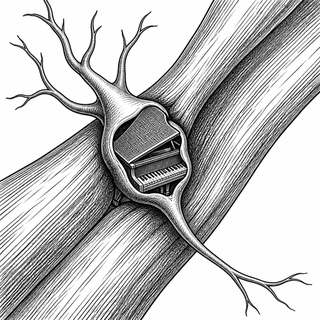
The nucleus, which carries the cell’s DNA, is the bulky piano. The neuron shoves it through narrow gaps between cells and fibers. Zhang and colleagues found that this confined migration creates mechanical stress strong enough to generate DNA double-strand breaks. The assigned Nature News & Views article summed up the charge sheet neatly: neurons migrate, DNA gets damaged, and the brain has a repair plan if everything goes well (doi:10.1038/d41586-026-01705-3).
Exhibit B: The Weapon Was Probably TOP2B
Now, ladies and gentlemen of the readership, let us cross-examine the suspect: topoisomerase II beta, or TOP2B. This enzyme normally untangles DNA. It makes temporary cuts, passes DNA strands around like a very stressed stage manager, and seals the break again.
The problem comes when a neuron’s nucleus gets squeezed. In the new study, confined migration increased TOP2B-linked DNA breaks. The enzyme seemed to get trapped mid-job, leaving DNA ends exposed. This is the biochemical equivalent of a contractor saying, “Back in five,” then vanishing into the parking lot.
The good news: most breaks did not doom the neuron. The cells used non-homologous end joining to stitch the severed ends back together. Think molecular duct tape with a surprisingly decent safety record. Many damage signals faded within about 24 hours, and the breaks tended to land in transcriptionally quiet regions, not the busy genes running the show (doi:10.1038/s41586-026-10648-8).
The Defense: This Is Normal, Mostly
Here is where the case gets weird in the best scientific way. DNA damage sounds like the villain, but neurons are not porcelain figurines. They are long-lived cells built to survive metabolic noise, electrical activity, oxidative stress, and whatever happens after three coffees and four hours of sleep.
Recent reviews argue that DNA damage and repair are part of normal neuronal life, not just disease pathology. Programmed DNA breaks can help regulate activity-dependent gene expression, while failed repair can threaten genome integrity and plasticity (doi:10.1038/s41588-021-01001-y). Another review connects accumulated DNA damage to aging and neurodegeneration, which is where the jury starts leaning forward (doi:10.1016/j.neuron.2024.12.001, PMCID: PMC11832075).
The question is not “Does DNA damage happen?” It does. When does ordinary repairable wear become lasting evidence?
Cross-Examination: What If Repair Fails?
Zhang and colleagues tested that by interfering with Ligase IV, a key repair enzyme. In mice lacking this repair activity in newly migrating cerebellar neurons, the animals developed without dramatic early disaster. No courtroom gasps. No collapsing witness.
But later, they showed mild progressive motor problems. That matters because the cerebellum helps coordinate movement, and human genome-instability syndromes often hit cerebellar function. The finding does not prove this mechanism causes human disease. The court will not accept vibes as evidence. But it suggests a plausible chain: mechanical stress creates breaks, repair usually cleans up, and incomplete repair may leave a long-term mark.
This also feeds into brain somatic mosaicism: your neurons may not all carry identical genomes. Small DNA changes can arise during development and aging, making the brain less like a photocopied document and more like a courtroom transcript with marginal notes from every witness. Recent work connects neuronal genome variation and double-strand breaks to neurodegeneration and brain disorders (doi:10.1016/j.cell.2023.08.038, PMCID: PMC10697236; doi:10.1146/annurev-pathmechdis-111523-023528).
Closing Argument
The verdict is not that brain development is dangerous. The verdict is better: brain development is physically intense, chemically clever, and less tidy than the textbook diagram suggests. Neurons are not placed into circuits like chairs around a conference table. They crawl, squeeze, deform, repair, and arrive carrying a molecular travel history.
If this result holds up in human studies, it could change how researchers think about neurodevelopmental disorders, movement problems, aging, and why individual neurons differ from their neighbors. It may also point toward repair pathways or nuclear mechanics as future targets. Not tomorrow’s miracle therapy, counselor. More like a promising lead the detectives should follow.
The brain, as usual, has entered a plea of “complicated.” The evidence is in, and frankly, it is showing off.
References
- Manam MD, Walsh CA. Navigating a crowded developing brain leaves neurons with broken DNA. Nature. 2026. doi:10.1038/d41586-026-01705-3
- Zhang Z, Canela A, Kurisu J, et al. Confined migration induces non-lethal DNA damage in developing neurons. Nature. 2026. doi:10.1038/s41586-026-10648-8
- Caldecott KW, Ward ME, Nussenzweig A. The threat of programmed DNA damage to neuronal genome integrity and plasticity. Nature Genetics. 2022;54:115-120. doi:10.1038/s41588-021-01001-y
- Delint-Ramirez I, Madabhushi R. DNA damage and its links to neuronal aging and degeneration. Neuron. 2025;113:7-28. doi:10.1016/j.neuron.2024.12.001, PMCID: PMC11832075
- Dileep V, Boix CA, Mathys H, et al. Neuronal DNA double-strand breaks lead to genome structural variations and 3D genome disruption in neurodegeneration. Cell. 2023;186:4404-4421.e20. doi:10.1016/j.cell.2023.08.038, PMCID: PMC10697236
- Corrigan RR, Mashburn-Warren LM, Yoon H, Bedrosian TA. Somatic Mosaicism in Brain Disorders. Annual Review of Pathology. 2025;20:13-32. doi:10.1146/annurev-pathmechdis-111523-023528
Disclaimer: The image accompanying this article is for illustrative purposes only and does not depict actual experimental results, data, or biological mechanisms.